Healthcare and Knowledge Management for Society 5.0
eBook - ePub

Healthcare and Knowledge Management for Society 5.0

Trends, Issues, and Innovations

  1. 320 pages
  2. English
  3. ePUB (mobile friendly)
  4. Available on iOS & Android
eBook - ePub

About this book

Healthcare and knowledge management is the need of the era; this book investigates various challenges faced by practitioners in this area. It also covers the work to be done in the healthcare sector and the use of different computing techniques for better insight and decision-making.

Healthcare and Knowledge Management for Society 5.0: Trends, Issues, and Innovations showcases the benefits of computing techniques used for knowledge management in the field of healthcare in the futuristic perspective of having a human-centric society 5.0. The book includes topics related to the use of technologies like artificial intelligence, machine learning, deep learning, Internet of Things, blockchain, and sensors for effective healthcare and management. Case studies are included for easy comprehension and the book covers the most up-to-date research in the field. The use of techniques like artificial intelligence in the field of knowledge management is also discussed.

This book is intended for researchers and academicians to explore new ideas, techniques, and tools. Researchers working in interdisciplinary research can also find many interesting topics which will pave the way for a new arena in healthcare and knowledge management.

Frequently asked questions

Yes, you can cancel anytime from the Subscription tab in your account settings on the Perlego website. Your subscription will stay active until the end of your current billing period. Learn how to cancel your subscription.
No, books cannot be downloaded as external files, such as PDFs, for use outside of Perlego. However, you can download books within the Perlego app for offline reading on mobile or tablet. Learn more here.
Perlego offers two plans: Essential and Complete
  • Essential is ideal for learners and professionals who enjoy exploring a wide range of subjects. Access the Essential Library with 800,000+ trusted titles and best-sellers across business, personal growth, and the humanities. Includes unlimited reading time and Standard Read Aloud voice.
  • Complete: Perfect for advanced learners and researchers needing full, unrestricted access. Unlock 1.4M+ books across hundreds of subjects, including academic and specialized titles. The Complete Plan also includes advanced features like Premium Read Aloud and Research Assistant.
Both plans are available with monthly, semester, or annual billing cycles.
We are an online textbook subscription service, where you can get access to an entire online library for less than the price of a single book per month. With over 1 million books across 1000+ topics, we’ve got you covered! Learn more here.
Look out for the read-aloud symbol on your next book to see if you can listen to it. The read-aloud tool reads text aloud for you, highlighting the text as it is being read. You can pause it, speed it up and slow it down. Learn more here.
Yes! You can use the Perlego app on both iOS or Android devices to read anytime, anywhere — even offline. Perfect for commutes or when you’re on the go.
Please note we cannot support devices running on iOS 13 and Android 7 or earlier. Learn more about using the app.
Yes, you can access Healthcare and Knowledge Management for Society 5.0 by Vineet Kansal, Raju Ranjan, Sapna Sinha, Rajdev Tiwari, Nilmini Wickramasinghe, Vineet Kansal,Raju Ranjan,Sapna Sinha,Rajdev Tiwari,Nilmini Wickramasinghe in PDF and/or ePUB format, as well as other popular books in Computer Science & Data Mining. We have over one million books available in our catalogue for you to explore.

Information

Publisher
CRC Press
Year
2021
Print ISBN
9780367768096
eBook ISBN
9781000529692

1 Blockchain Technology for Health Care

Kuldeep Singh Kaswan, Jagjit Singh Dhatterwal, and Santar Pal Singh
DOI: 10.1201/9781003168638-1
CONTENTS
  1. 1.1 Introduction
  2. 1.2 Literature Survey
  3. 1.2.1 Research State of Blockchain in Healthcare
  4. 1.2.2 Clinical Data Management/Patients Care Management
  5. 1.2.2.1 Simply Vital Health (Watertown, Massachusetts)
  6. 1.2.2.2 Hashed Health (Nashville)
  7. 1.2.2.3 Coral Health (Vancouver, Canada)
  8. 1.2.2.4 Robomed Network (Moscow, Russia)
  9. 1.2.2.5 Patientory (Atlanta, Georgia)
  10. 1.3 Medical Supply Chain Management
  11. 1.3.1 Chronicled (San Francisco, California)
  12. 1.3.2 Block Pharma (Paris, France)
  13. 1.3.3 Tierion (Mountain View, California)
  14. 1.3.4 Centers for Disease Control and Prevention (CDC) (Atlanta, Georgia)
  15. 1.3.5 Breakthroughs In Genomic Market
  16. 1.3.5.1 Nebula Genomics (Boston, Massachusetts)
  17. 1.3.5.2 Encrypgen Gene-chain (Coral Springs, Florida)
  18. 1.3.5.3 DOC.AI (Palo Alto, California)
  19. 1.4 Impact Of Blockchain in Healthcare
  20. 1.4.1 BURSTIQ (Colorado Springs, Colorado)
  21. 1.4.2 Factom (Austin, Texas)
  22. 1.4.3 Medical Chain (London, England)
  23. 1.4.4 Guard Time (Irvine, California)
  24. 1.4.5 MedRec (MIT Media Lab)
  25. 1.4.6 Stakeholders Of Healthcare
  26. 1.5 Integrated Digital Health Record/ Digital Health Data
  27. 1.5.1 Objectives of IDHR Integrates Different Segments of Medical Industry
  28. 1.5.2 Pharmaceutical Industry's Revenue
  29. 1.5.2.1 Revenue of Indian Pharma Industry
  30. 1.5.2.2 Blockchain-Based IDHR System
  31. 1.5.3 State-Of-The-Art For Health Records
  32. 1.5.4 Electronic Medical Records
  33. 1.5.5 IoT Sensors or Iot-Based Healthcare Devices
  34. 1.6 Use Cases and Its Solutions in Healthcare Using Blockchain
  35. 1.6.1 Use Case for Healthcare Providers and Insurance Companies
  36. 1.6.2 Use Case for Opioid Prescription Tracking
  37. 1.6.3 Use Case for Telemedicine and Patient Care
  38. 1.6.4 Use Case for Cancer Patient Care
  39. 1.7 Healthcare Challenges and Its Solutions in Blockchain
  40. 1.8 Conclusion
  41. References

1.1 Introduction

In almost every field Blockchain Technology (BT) is meant primarily to solve diverse problems. A decentralized uncorrupted Light-Emitting Diode-General Electric (LED-GE) technology can be described as Blockchain. This latest technology has an exciting potential to safely transfer any digital information or bitcoins amongst stakeholders. It is used mainly to guarantee the transparency and quality of data in the network, where multiple parties exist. All transactions in such a decentralized system shall be protected knowledge exchanged and made open to all nodes. The benefit of this new technology is that trustworthy data can be freely accessible via a decentralized system.
Centralized System use in the health sector was a promising challenge for researchers in the time of information and communication technology (ICT) and the internet of things (IOT). Many scientists already have begun researching BT into the area of health. Security, interoperability, anonymity, sharing, authentication and policy facets currently pose the main challenges in the healthcare sector. The concept of an effective special, sustained and standardized business model for knowledge is therefore important.
This chapter has seven sections as in section 2 explain literature survey, in sectioned 3 explain healthcare technology, in section 4 explained supply of medicine In this section explained effects on blockchain healthcare, in section 5 explained to collect the patient data, in section 6 explained about cases and healthcare solutions, in section 7 explained challenging healthcare solution in blockchain.

1.2 Literature Survey

In this section, we discuss various problems in science and their present state of research in the area of BT healthcare. There are various business models, and in the healthcare industry medical applications are specified which differ between countries. Any specialized medical applications have huge chances and advantages of replacing the current IT infrastructure with BT.
Dave et al. (2019) describe multiple dimensions in which BT turns into health technologies. The first choice was to create electronic records from blockchain such that a patient database could be created which can be accessed by each health department.
M. Ul Hassan, M.H. Rehmani, J. Chen (Xie et al., 2020) Most of our devices of daily use are linked in contemporary internet of things (IoT) systems for a revolutionizing world. In order to optimize the most of our chores, these devices will be able to connect with each other and their environment. This connectivity of IoT nodes requires safety, sophisticated authentication, solidity and easy maintenance. Blockchain is a feasible option to deliver such high-profile functionalities. The decentralized blockchain technology has answered several difficulties relating to IoT system security, management and identification.
So many alternatives to improve current health system restrictions using blockchain technology, which include approach and tools to measure the efficiency of the process are explored in depth, e.g., Hyperledger Fabric, Composer, Docker Container, Hyperledger Caliper and the Wireshark acquisition fuel system. The Information Security Policy Algorithm is proposed to improve information sharing among health service providers in order to simulate the implementation of the chaincode-based Hyperledger (EHR) system (Mistry et al., 2020).
We offer a thorough study of state-of-the-art implementations with 5G IoT enabled as the background to industrial blockchain automating for application such as Smart city, smart home, healthcare 4.0. Current statement explains that, through a thinly grained decentralized password protection, blockchain might change most existing and future industry applications in various industries (Ferrag et al., 2019).
In this, you can see a survey of blockchain topologies developed for IoT (Internet of Things), i.e., healthcare (IoHT), vehicle (IoV), energy (IoE) and cloud internet (IoC). This article begins with a transversal review of the technology blockchain. In addition, the report analyzes the relations among IoT, blockchain, IoHT, IoV, IoE, and IoC and other developing technologies (Peng et al., 2020).
The findings and analyses section show that the EH-IoT system deployment may considerably enhance the frequency band between the IoT cloud and the localized edges. If there is an installation of a lot of such gadgets on each IoT application, one can estimate how much bandwidth can be saved and how much delay reduces quality of service (Badr et al., 2018).
This article proposes and analyzes a multi-tier blockchain based Pseudonym Based Encryption with Different Authorities (PBE-DA) architecture for block-based generation or accessibility using ECC asymmetrical security policies. The initial level of our design was the Fog or accessibility layer used to link the patient via his/her IoT gadgets. We examined the communications or redistribution amongst the EHR member in the second level. Finally, the problem of compatibility amongst various EHR providers for the third level has been established. The architecture is verified with a set of MIRACL security techniques (Rathee, 2020).
It introduces the idea of block data integrity as well as contract. The historic background of the heritage of intelligent contracts is moreover established, and intelligent agreements enables blockchain that expand the distinction between “shallow smart contracts” and “deep smart contracts.” In conclusion, the standard SDLC models are not suited for intelligent service agreement technologies provided by blockchain (Xie et al., 2020).
Today, traditional company frameworks are increasingly developed that individual utilize to lead different types of e-business operations. The IoT internet provides a new foundation for e-business, being an inventive innovation on the web. But for the E-business on the IoT, conventional marketing strategies could not be suitable. In this Article we propose (1) an IoT-e-business model developed especially for the IoT E-business; (2) redesign several aspects in conventional e models; (3) carry out knowledgeable transactions and paid IoT data using the Blockchain- and Intelligent Contract-based P2P business (Zhang & Wen, 2015).
The second choice is to pursue a new approach in the management of...
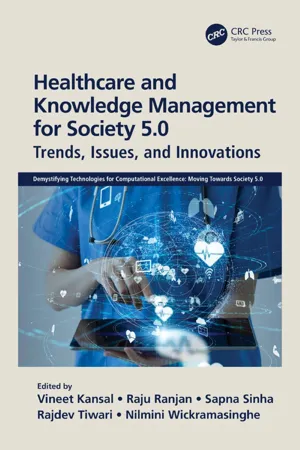
Table of contents

  1. Cover
  2. Half Title
  3. Title Page
  4. Copyright Page
  5. Contents
  6. Preface
  7. Editors
  8. Contributors
  9. Chapter 1: Blockchain Technology for Health Care
  10. Chapter 2: Diagnosing Patient Health Conditions and Improving the Patient Experience: An Application of AI and ML
  11. Chapter 3: Development of Thinking Computer Systems and Machine Learning in Health Care
  12. Chapter 4: Clinical Decision-Making as a Subset of Decision-Making: Leveraging the Concepts of Decision-Making and Knowledge Management to Characterize Clinical Decision-Making
  13. Chapter 5: Leveraging Artificial Intelligence in a Human-Centric Society 5.0: A Health Care Perspective
  14. Chapter 6: Blockchain-Based Medical Records for the Health Care Industry
  15. Chapter 7: Blockchain with Corona Virus: Moving Together to Prevent Future Pandemics
  16. Chapter 8: Computer Assisted Health Care Framework for Breast Cancer Detection in Digital Mammograms
  17. Chapter 9: Artificial Intelligence and Inpatients' Risk Vulnerability Assessment: Trends, Challenges, and Applications
  18. Chapter 10: Internet of Healthcare Things (IoHT) and Blockchain: An Efficient Integration for Smart Health Care Systems
  19. Chapter 11: Comparative Study of Machine Learning Techniques for Breast Cancer Diagnosis
  20. Chapter 12: Comparative Analysis and Experimental Study on MQ Sensor Series
  21. Chapter 13: Fine-Tuning of Recommender System Using Artificial Intelligence
  22. Chapter 14: Deep Learning in Health Care
  23. Chapter 15: Ontology Learning-Based e-Health Care System
  24. Chapter 16: A New Method for OTP Generation
  25. Chapter 17: A Visual Introduction to Machine Learning, AI Framework, and Architecture
  26. Chapter 18: Evolution of Business Intelligence System: From Ad-Hoc Report to Decision Support System to Data Lake Based BI 3.0
  27. Chapter 19: Novel Deep-Learning Approaches for Future Computing Applications and Services
  28. Index