eBook - ePub
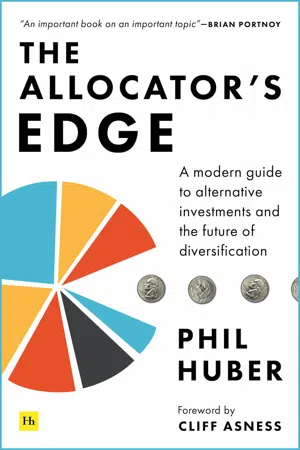
The Allocator's Edge
A modern guide to alternative investments and the future of diversification
- English
- ePUB (mobile friendly)
- Available on iOS & Android
eBook - ePub
The Allocator's Edge
A modern guide to alternative investments and the future of diversification
About this book
We are entering a golden age of alternative investments.
Alternative asset classes including private equity, hedge funds, catastrophe reinsurance, real assets, non-traditional credit, alternative risk premia, digital assets, collectibles, and other novel assets are now available to investors and their advisors in a way that they never have been before.
The pursuit of diversification is not as straightforward as it once was — and the classic 60/40 portfolio may no longer be sufficient in helping investors achieve their most important financial goals. With the ever-present need for sustainable income and risk management, alternative assets are poised to play a more prominent role in investor portfolios.
Phil Huber is the Chief Investment Officer for a multi-billion dollar wealth management firm and acts as your guide on a journey through the past, present, and future of alternative investments. In this groundbreaking tour de force, he provides detailed coverage across the spectrum of alternative assets: their risk and return characteristics, methods to gain exposure, and how to fit everything into a balanced portfolio.
The three parts of The Allocator's Edge address:
1. Why the future may present challenges for traditional portfolios; why the adoption of alternatives has remained elusive for many allocators; and why the case for alternatives is more compelling than ever thanks to financial evolution and innovation.
2. A comprehensive survey of the asset classes and strategies that comprise the vast universe of alternative investments.
3. How to build durable and resilient portfolios that harness alternative assets; and how to sharpen the client communication skills needed to establish proper expectations and make the unfamiliar familiar.
The Allocator's Edge is written with the practitioner in mind, providing financial advisors, institutional allocators, and other professional investors the confidence and courage needed to effectively understand, implement, and translate alternatives for their clients.
Alternative investments are the allocator's edge for the portfolios of tomorrow — and this is the essential guide for advisors and investors looking to seize the opportunity.
Information
Part I: The Allocator’s Dilemma
Chapter 1: Hindsight is 60/40—The Impaired Vision of Traditional Portfolios
“What got you here won’t get you there.”
— Marshall Goldsmith
“The first step towards getting somewhere is to decide that you are not going to stay where you are.”
— J.P. Morgan
We begin chapter 1 by challenging the conventional wisdom of traditional asset allocation methods.
Conventional asset allocators instinctively look backwards, sticking with what has worked in the rear-view mirror but not paying attention to the road ahead. With impeccable acuity, they can see that a balanced portfolio of stocks and bonds was just about the best diversification strategy money could buy for the last 40 years. To say their hindsight is 20/20 would be an understatement.
Their hindsight is better than 20/20. It’s 60/40.
The practice of asset allocation, at least as we know it today, can be traced primarily to the inaugural “Stocks, Bonds, Bills, and Inflation: The Past and Future” study, published by Roger Ibbotson and Rex Sinquefield in 1976. This landmark paper detailed the return histories of stocks, bonds, one-month T-Bills and inflation. The latest chart of Ibbotson data for the returns of these assets from 1926 to 2020 is shown in Figure 1.1.
Figure 1.1: Stocks, Bonds, Bills, and Inflation (1926–2020)

Source: Morningstar (Ibbotson SBBI).
The long-term risk premium generated by stocks is on full display, but stocks have experienced massive declines at multiple points along the way. Few possess the intestinal fortitude to ride the ups and downs of an all-stock portfolio throughout the duration of their investing lifetime, so a countervailing force is needed.
[Bonds have entered the chat]
The quest for uncorrelated return streams has always been the “holy grail” of investing. The combination of unrelated assets—each with independent return drivers—delivers the magic that is diversification. Said differently, diversification allows the whole to be greater than the sum of the parts.
For the last 40-plus years, bonds have been the peanut butter to stocks’ jelly. On their own, bonds have generated meaningful returns. Used in conjunction with stocks, they have offered low to negative correlation and positive returns when needed most—during crisis periods when equities suffer.
This successful one-two punch has led many to a default posture of (roughly) balancing the two asset classes. We can’t pinpoint its inception, but somewhere along the way 60% stocks and 40% bonds became the standard. Not quite an even split, but pretty darn close—with a slight nod given to stocks for their higher expected returns.
The 60/40 portfolio has become synonymous with balanced asset allocation. Stocks for growth, and bonds for income and diversification. As simple and easy as it gets. I’ll be referencing ‘60/40’ throughout the book, but please treat it as shorthand for any balanced allocation to stocks and bonds. This includes variants like 70/30 and 50/50 that while not 60/40 in name, should be thought of in concert.
The reason 60/40 is so canonical is quite simply because it has worked tremendously for investors for over four decades. The pleasant journey it has provided and its increasing ease of implementation have made it a perennial favorite among investors. But don’t take my word for it. Let’s go to the tape.
60/40: By the Numbers
Investor Michael Batnick compiled several historical statistics supporting the 60/40 portfolio’s reign at the top of the asset allocation food chain over the last 50 years. It is important to note that this example uses a U.S.-only version of the balanced portfolio. While many 60/40 investors deploy some level of...
Table of contents
- Contents
- About the Author
- Foreword by Cliff Asness
- Introduction
- How to Use This Book
- Part I: The Allocator’s Dilemma
- Chapter 1: Hindsight is 60/40—The Impaired Vision of Traditional Portfolios
- Chapter 2: Alternatives—The Most Loaded Word in Investing
- Chapter 3: How Investors Got to Now—The Evolution of Asset Allocation and the Democratization of Alternatives
- Part II: The Past, Present and Future of Alternative Investments
- Chapter 4: Too Big to Ignore—The Usual Suspects of Alternative Investing
- Chapter 5: When Alpha Met Beta—Systematic Approaches to Alternative Risk Premia
- Chapter 6: The Investor as Underwriter—Natural Diversification from Catastrophe Reinsurance and Insurance-Linked Securities
- Chapter 7: Keeping It Real—Cash Flow and Inflation Protection from Essential Assets
- Chapter 8: Extra Credit—Filling the Income Void with Non-Traditional Lending Strategies
- Chapter 9: The Future Investable Universe—Novel Asset Classes at the Intersection of Finance and Technology
- Part III: Building Better Portfolios
- Chapter 10: Containers and Contents—Matching the Right Structure with the Right Investment
- Chapter 11: The Allocator as Architect—Designing and Constructing Modern Portfolios
- Chapter 12: Sharpening Your Edge—Cultivating the Client Experience Through Courage and Communication
- Appendices
- Appendix 1: Investment Options by Category
- Appendix 2: Research Rabbit Hole
- Appendix 3: Investment Principles
- Acknowledgments
- Publishing details
Trusted by 375,005 students
Access to over 1.5 million titles for a fair monthly price.
Study more efficiently using our study tools.
Frequently asked questions
Yes, you can cancel anytime from the Subscription tab in your account settings on the Perlego website. Your subscription will stay active until the end of your current billing period. Learn how to cancel your subscription
No, books cannot be downloaded as external files, such as PDFs, for use outside of Perlego. However, you can download books within the Perlego app for offline reading on mobile or tablet. Learn how to download books offline
Perlego offers two plans: Essential and Complete
- Essential is ideal for learners and professionals who enjoy exploring a wide range of subjects. Access the Essential Library with 800,000+ trusted titles and best-sellers across business, personal growth, and the humanities. Includes unlimited reading time and Standard Read Aloud voice.
- Complete: Perfect for advanced learners and researchers needing full, unrestricted access. Unlock 1.5M+ books across hundreds of subjects, including academic and specialized titles. The Complete Plan also includes advanced features like Premium Read Aloud and Research Assistant.
We are an online textbook subscription service, where you can get access to an entire online library for less than the price of a single book per month. With over 1.5 million books across 990+ topics, we’ve got you covered! Learn about our mission
Look out for the read-aloud symbol on your next book to see if you can listen to it. The read-aloud tool reads text aloud for you, highlighting the text as it is being read. You can pause it, speed it up and slow it down. Learn more about Read Aloud
Yes! You can use the Perlego app on both iOS and Android devices to read anytime, anywhere — even offline. Perfect for commutes or when you’re on the go.
Please note we cannot support devices running on iOS 13 and Android 7 or earlier. Learn more about using the app
Please note we cannot support devices running on iOS 13 and Android 7 or earlier. Learn more about using the app
Yes, you can access The Allocator's Edge by Phil Huber in PDF and/or ePUB format, as well as other popular books in Business & Finance. We have over 1.5 million books available in our catalogue for you to explore.