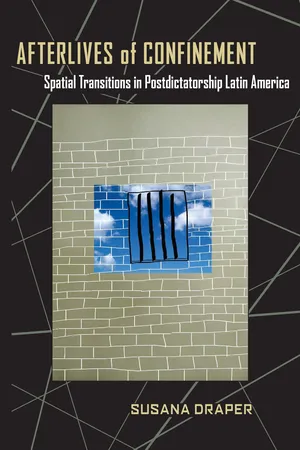
During the age of dictatorships, Latin American prisons became a symbol for the vanquishing of political opponents, many of whom were never seen again. In the postdictatorship era of the 1990s, a number of these prisons were repurposed into shopping malls, museums, and memorials. Susana Draper uses the phenomenon of the "opening" of prisons and detention centers to begin a dialog on conceptualizations of democracy and freedom in post-dictatorship Latin America. Focusing on the Southern Cone nations of Uruguay, Chile, and Argentina, Draper examines key works in architecture, film, and literature to peel away the veiled continuity of dictatorial power structures in ensuing consumer cultures.
The afterlife of prisons became an important tool in the "forgetting" of past politics, while also serving as a reminder to citizens of the liberties they now enjoyed. In Draper's analysis, these symbols led the populace to believe they had attained freedom, although they had only witnessed the veneer of democracy—in the ability to vote and consume.
In selected literary works by Roberto Bola–o, Eleuterio Fernandez Huidoboro, and Diamela Eltit and films by Alejandro Agresti and Marco Bechis, Draper finds further evidence of the emptiness and melancholy of underachieved goals in the afterlife of dictatorships. The social changes that did not occur, the inability to effectively mourn the losses of a now-hidden past, the homogenizing effects of market economies, and a yearning for the promises of true freedom are thematic currents underlying much of these texts.
Draper's study of the manipulation of culture and consumerism under the guise of democracy will have powerful implications not only for Latin Americanists but also for those studying neoliberal transformations globally.
eBook - PDF
Afterlives of Confinement
Spatial Transitions in Postdictatorship Latin America
- 249 pages
- English
- PDF
- Available on iOS & Android
eBook - PDF
About this book
Information
Index
HistoryTable of contents
- Contents
- Acknowledgments
- Introduction: The Afterlife of Prisons
- 1. Prison-Malls: Architectures of Utopic Regeneration
- 2. Literary Afterlives of the Punta Carretas Prison: Tunneling Histories of Freedom
- 3. The Workforce and the Open Prison: Awakening from the Dream of the Chilean Miracle in Diamela Eltit’s Mano de obra
- 4. Freedom, Democracy, and the Literary Uncanny in Roberto Bolaño’s Nocturno de Chile
- 5. Memorialistic Architectonics and Memory Marketing
- 6. It Goes without Seeing: Framing the Future Past of Violence in Postdictatorship Film
- Notes
- Bibliography
- Index
Trusted by 375,005 students
Access to over 1.5 million titles for a fair monthly price.
Study more efficiently using our study tools.
Frequently asked questions
Yes, you can cancel anytime from the Subscription tab in your account settings on the Perlego website. Your subscription will stay active until the end of your current billing period. Learn how to cancel your subscription
No, books cannot be downloaded as external files, such as PDFs, for use outside of Perlego. However, you can download books within the Perlego app for offline reading on mobile or tablet. Learn how to download books offline
Perlego offers two plans: Essential and Complete
- Essential is ideal for learners and professionals who enjoy exploring a wide range of subjects. Access the Essential Library with 800,000+ trusted titles and best-sellers across business, personal growth, and the humanities. Includes unlimited reading time and Standard Read Aloud voice.
- Complete: Perfect for advanced learners and researchers needing full, unrestricted access. Unlock 1.5M+ books across hundreds of subjects, including academic and specialized titles. The Complete Plan also includes advanced features like Premium Read Aloud and Research Assistant.
We are an online textbook subscription service, where you can get access to an entire online library for less than the price of a single book per month. With over 1.5 million books across 990+ topics, we’ve got you covered! Learn about our mission
Look out for the read-aloud symbol on your next book to see if you can listen to it. The read-aloud tool reads text aloud for you, highlighting the text as it is being read. You can pause it, speed it up and slow it down. Learn more about Read Aloud
Yes! You can use the Perlego app on both iOS and Android devices to read anytime, anywhere — even offline. Perfect for commutes or when you’re on the go.
Please note we cannot support devices running on iOS 13 and Android 7 or earlier. Learn more about using the app
Please note we cannot support devices running on iOS 13 and Android 7 or earlier. Learn more about using the app
Yes, you can access Afterlives of Confinement by Susana Draper in PDF and/or ePUB format, as well as other popular books in History & Latin American & Caribbean History. We have over 1.5 million books available in our catalogue for you to explore.