"I say that even later someone will remember us."—Sappho, Fragment 147, sixth century, BC
Sappho's prediction came true; fragments of work by the earliest woman writer in Western literate history have in fact survived into the twenty-first century. But not without peril. Sappho's writing remains only in fragments, partly due to the passage of time, but mostly as a result of systematic efforts to silence women's voices. Sappho's hopeful boast captures the mission of this anthology: to gather together women engaged in the art of persuasion—across differences of race, class, sexual orientation, historical and physical locations—in order to remember that the rhetorical tradition indeed includes them.
Available Means offers seventy women rhetoricians—from ancient Greece to the twenty-first century—a room of their own for the first time. Editors Joy Ritchie and Kate Ronald do so in the feminist tradition of recovering a previously unarticulated canon of women's rhetoric. Women whose voices are central to such scholarship are included here, such as Aspasia (a contemporary of Plato's), Margery Kempe, Margaret Fuller, and Ida B. Wells. Added are influential works on what it means to write as a woman—by Virginia Woolf, Adrienne Rich, Nancy Mairs, Alice Walker, and Hélène Cixous. Public "manifestos" on the rights of women by Hortensia, Mary Astell, Maria Stewart, Sarah and Angelina Grimké, Anna Julia Cooper, Margaret Sanger, and Audre Lorde also join the discourse.
But Available Means searches for rhetorical tradition in less obvious places, too. Letters, journals, speeches, newspaper columns, diaries, meditations, and a fable (Rachel Carson's introduction to Silent Spring) also find places in this room. Such unconventional documents challenge traditional notions of invention, arrangement, style, and delivery, and blur the boundaries between public and private discourse. Included, too, are writers whose voices have not been heard in any tradition. Ritchie and Ronald seek to "unsettle" as they expand the women's rhetorical canon.
Arranged chronologically, Available Means is designed as a classroom text that will allow students to hear women speaking to each other across centuries, and to see how women have added new places from which arguments can be made. Each selection is accompanied by an extensive headnote, which sets the reading in context. The breadth of material will allow students to ask such questions as "How might we define women's rhetoric? How have women used and subverted traditional rhetoric?"
A topical index at the end of the book provides teachers a guide through the rhetorical riches. Available Means will be an invaluable text for rhetoric courses of all levels, as well as for women's studies courses.
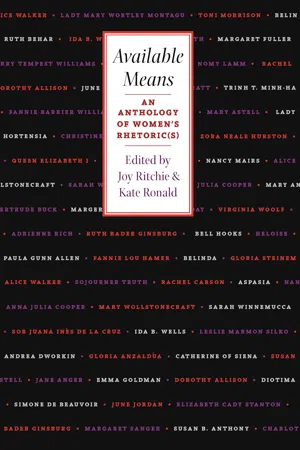
eBook - ePub
Available Means
An Anthology Of Women's Rhetoric(s)
- English
- ePUB (mobile friendly)
- Available on iOS & Android
eBook - ePub
Available Means
An Anthology Of Women's Rhetoric(s)
About this book
Information
Subtopic
LinguisticsTable of contents
- Cover Page
- Title Page
- Copyright Page
- Dedication
- Chronological Table of Contents
- Acknowledgments
- Introduction
- Aspasia
- Diotima
- Hortensia
- Heloise
- Julian of Norwich
- Catherine of Siena
- Christine de Pizan
- Margery Kempe
- Queen Elizabeth I
- Jane Anger
- Rachel Speght
- Margaret Fell
- Sor Juana Inés de la Cruz
- Mary Astell
- Lady Mary Wortley Montagu
- Belinda
- Mary Wollstonecraft
- Cherokee Women
- Maria W. Stewart
- Sarah Grimké
- Angelina Grimké Weld
- Margaret Fuller
- Seneca Falls Convention
- Sojourner Truth
- Frances Ellen Watkins Harper
- Susan B. Anthony
- Sarah Winnemucca
- Anna Julia Cooper
- Elizabeth Cady Stanton
- Fannie Barrier Williams
- Ida B. Wells
- Charlotte Perkins Gilman
- Gertrude Buck
- Mary Augusta Jordan
- Margaret Sanger
- Emma Goldman
- Alice Dunbar Nelson
- Dorothy Day
- Virginia Woolf
- Zora Neale Hurston
- Simone de Beauvoir
- Rachel Carson
- Fannie Lou Hamer
- Adrienne Rich
- Hélène Cixous
- Combahee River Collective
- Audre Lorde
- Merle Woo
- Alice Walker
- Evelyn Fox Keller
- Andrea Dworkin
- Paula Gunn Allen
- Gloria Anzaldúa
- June Jordan
- Trinh T. Minh-ha
- Bell Hooks
- Nancy Mairs
- Terry Tempest Williams
- Patricia Williams
- Toni Morrison
- Minnie Bruce Pratt
- Dorothy Allison
- Nomy Lamm
- Leslie Marmon Silko
- Ruth Bader Ginsburg
- Ruth Behar
- Gloria Steinem
- Appendix A: Alternative/Rhetorical Table of Contents
- A Select Bibliography of Works on Women's Rhetorics
- Index
Trusted by 375,005 students
Access to over 1.5 million titles for a fair monthly price.
Study more efficiently using our study tools.
Frequently asked questions
Yes, you can cancel anytime from the Subscription tab in your account settings on the Perlego website. Your subscription will stay active until the end of your current billing period. Learn how to cancel your subscription
No, books cannot be downloaded as external files, such as PDFs, for use outside of Perlego. However, you can download books within the Perlego app for offline reading on mobile or tablet. Learn how to download books offline
Perlego offers two plans: Essential and Complete
- Essential is ideal for learners and professionals who enjoy exploring a wide range of subjects. Access the Essential Library with 800,000+ trusted titles and best-sellers across business, personal growth, and the humanities. Includes unlimited reading time and Standard Read Aloud voice.
- Complete: Perfect for advanced learners and researchers needing full, unrestricted access. Unlock 1.5M+ books across hundreds of subjects, including academic and specialized titles. The Complete Plan also includes advanced features like Premium Read Aloud and Research Assistant.
We are an online textbook subscription service, where you can get access to an entire online library for less than the price of a single book per month. With over 1.5 million books across 990+ topics, we’ve got you covered! Learn about our mission
Look out for the read-aloud symbol on your next book to see if you can listen to it. The read-aloud tool reads text aloud for you, highlighting the text as it is being read. You can pause it, speed it up and slow it down. Learn more about Read Aloud
Yes! You can use the Perlego app on both iOS and Android devices to read anytime, anywhere — even offline. Perfect for commutes or when you’re on the go.
Please note we cannot support devices running on iOS 13 and Android 7 or earlier. Learn more about using the app
Please note we cannot support devices running on iOS 13 and Android 7 or earlier. Learn more about using the app
Yes, you can access Available Means by Joy Ritchie, Katharine Ronald, Joy Ritchie,Kate Ronald,Joy S. Ritchie,Katharine J. Ronald in PDF and/or ePUB format, as well as other popular books in Languages & Linguistics & Linguistics. We have over 1.5 million books available in our catalogue for you to explore.