Translated by Cynthia Klohr
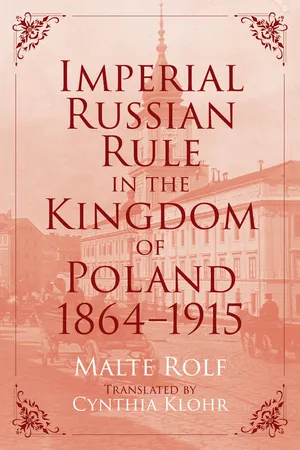
After crushing the Polish Uprising in 1863–1864,Russia established a new system of administration and control. Imperial Russian Rule in the Kingdom of Poland, 1864–1915 investigates in detail the imperial bureaucracy's highly variable relationship with Polish society over the next half century. It portrays the personnel and policies of Russian domination and describes the numerous layers of conflict and cooperation between the Tsarist officialdom and the local population. Presenting case studies of both modes of conflict and cooperation, Malte Rolf replaces the old, unambiguous "freedom-loving Poles vs. oppressive Russians" narrative with a more nuanced account and does justice to the complexity and diversity of encounters among Poles, Jews, and Russians in this contested geopolitical space. At the same time, he highlights the process of "provincializing the center," the process by which the erosion of imperial rule in the Polish Kingdom facilitated the demise of the Romanov dynasty itself.
- English
- ePUB (mobile friendly)
- Available on iOS & Android
eBook - ePub
Imperial Russian Rule in the Kingdom of Poland, 1864-1915
About this book
Information
Subtopic
European HistoryIndex
HistoryPART I
Russian Imperial Rule and the Kingdom of Poland
Conditions, Roles, and Relationships
1
The Tsar and Partitioned Poland
(1772–1863)
THE JANUARY UPRISING OF 1863–1864 MARKED A CLEAR DISRUPTION IN the century-long Russian rule of the region that had formerly constituted the Polish–Lithuanian Commonwealth. The tsar’s officials reacted with severe brutality and repression to the renewed Polish rejection of Russian hegemony and the unity of the empire that it sought to enforce. They introduced a number of measures that they thought would pacify the Polish zone. Some of those measures focused on the inner constitution of the kingdom. They wanted to permanently envelope the Polish province and diminish distinctive local features that were so characteristic of that region at the edge of the empire. By crushing the uprising in 1863–1864, Petersburg altered its imperative of rule and its hold on the land and the people of the Polish governorate.
As much as the uprising would later come to be seen as a sudden outbreak of discontent, the Polish revolt and the authorities’ reaction to it were in fact shaped by Petersburg’s long presence in the territories that had once belonged to Rzeczpospolita. We can better understand the reasons for the uprising, the severity of the Russian reaction, and various other early nineteenth-century events by taking a closer look at the tsarist regime that existed in the western governorates (zapadnye gubernii) after 1772 and in what came to be called the Kingdom of Poland after 1815.
Dividing up Poland and Lithuania in 1772, 1793, and 1795 was in line with the negative policy on Poland pursued by Petersburg throughout the entire eighteenth century in order to seriously weaken a nearby foe.1 In 1772 the first partitioning showed no intent of entirely dissolving the country of Poland, but the dynamics that developed from dividing up the region began to suggest that outcome. The more Poland’s political elite, on their reduced territory and facing existential threats, went along with certain reforms, the more the partitioning powers began to demand even more territory in order to effectively sustain Polish agony. After the reformed constitution of May 3, 1791, which Catherine II considered a “Jacobean” challenge, the second partition in 1793 was just a step away. Extending the Russian Empire westward followed the traditional logic of imperial expansion and, just one year after suppressing the revolt led by General Kościuszko in 1794, resulted in the dissolution of the Polish state.2 The occupation and integration of Polish territory was not a first for those in power in Petersburg. They were well-versed in setting up imperial rule. They had taken over Baltic Sea provinces by co-opting loyal members of the local nobility and they used the same tactic to gain control of the Polish provinces. It had been Catherine’s proven method for amalgamating the early modern multiethnic empire, and Alexander I followed the same principle.3
ONE OF THE TSAR’S LOYAL NOBLE POLISH ARISTOCRATS, PRINCE ADAM Czartoryski, also became one of his closest friends and advisers. Czartoryski had been foreign minister of the Russian Empire since 1804. He had played a major role in shaping the independent Kingdom of Poland closely tied to the House of Romanov.4 Once they realized that there was little hope of restoring an independent, united Poland, part of the Polish aristocracy found the solution of existing under Russian rule viable. The arrangement created by Napoleon in the Prussian and Austrian partitions had become largely discredited. Although Polish engagement in Europe’s battles lent itself to myth, Napoleon’s prosaic creation of the Duchy of Warsaw belied such glorification. The duchy was embellished with a few French fineries such as a constitution, separation of powers, and the code civil, but its primary function was very obviously to gather and form reserves for the Grande Armée that Napoleon was recruiting on the Vistula in preparation for his campaign into Russia.
At the same time, some of the changes to the constitution and to civil law that characterized the Duchy of Warsaw would later also be significant for Russian power. The Kingdom of Poland’s constitution of 1815 was modeled in some respects on its French precursor, and the Napoleonic Code remained in force in Poland until 1915.5
Nonetheless, due to the presence of the French Regiment in the Duchy of Warsaw, large parts of the Polish aristocracy quickly lost faith in Napoleon as an ally. The disaster of the Russia campaign in 1812 made many of them willing to negotiate with Tsar Alexander I. He brought to the Vienna Congress of 1814 a carefully worded intention to establish a Kingdom of Poland backed not only by the strength of the Russian army but also by the consent of some of Poland’s most significant noble families.6
But in Vienna Tsar Alexander was unable to achieve what he wanted most. Instead, the Congress confirmed that the Austrian Empire and the Kingdom of Prussia would control the greatest portions of Polish territory. An agreement was reached to carve out a small Kingdom of Poland in personal union with the rulers in Petersburg. The territory of this polity, also called Congress Poland, stretched far to the south and west and included the cities of Warsaw, Kaliz, Lublin, and Płock. The resolutions of the Congress of Vienna meant two things for imperial Russia: first, they guaranteed the permanence of Polish subordination and eradicated any doubt about who was in control in the Kingdom of Poland; and second, they meant that the old eastern regions of Poland and Lithuania were now indirectly internationally recognized as Russian provinces. At the Congress of Vienna no mention had been made of these areas being connected to the Kingdom of Poland. But from the Russian standpoint, it was clear that Congress Poland represented only what had traditionally been seen as belonging to the state of Poland, while the so-called western governorates were considered part of the tsardom and seen as being originally and genuinely Russian. In fact, creating the Kingdom of Poland quickly separated these territories from one another. Although a large part of the old commonwealth was now ruled by the tsar, in the course of a few years, the differences in administrative practices in the separate regions would come to highlight the difference between the Kingdom of Poland and the western governorates.
The distinction was enhanced when the Russian regime granted the Kingdom of Poland privileges that exceeded those enjoyed by the rest of the empire. The constitution, written up by Czartoryski and others in 1815, awarded the kingdom a special status and gave Alexander I elbow room to experiment with constitutional reforms. The constitution allowed Russian Poland to have a privy council installed by the king of Russia and a parliament. Half of the members of parliament were to be elected to a house of representatives by provincial and communal chambers. The other half would be appointed to the senate by the king himself. The kingdom would also have its own independent high court of justice and its own national army.7 Alexander made many reconciliatory gestures in a serious attempt to convince Poland’s nobility of the advantages of existing under tsarist rule. He ordered the kingdom’s administration to be organized according to the traditional pattern of Polish voivodeships and positions in bureaucracy to be filled exclusively by locals. In 1815 he named Prince Józef Zajączek the imperial viceroy (namestnik), who thus became the head of the administrative council, Congress Poland’s actual government. Zajączek had just shortly before stood by Napoleon in the Russia campaign and now became the tsar’s official ambassador to the kingdom.8
The University of Warsaw was founded in 1816. Petersburg wanted to demonstrate that local concerns and the Polish desire for education and development were being given high priority. Alexander personally attended the inauguration celebration to honor the new university. During the first phase of the kingdom’s existence the tsar visited the metropolis on the Vistula regularly, underscoring the importance of Polish concerns for the empire.9
This short period of Polish self-governing contributed considerably to imminent developments. The decade and a half between 1815 and 1830 became a point of reference for all subsequent deliberations on how and whether some sound way could be found to solve the “Polish question” within the concept of the Russian Empire. It was the reference point for Alexander Wielopolski’s reforms in the 1860s, for the subsequent demands for autonomy formulated by the moderate Poles, and for those within the tsarist bureaucracy and Russian public who were willing to make concessions.
In reality, there were few ways to further develop a constitutional Polish kingdom under the rule of the Russian sovereign. There were strong reasons for a mutual lack of trust, and both parties were discontent with the status quo. Polish nobility remained traditionally split into the so-called red middle and lower szlachta and a white upper nobility. Only the latter were willing to enter long-term cooperation with the partition powers, while the members of lower nobility were increasingly susceptible to the pan-European excitement for revolution in the Age of Metternich. The Russian authorities perceived suspicious tendencies of Congress Poland beginning to go its own way. In the 1820s Royal Commissioner Nikolai Novosil’tsev, who was responsible for overseeing the Polish Privy Council and the cultural life of the kingdom, and Grand Duke Constantine, commander in chief of the Polish army, began pursuing activities that produced numerous disputes. A Polish network of secret societies began to form with an increasing emphasis on the rejection of Russian suzerainty. Several factors and developments soon caused these circles to become radical. These included the tightening of censorship measures following the Decembrist revolt of 1825, the tracking down of underground organizations of all kinds, the increasing number of violations against the constitution carried out by imperial officials, the suppression of the Polish language and Polish educational content in the institutions of the Vilnius school district driven by the new curator Novosil’tsev, and last, but not least, the rhetoric of revolution spreading through Europe. All these developments were reasons for secret societies to begin favoring armed rebellion against foreign rule and sparked the November Uprising of 1830–1831.10 In light of the poor, or, for the most part actual lack of planning behind the revolt, it is rather surprising that the subversive attack led by a few officer cadets resulted in a full-fledged Polish–Russian war that at least temporarily questioned the legitimacy of Russian imperial rule in the Kingdom of Poland. But ultimately, even the mobilization of almost eighty thousand rebels could not prevent the Russian army from defeating the Polish cause. Warsaw capitulated in September 1831, and in October the remainder of the Polish troops fled to Prussia, where they were detained.11
The rise and crushing of the rebellion in November made a deep mark on the history of the Kingdom of Poland and on the overall Polish–Russian relationship. The subsequent “Great Emigration” had a considerable effect on Congress Poland’s nobility and educated society. In the autumn of 1831 about fifty thousand people were forced to leave the country. From among those in exile emerged a community that in subsequent decades would starkly influence Polish culture and public opinion. It was the source of Polish messianism and the vision of Poland as the “Christ of the Peoples.” The displaced upheld a revolutionary pathos that reverberated across the partitions of Poland, feeding into the myths surrounding the uprising and stimulating talk of unification. The Lambert Hotel in Paris belonged to the Czartoryski family and became a center for expatriates. Frédéric Chopin, Zygmunt Krasinski, Juliusz Słowacki, and particularly Adam Mickiewicz articulated the dire concerns of the emigrant world. And in the city state of Cracow, which remained independent until 1846, opinion makers gathered at the Jagiellonian University, upholding the memory of the Polish nation, its compass within the borders of 1772, and how it had been constitutionally reformed in May 1791. The era of Polish Romanticism after 1831 was characterized by the profound experience of losing statehood and the belief that revolution would revise the existing conditions. It was also an intense time of defining what it meant to be Polish with clear demarcation from “the Muscovite others.” Poles and Russians were seen as representatives of two antagonistic mental principles.12
The November Uprising also proved to be fruitful for the history of Russian thought. It gave birth to the topos of the ungrateful and rebellious Poles that occupied the minds of imperial bureaucrats and the Russian public down to the last day of stardom. Many of them saw Poles as a trigger behind the forces that would—to rephrase Alexander Pushkin’s angry poem “Klevetnikam Rossii”—slander Russia. The struggle with Polish rejection also promoted debate on what it meant at that time to be Russian. The 1830s controversy in Russia between publicists called Westernizers and those who saw themselves as Slavophiles got its impetus from popular outrage at what was deemed to be “Polish mutiny.”13
After 1831 Russian imperial rule in the Kingdom of Poland began to change. Congress Poland’s constitution was suspended, Polish parliament dissolved, and the country’s independent army disbanded. Nicholas I announced a permanent state of emergency for the rebellious area. The Organic Statute of the Kingdom of Poland that had been issued in 1832 to replace the constitution now meant nothing. It was suspended in 1833 with the proclamation of martial law and remained invalid until the emperor died in 1855. The tsar installed Ivan Paskevich, a triumphant general, as his viceroy in Warsaw. There Paskevich remained the imperial viceroy until his death in 1856. The repressive nature of what has been called the “period of gendarmes” in the kingdom was, to a great extent, of his doing.14
Backed by the authorities in Petersburg, Paskevich’s first official act after crushing the revolt was to punish insurgents. Eighty thousand inhabitants of the kingdom and the western region were banished to Siberia. The property of nobles suspected of having been involved in the uprising, or suspected of having supported it, was confiscated and given to non-Poles, primarily Russians. Poles were removed from leading positions in local administration. The Polish language did, however, remain the official language for local administrative purposes. After 1831 imperial policy appears to have been focused in general solely on condemning rebels and preventing further uprisings. On the one hand, Petersburg did take several administrative measures to bind the kingdom closer to the empire. But many orders and practices also suggest that the tsar’s government basically accepted the fact that Congress Poland was different. Imperial Commissioner Paskevich continued to fulfill his official functions in the kingdom, but the State Council remained in place until 1841 and the kingdom kept an independent ministry of the interior, justice department, and treasury department. In 1847 Petersburg introduced Russian criminal law to the kingdom, but on the other hand, the Napoleonic Code Civil remained in use. In 1837 Petersburg ordered a restructuring of the governorates based on the Russian model, and yet local administration retained the traditional pattern of cooperating with the elites. Even changing currency, weights, and measures to conform to Russian sta...
Table of contents
- Cover Page
- Title Page
- Copyright Page
- Dedication
- Contents
- Acknowledgments
- Remarks on Transcription, Transliteration, and Quotations
- Note on Calendar
- Introduction: The Kingdom of Poland and Petersburg Rule
- Part I. Russian Imperial Rule and the Kingdom of Poland: Conditions, Roles, and Relationships
- Part II. Warsaw and the Empire
- Part III. Multiple Faces of an Imperial Society
- Part IV. The Empire’s Crisis in Poland
- Part V. Closing Remarks on the Kingdom of Poland and the Russian Empire
- Glossary of Names
- Notes
- Bibliography
- Index
Trusted by 375,005 students
Access to over 1.5 million titles for a fair monthly price.
Study more efficiently using our study tools.
Frequently asked questions
Yes, you can cancel anytime from the Subscription tab in your account settings on the Perlego website. Your subscription will stay active until the end of your current billing period. Learn how to cancel your subscription
No, books cannot be downloaded as external files, such as PDFs, for use outside of Perlego. However, you can download books within the Perlego app for offline reading on mobile or tablet. Learn how to download books offline
Perlego offers two plans: Essential and Complete
- Essential is ideal for learners and professionals who enjoy exploring a wide range of subjects. Access the Essential Library with 800,000+ trusted titles and best-sellers across business, personal growth, and the humanities. Includes unlimited reading time and Standard Read Aloud voice.
- Complete: Perfect for advanced learners and researchers needing full, unrestricted access. Unlock 1.5M+ books across hundreds of subjects, including academic and specialized titles. The Complete Plan also includes advanced features like Premium Read Aloud and Research Assistant.
We are an online textbook subscription service, where you can get access to an entire online library for less than the price of a single book per month. With over 1.5 million books across 990+ topics, we’ve got you covered! Learn about our mission
Look out for the read-aloud symbol on your next book to see if you can listen to it. The read-aloud tool reads text aloud for you, highlighting the text as it is being read. You can pause it, speed it up and slow it down. Learn more about Read Aloud
Yes! You can use the Perlego app on both iOS and Android devices to read anytime, anywhere — even offline. Perfect for commutes or when you’re on the go.
Please note we cannot support devices running on iOS 13 and Android 7 or earlier. Learn more about using the app
Please note we cannot support devices running on iOS 13 and Android 7 or earlier. Learn more about using the app
Yes, you can access Imperial Russian Rule in the Kingdom of Poland, 1864-1915 by Malte Rolf in PDF and/or ePUB format, as well as other popular books in History & European History. We have over 1.5 million books available in our catalogue for you to explore.