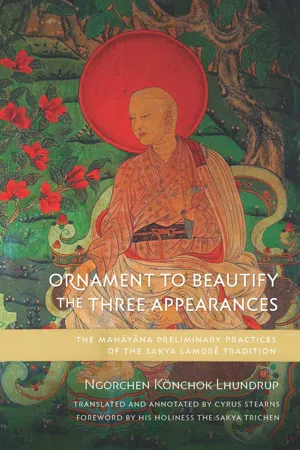
Ornament to Beautify the Three Appearances
eBook - ePub

Ornament to Beautify the Three Appearances

The Mahayana Preliminary Practices of the Sakya Lamdré Tradition

  1. 304 pages
  2. English
  3. ePUB (mobile friendly)
  4. Available on iOS & Android
eBook - ePub

Ornament to Beautify the Three Appearances

The Mahayana Preliminary Practices of the Sakya Lamdré Tradition

About this book

The latest offering from a renowned translator in the Buddhist world of one of the most important texts in the Sakya tradition of Tibetan Buddhism. This translation was made at the request of the head of the Sakya tradition. Ornament to Beautify the Three Appearances is the first book of a two-volume set of works written by Ngorchen Könchok Lhundrup (1497–1557) to explain the Lamdré teachings, the most important system of tantric theory and practice in the Sakya tradition of Tibetan Buddhism. The Lamdré, or Path with the Result, is based on the Vajra Lines of the great Indian adept Virupa (ca. seventh–eighth centuries). The first topic is the fundamental meditative practices of Hinayana and Mahayana Buddhism. In the Lamdré teachings, these preliminary instructions are known as the Three Appearances. The guiding instructions on impure appearance are for the purpose of developing renunciation. These focus on the defects of samsara; the rarity, benefit, and transience of human life; and the nature of positive and negative actions and results. The guiding instructions on the appearance of the experiences are for the purpose of producing the altruistic intent. These focus on developing love, compassion, and bodhicitta, and on cultivating joy now about the uncommon experiences that will arise later when practicing the Vajrayana teachings. The guiding instructions on pure appearance are for the purpose of producing enthusiasm for the ultimate result of complete awakening. These briefly describe the inconceivable nature of a buddha's enlightened body, speech, and mind. Having absorbed these preliminary instructions, the practitioner may go on to the second volume of Ngorchen's works, a restricted text that explains the main tantric practices of the Three Continua, intended for students who have at least received the great initiation of Hevajra. Volume 2 is available in a restricted box set that includes this first volume and may be obtained only on the Wisdom Publications website.
Frequently asked questions

Yes, you can cancel anytime from the Subscription tab in your account settings on the Perlego website. Your subscription will stay active until the end of your current billing period. Learn how to cancel your subscription.
At the moment all of our mobile-responsive ePub books are available to download via the app. Most of our PDFs are also available to download and we're working on making the final remaining ones downloadable now. Learn more here.
Perlego offers two plans: Essential and Complete
  • Essential is ideal for learners and professionals who enjoy exploring a wide range of subjects. Access the Essential Library with 800,000+ trusted titles and best-sellers across business, personal growth, and the humanities. Includes unlimited reading time and Standard Read Aloud voice.
  • Complete: Perfect for advanced learners and researchers needing full, unrestricted access. Unlock 1.4M+ books across hundreds of subjects, including academic and specialized titles. The Complete Plan also includes advanced features like Premium Read Aloud and Research Assistant.
Both plans are available with monthly, semester, or annual billing cycles.
We are an online textbook subscription service, where you can get access to an entire online library for less than the price of a single book per month. With over 1 million books across 1000+ topics, we’ve got you covered! Learn more here.
Look out for the read-aloud symbol on your next book to see if you can listen to it. The read-aloud tool reads text aloud for you, highlighting the text as it is being read. You can pause it, speed it up and slow it down. Learn more here.
Yes! You can use the Perlego app on both iOS or Android devices to read anytime, anywhere — even offline. Perfect for commutes or when you’re on the go.
Please note we cannot support devices running on iOS 13 and Android 7 or earlier. Learn more about using the app.
Yes, you can access Ornament to Beautify the Three Appearances by Ngorchen Könchok Lhundrup, Cyrus Stearns in PDF and/or ePUB format, as well as other popular books in Theology & Religion & Buddhism. We have over one million books available in our catalogue for you to explore.

Information

THE MAIN PRACTICE

Image
To practice the individual topics of meditation:
Guiding instructions on impure appearance,
to produce renunciation.
Guiding instructions on the appearance of the experiences,
to produce the altruistic intent.
Guiding instructions on pure appearance,
to produce enthusiasm.
PART 1
Image

Guiding Instructions on Impure Appearance, to Produce Renunciation

Guiding instructions on the defects of saṃsāra,
to produce renunciation.
Guiding instructions on the difficulty of gaining
the freedoms and endowments, to arouse diligence.
Guiding instructions on positive and negative actions
and results, to show what should be accepted and rejected.
CHAPTER 1
Image

Guiding Instructions on the Defects of Saṃsāra, to Produce Renunciation

THIS IS PRESENTED in the treatise by the phrase “A sentient being,”69 because, if the realms of sentient beings are examined, it will be understood that they have not passed beyond only suffering.
Therefore, those who strive for nirvāṇa, a liberation that is permanent freedom from saṃsāra, must eliminate attachment to saṃsāra. To abandon attachment to saṃsāra, we must be mindful of the defects of saṃsāra. To be mindful of the defects of saṃsāra, we must depend on the oral instructions of a guru and understand the nature of all saṃsāra to be suffering.
A song of the precious venerable lord says:
To achieve nirvāṇa, abandon attachment
to the three realms.
To abandon attachment to the three realms,
be mindful of the defects of saṃsāra.70
And a sūtra also says:
The desire realm has faults, and the form realm
also has faults. In a similar way, the formless realm
also has faults. Only nirvāṇa is seen to be faultless.71 [10a]
And Maitreyanātha also says:
Just as feces have no sweet aroma, there is no happiness among these
five living beings. Their sufferings are constant, like those produced
by contact with fire, weapons, salt amoniac, and so forth.72
It might be asked, “Well, what types of suffering, faults, and defects exist in saṃsāra?”
The Sūtra on the Foundations of Mindfulness says:
Sentient beings in the hells are tormented by hellfire.
Hungry spirits are tormented by hunger and thirst.
Animals are tormented by eating each other.
Human beings are tormented by short lifespans.
Gods are tormented by carelessness.
There is never any happiness on the needle-tip
of saṃsāra.73
For reflection on their sufferings:
Reflection on the suffering of suffering,
and developing renunciation.
Reflection on the suffering of change,
and abandoning attachment.
Reflection on the suffering of conditioned existence,
and cultivating the wish for liberation.

I. REFLECTION ON THE SUFFERING OF SUFFERING, AND DEVELOPING RENUNCIATION

A song of the precious venerable lord says:
First, the suffering of suffering, which
is the suffering of the three lower realms.
If you reflect well on that your flesh will
crawl. If it fell upon you there would be
no way to bear it.
Not achieving the virtue to avoid it,
those who keep cultivating the crops
of the lower realms are so pitiful,
wherever they are!74
The Reply to Tratön’s Request also says:
The suffering of suffering is in the three lower realms,
like abscesses upon leprosy sores. If you have reflected
well on that—how could it be endured? Thinking of that,
turn away from nonvirtuous actions.75 [10b]
Determining this has three topics:
A. Reflection on the sufferings of the hells
B. Reflection on the sufferings of the hungry spirits
C. Reflection on the sufferings of animals
A. REFLECTION ON THE SUFFERINGS OF THE HELLS
1. Reflection on the sufferings of the cold hells
2. Reflection on the sufferings of the hot hells
3. Reflection on the sufferings of the peripheral and minor hells
1. Reflection on the sufferings of the cold hells
The eight are:
Blistering, Bursting Blisters, Crying “Alas!,”
Crying “Woe!,” and Chattering Teeth,
Split Open Like an Utpala, Split Open Like a Lotus,
and Greatly Split Open Like a Lotus.
Blistering
The place of birth is a land totally surrounded on all sides by a ring of great glacial peaks. On a vast icy plain, a place of torment by sharp contact with horrible snow blizzards, without even starlight as a source of light, and without the chance to rely on even a scrap of cloth as a source of warmth, the hell beings are magically and instantly born alone with full-grown bodies, as sentient beings for whom the results of their own previously performed acts have ripened. From being struck by contact with the cold there, countless bunches of blisters appear on the body.
Bursting Blisters
Contact with the cold twenty times greater than that makes even the blisters burst and ooze blood, serum, and so forth, which also become ice.
Crying “Alas!”
In a similar way, the force of extreme cold makes them wail, “Alas!”
Crying “Woe!”
Contact with the cold even greater than that makes them scream in misery, “Woe!”
Chattering Teeth
Contact with the cold even greater than that makes the teeth chatter and the body stiffen. [11a]
Split Open Like an Utpala
Contact with the cold even greater than that makes the outer skin of the body turn bluish and split into pieces.
Split Open Like a Lotus
After that outer skin is carried off by the blizzard, the body that has become red like fresh, raw meat also splits into bits and pieces.
Greatly Split Open Like a Lotus
The body, changed as before, splits into hundreds and thousands of pieces, the internal organs spill out, and those also split open.
Concerning these, the master Candragomin says:
An incomparable wind, penetrating even its bones, freezes
the body, carries off its quivering flesh, and it curls into a ball.
Hundreds of blisters form and burst, from which creatures are born
who strike with weapons, and blood, serum, and marrow ooze.76
The Treasury mentions the lifespans in those hells:
By removing a sesame seed once every
hundred years from a sesame bin, it will
be emptied. That is the lifespan in Blistering.
The lifespans of the others multiply by twenty.77
A sesame bin is a container that holds eighty loads of sesame calculated in the large measures78 of the Magadha region [in India]. The amount of time it takes to empty that sesame bin by discarding a single sesame seed once every hundred human years is the lifespan in Blistering. And that of the seven lower hells is each twenty times longer than the one above it. Accordingly:
The duration in Bursting Blisters is 20 times longer.
Crying “Alas!” is 400. Crying “Woe!” is 8,000,
and Chattering Teeth is 160,000. Split Open Like
an Utpala is 3.2 million, Split Open Like a Lotus
is 64 million, and Greatly Split Open Like a Lotus
is 1.28 billion. [11b]
Even those lifespans are just approximate. If given in detail, they would obviously be even longer than that, because a sūtra says:
O monks, for example: if a sesame bin of the land of Magadha (holding eighty loads of sesame) is filled to the brim with sesame and then someone throws out a single sesame seed when each century has passed, through that process those eighty loads of sesame will be absolutely emptied very quickly. But I do not say that the lives of sentient beings born in Blistering will have reached an end.
Ju...

Table of contents

  1. Cover Page
  2. Title Page
  3. Contents
  4. Foreword by His Holiness the Sakya Trichen
  5. Translator’s Introduction
  6. Ornament to Beautify the Three Appearances
  7. Introduction
  8. The Preliminaries
  9. The Main Practice
  10. Conclusion
  11. Outline of Ornament to Beautify the Three Appearances
  12. Notes
  13. Bibliography
  14. Index
  15. About the Translator
  16. Copyright