- English
- ePUB (mobile friendly)
- Available on iOS & Android
eBook - ePub
About this book
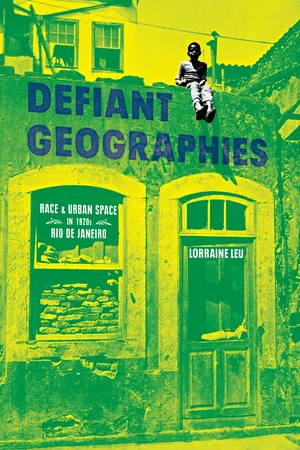
Defiant Geographies examines the destruction of a poor community in the center of Rio de Janeiro to make way for Brazil's first international mega-event. As the country celebrated the centenary of its independence, its postabolition whitening ideology took on material form in the urban development project that staged Latin America's first World's Fair. The book explores official efforts to reorganize space that equated modernization with racial progress. It also considers the ways in which black and blackened subjects mobilized their own spatial logics to introduce alternative ways of occupying the city. Leu unpacks how the spaces of the urban poor are racialized, and the impact of this process for those who do not fit the ideal models of urbanity that come to define the national project. Defiant Geographies puts the mutual production of race and space at the heart of scholarship on Brazil's urban development and understands urban reform as a monumental act of forgetting the country's racial past.
Information
Index
Literature1
RACE, ETHNICITY, AND URBANIZATION
ON JUNE 25, 1921, A GRUESOME DISCOVERY halted demolition work on Castelo Hill. Two workers on the site were wielding their pickaxes on the flank of the hillside behind the School of Fine Arts when they came across a human head. After notifying their supervisor of the discovery, further investigation revealed a body buried in shallow dirt and the police were summoned. The body was that of a young, white man whose pockets contained only a few coins, handkerchiefs, a ticket from the People’s Laundry for a pair of trousers, and a copy of the score to a samba song.1 In the lengthy time that it took police medical and pathology experts to arrive at the scene, a large crowd gathered to witness the find. It grew as the officials carried out their business, with bystanders pushing and shoving in their attempts to breach the police cordon around the body, and sprinting up the hillside to get a better view. Sensational talk of murder dissipated later that day after the autopsy revealed that the body bore no signs of violence or a struggle. The medical examiners concluded instead that the young man had been the victim of an accident. Attempts to learn his identity failed until late that night when two men identified him at the police morgue. The dead man was one Manuel Jesus Gomes, a twenty-two-year-old Spanish immigrant. Gomes was a former employee at the Club Central, a stone’s throw away on the Avenida Rio Branco (formerly the Avenida Central), the city’s European-style boulevard created by the Passos reforms of 1903–1906. Gomes had formerly resided in a rooming house in the center of the city. Having lost his job, he had disappeared from his room without paying the rent he owed and was homeless at the time of his death. This version of events matched the manner in which Gomes’s body was discovered—in a crouching position, covered with a newspaper that served as a blanket. It also provided the missing piece in the puzzle of his death. Gomes had been sleeping on the demolition site when earth from the hillside collapsed and suffocated him.2
Manuel Jesus Gomes and the two construction workers who found him, José Vieira and Cícero Pereira, would have remained entirely anonymous and invisible actors in the centennial reform project, one of the most extraordinary episodes in the capital’s urban history, were it not for Gomes’s newsworthy death. On the surface the incident appears to be nothing more than a sad footnote in a grand narrative of progress. However, these three individuals map out key coordinates of the racialized landscape of the city on the eve of its centenary. Gomes, the Spanish immigrant, described as “white” in press coverage, may have been a gallego from northwestern Spain, given the spelling of his surname; José Vieira was Afro-descendant; and Cícero Pereira was a northeasterner from the interior whose phenotype evinced the mixture of Portuguese with indigenous, and perhaps some black heritage. These men represent “types” that dominated social thinking on race at a moment when the country’s elites were wringing their hands over how to reconcile its racial makeup with their aspirations to European-style modernity. The incident points to intersections of race, ethnicity, and urbanization in the city, and hints at the vast breach between the vision for the city held by ruling social groups and the lived experience of the city of those who serviced the modernizing project but were not its beneficiaries.
This chapter follows currents of optimism and pessimism in social thinking regarding race and Brazil’s potential for achieving modernity in the early twentieth century. It then considers specifically how the racialized groups represented by the immigrant and the two construction workers fit into those discussions and debates. Finally, it explores how an intertwined discourse of race and progress understood urban space and shaped urbanization. Overall, the chapter teases out the anxieties but also the aspirations about race that lay behind the reorganizing of space for the centenary. Racialized discourse in the runup to 1922 was not frequently overt in urbanization language and policy, but by sketching out a panorama of race thinking at the time it is possible to glimpse the refracted or coded nature of racial discourse in the process of reimagining the city for the next century. In an important book on the rescripting of white supremacy through practices and policies of education in this period, Jerry Dávila (2003) unpacks how race thinking provided the conceptual framework for an ambitious reform of Rio de Janeiro’s schools. Like the educators whom Dávila discusses, urban reformers were profoundly influenced by racial ideology in their vision and their actions. Consistent with the near consensus among the elites on the future path of the country, the modernization of the capital meant the whitening of the capital. The coexistence of different racial and ethnic groups in the poorest neighborhoods of the city has tended to obscure the centrality of whitening to urbanization in a great deal of the existing scholarship. However, as George Reid Andrews (2004) has observed, urban reform was a fundamental strategy of the whitening project, or what he calls “the war on blackness.” Across Latin America the material and aesthetic transformation of cities sought not just to modernize their infrastructure but also to reconfigure their class and racial composition (118–20).3 Urbanization and whitening were conjoined and fundamental to the pursuit of modernity. With the intention of creating a showcase for Brazil’s modernizing ambitions, spaces of the city first functioned as a huge laboratory for experimentation with whether material changes to the built environment could result in at least a socially and culturally whiter population. The centennial reform was a project of monumental proportions, undertaken by the mayor’s office and with the support of the president and the federal government.4 It is, therefore, a stage on which shifting ideas about race in the 1920s were writ large and spectacularly enacted. Profound changes occurred in the occupation and distribution of space in the city at this time as a result of attempts to address Brazil’s racial “problem.”5 This chapter seeks to make connections between urban and racial progress. Its sources are primarily chronicles, articles, and political cartoons from the press, as well as accounts by city officials. These narratives of urbanization are therefore told from the perspective of the governing classes and the emerging middle classes, though they can be ambivalent or critical with regard to the national project of modernity. Some press publications challenge aspects of that project on behalf of the city’s poor racialized population, whose voices occasionally break through in the third person, or whose views are construed in cartoons.
BETWEEN OPTIMISM AND PESSIMISM
Our latest sanitation project, modeled after the most progressive examples, visibly facilitates the strengthening of the race and increases its productive capacity.
—Epitácio Pessoa, inaugural speech for the Centennial World Fair, 1922 (Livro de ouro 1923, 363).
President Pessoa’s upbeat prediction that the hastily (and partially) concluded urban reform project to host the Rio World Fair would improve “the race” and, therefore, national productivity is not refracted or coded. In fact, he could not be more explicit in making the link between race, progress, and urbanization. But to what race was he referring? Not long before his pronouncement a gloomy sense that Brazil had no race pervaded and preoccupied its intellectual community.6 Miscegenation, they believed, had doomed the country and produced a backward, unhealthy, and lazy majority population that was more “bestial” than it was civil society.7 As Dain Borges (1993) has discussed, from the 1880s through the 1920s medicalized social thinking understood this problem as degeneration, and the notion persisted in following decades as a means of social analysis for Brazilian intellectuals.8 Degeneration was a quasi-official ideology of the Republican government in its first two decades. It borrowed from European scientific racism and lamented that the tropical environment reduced individuals to unproductive laziness and society to a parasitic organism. The threat of degeneration hung over various modernization projects designed to cure a sick nation, including European immigration, urban renewal, and public health campaigns. The unequivocal goal of these projects, therefore, was achieving racial advancement (235, 256, 249). The voices of progress frequently wrestled with pessimism, their own and that of others, given the scope of this racial degeneracy. This is very much in evidence in the pro-reform press. The Revista da Semana frequently bemoaned, for example, that the space of “barbarity” that was Morro do Castelo persisted adjacent to the island of civilization that the Passos reforms had created downtown.9
Accompanying the gloomy outlook of degeneracy, however, was always a more optimistic current of thinking that was necessary to the effort of imagining a nation blighted by its climate and inferior peoples (Oliveira 2006, 25). This more positive vision of the country’s future relied in part on a belief that white immigration could counter and gradually eliminate the weaker black race in the process of race mixing. One of the most buoyant predictions in this regard undoubtedly came from João Batista de Lacerda, the director of the National Museum. In the paper he delivered at the First Universal Races Congress in London in 1911, he projected that in one century the black race would be extinguished in Brazil (Skidmore 1993, 65–66); Schwarcz 1999, 3). In the meantime, however, impatient ideologues of nation, or those who doubted (privately or publicly) that there was an infusion of white blood sufficient to purge blackness from the population, were obliged to think more creatively about the country’s racial dilemma. According to Lilia Moritz Schwarcz (1999, 42), Brazilian social thinkers demonstrated original approaches to evolutionist doctrine that made race theory borrowed from Europe very much their own. The First World War further encouraged a questioning of European ideas and provoked a feeling that Brazil could challenge the future that determinist racist thought predicted for it. At this time the competing theory from Europe and North America of race as cultural rather than biological was also circulating in Brazil, particularly in the work of the anthropologist Edgar Roquette-Pinto (Skidmore 1993, 146, 185–89). These factors coincided to produce a more “elastic” view of degeneracy, as an acquired, rather than innate condition (Dávila 2003, 6).
This expanded notion provided a logic for apprehending Brazil’s racial realities to its nation builders (see Lima and Hochman 1996, 28). To return to Manuel Jesus Gomes, it explains why a European migrant who bore the hopes of the elite for the improvement of the Brazilian nation could be reduced to homelessness—a condition that the postabolition Penal Code of 1890 had criminalized as vagabondage and that affected Afro-descendants disproportionately.10 From the perspective of degeneracy, a poor white obliged to coexist alongside the black population in difficult and insalubrious conditions could end up dissolute and dying like a malandro, with only a few pennies and a samba score in his pocket. A more fluid view of degeneracy also offered some hope for the social and racialized group to which the construction worker Cícero Pereira belonged. Improvements in education and living conditions presented the possibility of rehabilitating “backward” rural, miscegenated types from the interior. As far as the other worker, José Vieira, was concerned, theoretically this elastic degeneracy meant that in the right conditions it was possible for Afro-descendants to achieve some social ascension. However, given the hope held out by many officials and elites that the country was following a trajectory of racial progress from blackness to whiteness (Dávila 2003, 6), the section of the population to which he belonged would eventually be eliminated in any case.
Degeneracy is therefore the notion that provides the key link between urban reform and racial thinking. As Dávila has observed, although overt discussions of race may often be elusive in analyzing public discourse or policy at this time, racial meanings were diffused into the discourse of degeneracy (2003, 13). Ruling groups considered degeneracy a condition particular to people of color, and later, a condition that affected whites compelled to live in close proximity to them and who adopted their behavior. Race, therefore, was the motor driving the determined and concerted campaigns to extirpate degeneracy that preoccupied urbanizers in the First Republic, and beyond. This is why talk of “laziness,” “filth,” and “ugliness” by city administrators, engineers, and in the press is talk about race. Dávila is entirely right when he says in the context of his analysis of education that racial ideology is actually a metanarrative, a whole complex of values and concepts that guided policy and practice. Though frequently no one may be ostensibly speaking of race, race was embedded in assumptions about different social groups that shaped the intentions and outcomes of public policies (14). For example, when the head of the Settlement Service of the Ministry of Agriculture, Industry and Commerce calls repeatedly for the “homogenization of the national type” in his History of the Colonization of Brazil (1918), he never uses the word whitening, yet it is clear that he was calling for immigration by white Europeans with assimiliationist tendencies (Seyferth 1996, 55). This chapter, therefore, examines one strand of the metanarrative of race in Brazil at an important moment in the reorganization of space in the capital.
So, what concept of race is President Epitácio Pessoa openly invoking in his speech? According to Pessoa it is a “Brazilian race” in formation that the capital’s latest urbanization project aimed to nurture. The national type or race that Pessoa envisages is ideally white, or more precisely, whitened. Although European immigration was to make a key contribution to this process, in his speech Pessoa clearly attributes a major role to urban reform in creating the appropriate environment.11 It is significant, too, that he understands the entire engineering and architectural project of removing and destroying a neighborhood, flattening a hill downtown, and constructing a new mini-city of monumental buildings on the site primarily as a sanitation initiative. Sanitation was a central concern of those who fretted about the country’s degeneracy, and one of the most important goals of the key urban reform initiatives of the Republic. Sanitation would prepare the stage for productivity, and the displays at the World Fair made it clear that progress would result from work regimes and norms that the state established (Neves 1986, 68–69). This vision of modernization effectively excluded the black population, given the preference for hiring European immigrants after abolition. Ruling social groups considered Afro-descendants bad workers, as opposed to European immigrants, who would facilitate the country’s transition to a capitalist order (Chalhoub 1986, 75). The newly improved built environment would also help Brazilians to Europeanize culturally. According to Dávila, new policies of cultural or behavioral whitening emerged with the public health and hygiene movement of the second decade of the twentieth century and became central to the notion of the raça brasileira. The raça would eventually facilitate the idea of a racial democracy because it occluded the perpetuation of racial hierarchy within notions of a “common ethnicity” shared by Brazilian society (2003, 26, 27).
The idea of a Brazilian race was a catchall notion that favored diverse interpretations in the public sphere. In the official publications accompanying the fair, the organizing committee presented the raça as “Lusitanian,” based on “one shared race, moral values, and language.” The pro-urban-reform Revista da Semana took a more wide-ranging approach when it organized a competition in 1921 to find “the most beautiful girls in Brazil.” It aimed to “gather together varying representations of Brazil’s beauty, from the dusky miss from the North to the blonde types of the deep South.” According to the Revista, the contest would “document the superior qualities of our Race, showing off Brazil in its most aesthetically pleasing human aspect.” It assured its readers that this was no frivolous enterprise. In fact, this would constitute an archive of beauty that was both “artistic and patriotic,” and would represent “a hymn of praise to our Race.” The assurance was necessary in part to emphasize that this was not a prurient initiative that might wound delicate moral sensibilities; indeed, the photographs would compose “a gallery of both Virtue and Beauty.”12 Its emphasis on the imbricated values of aesthetics and nationalist fervor speaks directly to one of the main concerns of degeneracy thought—the nation’s ugliness. Degeneracy thinking held laziness, dirtiness, ill health, and ugliness as some of the main characteristics and most troubling aspects of Brazil’s population of color. The link between non-European physiognomies, unattractiveness, and racial inferiority is exemplified in Gilberto Freyre’s infamous confession to his diary in the same year of the Revista’s beauty contest. On observing a group of mixed-race Brazilian sailors on shore leave in New York he recalled the verdict of an Am...
Table of contents
- Cover Page
- Title Page
- Copyright Page
- Dedication
- Contents
- Acknowledgments
- Introduction
- 1. Race, Ethnicity, and Urbanization
- 2. Race, Ethnicity, and Visuality
- 3. Alternative Geographies and Spatial Practices
- 4. Eradicating Blackness from the Ideal City
- Epilogue: Mega-events, Ruination, and the Politics of Staying Put
- Notes
- Bibliography
- Index
Trusted by 375,005 students
Access to over 1.5 million titles for a fair monthly price.
Study more efficiently using our study tools.
Frequently asked questions
Yes, you can cancel anytime from the Subscription tab in your account settings on the Perlego website. Your subscription will stay active until the end of your current billing period. Learn how to cancel your subscription
No, books cannot be downloaded as external files, such as PDFs, for use outside of Perlego. However, you can download books within the Perlego app for offline reading on mobile or tablet. Learn how to download books offline
Perlego offers two plans: Essential and Complete
- Essential is ideal for learners and professionals who enjoy exploring a wide range of subjects. Access the Essential Library with 800,000+ trusted titles and best-sellers across business, personal growth, and the humanities. Includes unlimited reading time and Standard Read Aloud voice.
- Complete: Perfect for advanced learners and researchers needing full, unrestricted access. Unlock 1.5M+ books across hundreds of subjects, including academic and specialized titles. The Complete Plan also includes advanced features like Premium Read Aloud and Research Assistant.
We are an online textbook subscription service, where you can get access to an entire online library for less than the price of a single book per month. With over 1.5 million books across 990+ topics, we’ve got you covered! Learn about our mission
Look out for the read-aloud symbol on your next book to see if you can listen to it. The read-aloud tool reads text aloud for you, highlighting the text as it is being read. You can pause it, speed it up and slow it down. Learn more about Read Aloud
Yes! You can use the Perlego app on both iOS and Android devices to read anytime, anywhere — even offline. Perfect for commutes or when you’re on the go.
Please note we cannot support devices running on iOS 13 and Android 7 or earlier. Learn more about using the app
Please note we cannot support devices running on iOS 13 and Android 7 or earlier. Learn more about using the app
Yes, you can access Defiant Geographies by Lorraine Leu in PDF and/or ePUB format, as well as other popular books in Literature & Latin American & Caribbean History. We have over 1.5 million books available in our catalogue for you to explore.