A student's avatar navigates a virtual world and communicates the desires, emotions, and fears of its creator. Yet, how can her writing instructor interpret this form of meaningmaking?
Today, multiple modes of communication and information technology are challenging pedagogies in composition and across the disciplines. Writing instructors grapple with incorporating new forms into their curriculums and relating them to established literary practices. Administrators confront the application of new technologies to the restructuring of courses and the classroom itself.
Multimodal Literacies and Emerging Genres examines the possibilities, challenges, and realities of mutimodal composition as an effective means of communication. The chapters view the ways that writing instructors and their students are exploring the spaces where communication occurs, while also asking "what else is possible." The genres of film, audio, photography, graphics, speeches, storyboards, PowerPoint presentations, virtual environments, written works, and others are investigated to discern both their capabilities and limitations. The contributors highlight the responsibility of instructors to guide students in the consideration of their audience and ethical responsibility, while also maintaining the ability to "speak well." Additionally, they focus on the need for programmatic changes and a shift in institutional philosophy to close a possible "digital divide" and remain relevant in digital and global economies.
Embracing and advancing multimodal communication is essential to both higher education and students. The contributors therefore call for the examination of how writing programs, faculty, and administrators are responding to change, and how the many purposes writing serves can effectively converge within composition curricula.
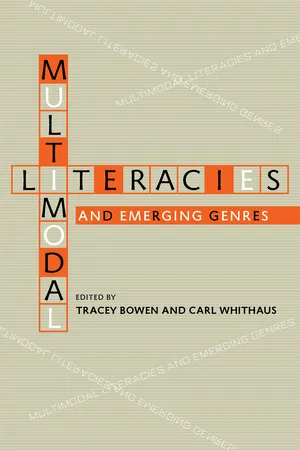
eBook - ePub
Multimodal Literacies and Emerging Genres
- English
- ePUB (mobile friendly)
- Available on iOS & Android
eBook - ePub
Multimodal Literacies and Emerging Genres
About this book
Information
Topic
Lingue e linguisticaSubtopic
Scrittura creativaPART I
Multimodal Pedagogies That Inspire Hybrid Genres
CHAPTER 1
Genre and Transfer in a Multimodal Composition Class
IN SOME OTHER CHAPTER, IN some other collection, a teacher writes about how great her semester went teaching a new syllabus that seemed to have worked extraordinarily well. She details that syllabus and discusses how the assignments were sequenced; she concludes by providing quotes from the students' portfolio reflections to show that they learned a great deal from the class, from her. The reflections would say things like:
When I was a child, I was fascinated by technology. I had an 8-bit Nintendo, built my own computer, and generally geeked out when it came to science and technology. But I wasn't always interested in this stuff. Personally, I blame Ender. I don't know who introduced me to the science fiction novel Ender's Game, but whoever it was inadvertently sparked my love for books, science, and technology. Working on the documentary in English 3040 reminded me of my early school years and my love of technology as a form of expression. As a kid I had a wild imagination, and as a senior in college [when I took 3040] I had a lot of ideas to express. Technology, writing, and good teachers gave me a way to do it. (Excerpt from Tyrell Fenn's design justification, December 2006)
Insert the teacher's glowing reflection of the class and the student. Then the teacher would insert another student reflection, this time moving the argument along toward the multimodal bit she was intending:
Growing up, I was determined to be an inventor. What I wanted was for people to crowd my little cul-de-sac just to get their hands on the only “decorative mud-ball” in town. But since nothing I created had a significant impact on society, I quit the idea and my inventor dreams seemed to be doomed for good, until this class came along, giving me the option to dabble for a grade. My perspective of inventing has grown: Now my idea of invention is still tied to what's important to me right now, but how I invent something to fill that need has changed. For instance, unlike my older sister, who writes and writes and writes in her journal, I get overwhelmed by journal writing, but I love to reminisce and hold onto memories, so camcorders and pictures became my journals. Before I learned how to use programs that made slideshows, I would line pictures up next to each other on the floor, turn on a song in the background, make sure cell phones and pagers were turned down, turn on my parents' oversized camcorder, and record each picture manually. Watching them now, it's comical, but then I thought it was brilliant. (Excerpt from Tia Scoffield Bowen's design justification, December 2006)
That, however, is not this chapter. It would have been if written several years ago. Now, the then-brilliant reflections by the teacher seem comically naïve. She is not such a n00b (newbie) anymore to think that that imaginary version of this chapter would still have been accurate. Instead, this chapter is about a once-upon-a-time, newish tenure-track teacher who misplayed a crucial teaching moment, which spiraled into a misuse of genre, and how she learned to recover and resituate her teaching-research with a genre studies approach. And the students (Tia Scoffield Bowen and Tyrell Fenn) are not trapped in some time-independent “student” status where their design justification statements represent a stagnant contribution to multimodal research. This chapter is now a coauthored piece written by two once-upon-a-time students and their somewhat nutty teacher. All three have moved on from the English 3040 course at Utah State University, and all three have continued to work in multimedia fields. This chapter synthesizes the experience of a multimedia composition course and asks how concepts of genre transfer across multiple boundaries.
A MULTIMODAL COMPOSITION CLASS
The course catalog description for English 3040, Perspectives in Writing and Rhetoric, is “an in-depth study of rhetoric and writing for non-majors” (Peterson 2009–10, 549). Over the three years Cheryl taught this course at Utah State University, she treated it like a special topics class in different forms of multimodal composition, and the genres that students produced were expansive:
(a) websites (i.e., religious travelogues of missionary trips, commercial sites promoting student-run businesses, genealogies, an intranet training site for a local veterinarian's office, and promotional sites for student clubs);
(b) literary hypertexts (poetic, prosaic, and imagistic); and
(c) videos (documentaries, poems, remediated research papers, visual argument slideshows, music videos, etc.).
The course topic—digital narratives—for the fall 2006 term in which Tyrell and Tia were enrolled was purposefully vague because Cheryl did not want students to have to choose from a narrow set of genres as they had done for the e-literature version of the course. Narrative left the generic option open, because Cheryl's hope was that students would produce a range of genres as well as multigenre texts.
Students sometimes resist open-ended assignments, which had been a staple and seemingly successful part of Cheryl's Happenings pedagogy repertoire. She chalked it up to the lack of incense.1 But she had stuck with it because a Happenings pedagogy best explained what she did in her classes and why she did it, and it allowed her to change teaching directions suddenly if needed. This pedagogy is infused with a socioepistemic critical lens (add Berlin 1988 to Sirc 2002, if you will). Geoffrey Sirc would probably approve despite his criticism of composition's epistemic turn and its formation of, in his words, “a compositional canon” where material restraints—that is, what we can and should be producing in writing classes and writing scholarship—are born (Sirc 2002, 7–8). Cheryl doesn't think, as James Berlin (1988, 485) has argued, that an expressive-ish Happenings pedagogy—as Sirc dreams it—is focused solely on “liberating students from the shackles of a corrupt society.” It was Sirc's goal to examine and disrupt the space and materials of composition studies after its epistemic turn, and it is one of Cheryl's pedagogical goals to examine the material, rhetorical conditions in which we compose, while also asking students to produce texts that break out of traditional material restraints. Thus Cheryl combined socioepistemic and Happenings pedagogies, with a little critical, cultural, feminist, multimodal, and other pedagogies thrown in as needed.
As an early tenure-track faculty member in 2006, Cheryl worried that a Happenings pedagogy—one filled with wow and wonder and a want to write, to make meaning—was a thing she should leave to the tenured or the avant-garde. That worry is relevant to this story and yet she is a stubborn, mouthy daughter of Southern women, and she tends to do what she wants when teaching, if there's good justification for doing so. Sirc's pedagogical manifesto oddly justifies the brand of sustainability she was using in the teaching of writing: the recursive nature of teaching, learning, and writing as open, collaborative processes. Because she wants students to compose texts other than those that were typically found in first-year and other writing classrooms in 2006 (and, oh, how things have changed in those intervening years!), she needs to teach in a way so that students can relearn how to compose in media that is new to them as composers (not consumers), using modes of communication that are also new to their compositional wheelhouse.
To prepare students for the English 3040 course, Cheryl spent a good portion of the first day(s) convincing students that the course actually fulfills their writing requirement. In that discussion she didn't refer to the theoretical support for this work, such as the New London Group's Multiliteracies: Literacy Learning and the Design of Social Futures (Cope and Kalantzis 2000) or Gunther Kress and Theo van Leeuwen's (2001) Multimodal Discourse: The Modes and Media of Contemporary Communication. But that foundation is clearly evident in how she introduced students to the idea that none of us communicates only through writing and that written text itself is multimodal in that it carries visual, spatial, and sonic properties every time students type a new letter-character on the page. The course would then launch into a sequence of rhetorical analysis and production, each week covering a different medium. In relation to the 3040 class, here are some examples of modes, media, and genres used:
• modes of communication: linguistic, aural, visual, spatial, gestural, and combinations thereof (see Cope and Kalantzis 2000, 26).
• media: written text, static image, audio, video with only diagenic sound of the shot location, video with soundtracks, other audio, and writing.
• genres: blogged reading response, analog photograph, digital illustration, voiceover, soundtrack, vogs, and video documentaries.2
The syllabus was set up to step students through these progressively more multimodal and multimedia assignments. Although this metaphor was dated to her own process of learning to write before computers, she likened the shift from linguistic to aural to visual modes of communication in these assignments to how students at an early age first learn to write with crayons, then pencils, then pens (and now computers). This progression gave students hands-on practice with the increasingly complicated technologies they would need for their major projects. Once they got to the final project, students could readily see how the added, mediated components were sequenced to prepare them. But the main reason for using this assignment sequence was so that students could spend a week discussing how each medium (writing, audio, video) helped readers understand the text.
At the end of each semester, students indicated their raised awareness of critical and rhetorical (as well as technological) literacies—exhibited in portfolio reflective letters, in-class feedback to the instructor, and narrative course evaluations, as well as in the portfolio of work students submitted. For instance—and regardless that Cheryl promised just paragraphs ago not to rely on years-old student reflective writing to explain her coming to terms with the way she taught multimodal composition classes—Tyrell concludes the design justification of his video documentary about martial arts, “East Meets West,” by hitting nearly all of the teacher's happy-dance words as possible:
In the end, weaving a meaningful narrative using music, images, video, text, and voice really made the assignment worthwhile. The video editing and text creation were important aspects of that process, but it is the people who watch the film—those who may not already love martial arts or understand why or how it came to the States—whom I kept in the forefront of my mind during the composition process. The struggle to accurately represent the views of others forced me to think critically about the way the film would be received and therefore I had to think critically about the various media I was collecting and composing for the documentary. As part of being able to choose my own topic and interview people I knew (and some I didn't know that well), I learned that it's important to frame others' comments in ways that are fair to them while still choosing clips that are interesting to read or see. Ethics became a bigger concern when I knew the people whose words where being represented in my documentary. That's something that may be more difficult to relay (to students, to audiences) when you're dealing with impersonal texts. The creation of a research proposal for the documentary—while not a lot of people's idea of a good time—was a great learning experience that helped me foresee the ethical choices I had to make in the media I used. The proposal allowed me to put what were just ideas down on paper in a way that could be systematically useful to both my professor and me. Even in a narrative text, the research you do can and should change the direction of that text. If I had been unflinching in my drive to sell my message, it is likely that the significance of the message itself would be lost.
One of the biggest lessons I took away from this project was that being given more power over my education (i.e., choosing the genre, focus, and media for my assignments) gives me more motivation to perform. It's something that I knew before but that was emphasized by this assignment. I liked all the other classes I took that semester, but I found myself worrying and working on the documentary in preference to other classes. Also, the assignments that led up to the documentary work focused on one aspect of the documentary process and were great preparation for the final project. For me, the introduction to technologies (such as the audio-editing software) was unnecessary because I've worked with them my whole life, but I can see how it was important to other members of the class, and I was able to help others who needed it if I already knew how to do a particular assignment or task. In the end, the sequence of individual media assignments leading up to our documentary research proposal, storyboard, interviews, and choices in editing the media clips provided me with a process in which I could understand how to ethically compose a multimedia text for a specific audience and purpose.
Tyrell's reflection, however, is not representative of the majority of the students who had been through that iteration of English 3040, nor of Cheryl's previous iterations of the class. Students indicated in their numeric and narrative evaluations that despite the teacher's enthusiasm for the course material, the syllabus lacked organization and focus. This is not an unusual critique for her teaching, and students don't always mean it negatively. One dedicated student referred to her teaching style as “controlled chaos,” which Cheryl knew would not sound appropriate in the rhetorical situation of her impending, third-year tenure review. So she had crafted the digital narrative version of this class (which occurred the semester she was to have her teaching observed in preparation for her third-year review) to turn what students perceived as chaos into what they could recognize as a purposeful yet spontaneous series of events while also unintentionally clamping down on the opportunities Cheryl thought open assignments provided for students. Here's what happened:
When the semester started, students were supposed to choose which genres, or combinations of genres, they wanted to use in their major projects. But the students and teacher discovered about four weeks into class that the experimental design of the syllabus was perhaps too grand in the making. The original syllabus had two major assignments: The first one was purposefully vague so that students could choose which combinations of media and genres they would use, which, as Julie Jung (2005, xi) noted, would help students disrupt their generic “expectations [and] result in expanded and revised points of view,” helping students to “develop the epistemological pliancy one needs to negotiate responsibly in an ever-changing world.”
The second project was an inquiry-based video. Cheryl had been speaking of this second assignment as a narrative documentary, in which she wanted students to use the storytelling techniques they'd learned in the sequenced assignments as a way to frame their documentaries. In negotiating a revised syllabus, students voted to remove the vague assignment in favor of the documentary. There were several reasons for their choice, including that the vague assignment was supposed to be composed in a software program that wasn't yet installed on ...
Table of contents
- Cover Page
- Title Page
- Copyright Page
- Dedication
- Contents
- Acknowledgments
- Introduction. “What Else Is Possible”: Multimodal Composing and Genre in the Teaching of Writing
- Part I. Multimodal Pedagogies That Inspire Hybrid Genres
- Part II. Multimodal Literacies and Pedagogical Choices
- Part III. The Changing Structures of Composition Programs
- Contributors
- Index
Trusted by 375,005 students
Access to over 1.5 million titles for a fair monthly price.
Study more efficiently using our study tools.
Frequently asked questions
Yes, you can cancel anytime from the Subscription tab in your account settings on the Perlego website. Your subscription will stay active until the end of your current billing period. Learn how to cancel your subscription
No, books cannot be downloaded as external files, such as PDFs, for use outside of Perlego. However, you can download books within the Perlego app for offline reading on mobile or tablet. Learn how to download books offline
We are an online textbook subscription service, where you can get access to an entire online library for less than the price of a single book per month. With over 1.5 million books across 990+ topics, we’ve got you covered! Learn about our mission
Look out for the read-aloud symbol on your next book to see if you can listen to it. The read-aloud tool reads text aloud for you, highlighting the text as it is being read. You can pause it, speed it up and slow it down. Learn more about Read Aloud
Yes! You can use the Perlego app on both iOS and Android devices to read anytime, anywhere — even offline. Perfect for commutes or when you’re on the go.
Please note we cannot support devices running on iOS 13 and Android 7 or earlier. Learn more about using the app
Please note we cannot support devices running on iOS 13 and Android 7 or earlier. Learn more about using the app
Yes, you can access Multimodal Literacies and Emerging Genres by Tracey Bowen, Carl Whithaus, Tracey Bowen,Carl Whithaus in PDF and/or ePUB format, as well as other popular books in Lingue e linguistica & Scrittura creativa. We have over 1.5 million books available in our catalogue for you to explore.