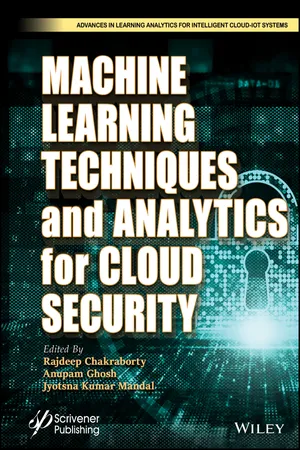
Machine Learning Techniques and Analytics for Cloud Security
eBook - ePub

Machine Learning Techniques and Analytics for Cloud Security

  1. English
  2. ePUB (mobile friendly)
  3. Available on iOS & Android
eBook - ePub

About this book

MACHINE LEARNING TECHNIQUES AND ANALYTICS FOR CLOUD SECURITY

This book covers new methods, surveys, case studies, and policy with almost all machine learning techniques and analytics for cloud security solutions

The aim of Machine Learning Techniques and Analytics for Cloud Security is to integrate machine learning approaches to meet various analytical issues in cloud security. Cloud security with ML has long-standing challenges that require methodological and theoretical handling. The conventional cryptography approach is less applied in resource-constrained devices. To solve these issues, the machine learning approach may be effectively used in providing security to the vast growing cloud environment. Machine learning algorithms can also be used to meet various cloud security issues, such as effective intrusion detection systems, zero-knowledge authentication systems, measures for passive attacks, protocols design, privacy system designs, applications, and many more. The book also contains case studies/projects outlining how to implement various security features using machine learning algorithms and analytics on existing cloud-based products in public, private and hybrid cloud respectively.

Audience

Research scholars and industry engineers in computer sciences, electrical and electronics engineering, machine learning, computer security, information technology, and cryptography.

Trusted by 375,005 students

Access to over 1 million titles for a fair monthly price.

Study more efficiently using our study tools.

Part I
CONCEPTUAL ASPECTS ON CLOUD AND APPLICATIONS OF MACHINE LEARNING

1
Hybrid Cloud: A New Paradigm in Cloud Computing

Moumita Deb* and Abantika Choudhury
RCC Institute of Information Technology, Kolkata, West Bengal, India
Abstract
Hybrid cloud computing is basically a combination of cloud computing with on-premise resources to provide work portability, load distribution, and security. Hybrid cloud may include one public and one private cloud, or it may contain two or more private clouds or may have two or more public clouds depending on the requirement. Public clouds are generally provided by third party vendors like Amazon, Google, and Microsoft. These clouds traditionally ran off premise and provide services through internet. Whereas private clouds also offer computing services to selected user either over the internet or within a private internal network and conventionally ran on-premise. But this scenario is changing nowadays. Earlier distinction between private and public clouds can be done on the location and ownership information, but currently, public clouds are running in on-premise data centers of customer and private clouds are constructed on off premise rented, vendor-owned data centers as well. So, the architecture is becoming complex. Hybrid cloud reduces the potential exposure of sensitive or crucial data from the public while keeping non-sensitive data into the cloud. Thus, secure access to data while enjoying attractive services of the public cloud is the key factor in hybrid cloud. Here, we have done a survey on hybrid cloud as it is one of the most promising areas in cloud computing, discuss all insight details. Security issues and measures in hybrid cloud are also discussed along with the use of artificial intelligence. We do not intend to propose any new findings rather we will figure out some of future research directions.
Keywords: PaaS, SaaS, IaaS, SLA, agility, encryption, middleware, AI

1.1 Introduction

Cloud computing is catering computing services such as storage, networking, servers, analytics, intelligence, and software though the internet on demand basis. We typically have to pay for only for the services we use. IT is a growing industry and catering its service requirement is challenging. On-premise resources are not sufficient always, so leveraging attractive facilities provided by cloud service providers is often required. Typical services provided by cloud computing are Platform as a service (PaaS), Software as a service (SaaS), and Infrastructure as a service (IaaS). But all the clouds are not same and no one particular cloud can satisfy all the customer. As a result, various types of services are emerging to cater the need of any organization. The following are the facilities cater by cloud computing.
  • Scalability: IT services are not restricted to offline resources anymore, online cloud services can do a wonder. Any business can be extended based on the market need through the use of cloud computing services. A client needs almost nothing but a computer with internet connection, rest of the services can be borrowed from cloud vendors. Business can grow according to the requirement. Scalability is the key factor in adoption of any new paradigm. An organization meant for 100 people can be easily scaled up to 1,000 (ideally any number) people with the help of the cloud computing services.
  • Cost: Since cloud provides services pay as you use basis, cost of setting up a business has reduced manifolds. Capital expense in buying server, software, and experts for managing infrastructure is not mandatory anymore; vendors can provide all these services. Cost saving is one of the most lucrative features of cloud computing. Any startup company can afford the cost of the setup price required for the orchestration of public cloud; thus, they can engage their selves exclusively for the development of their business.
  • Speed: Cloud computing helps to speed up the overall functioning of any organization. Several lucrative easy-to-use options are just one click away, so designers and programmers can freely think about their innovations, and as a result, the speed and performance can be enhanced. Moreover, since most of the background hazards are handled by the cloud service providers as a result implementation of any advanced thinking can be made possible quickly and effortlessly.
  • Reliability: Reliability is a key factor where huge data need to handle all the time. Periodic data backup and use of disaster recovery methods helps to increase the data reliability in cloud computing. Also, since space is not a constraint anymore, clients can keep mirrored data. A reliable system often leads to a secure system. Any organizations need to handle huge user centric sensitive data as well as business related data. Maintaining the reliability in the data need several rules and regulations to be enforced.
  • Performance: Improved operation, better customer support, and flexible workplace aid companies to perform better than conventional on-premise system. Amazon helps Car company Toyota to build cloud-based data centers. The company is going to use the behavioral data of the user of the car, and based on that, they will send service and insurance related data [1]. User can also use Facebook or Twitter in their car dashboard. This is only an example; there is lot more. Adaptation of advanced technology excels the performance of existing system as cloud plays a crucial role here.
  • Security: Cloud service providers use many security mechanisms like encryption, authentication of user, authorization, and use of some Artificial Intelligence (AI)–based method to secure their app, data, and infrastructure from possible threats.
A combination of secure open source technologies along with integrated network may be used for secure hybrid cloud deployment like it does in HCDM [16]. But, before deployment, the customer need to determine what type of cloud computing architecture is best suitable. There are three different ways to organize cloud: private, public, and hybrid. Here, we will discuss about hybrid cloud, its benefits, ...

Table of contents

  1. Cover
  2. Table of Contents
  3. Title Page
  4. Copyright
  5. Preface
  6. Part I CONCEPTUAL ASPECTS ON CLOUD AND APPLICATIONS OF MACHINE LEARNING
  7. Part II CLOUD SECURITY SYSTEMS USING MACHINE LEARNING TECHNIQUES
  8. Part III CLOUD SECURITY ANALYSIS USING MACHINE LEARNING TECHNIQUES
  9. Part IV CASE STUDIES FOCUSED ON CLOUD SECURITY
  10. Part V POLICY ASPECTS
  11. Index
  12. End User License Agreement

Frequently asked questions

Yes, you can cancel anytime from the Subscription tab in your account settings on the Perlego website. Your subscription will stay active until the end of your current billing period. Learn how to cancel your subscription
No, books cannot be downloaded as external files, such as PDFs, for use outside of Perlego. However, you can download books within the Perlego app for offline reading on mobile or tablet. Learn how to download books offline
Perlego offers two plans: Essential and Complete
  • Essential is ideal for learners and professionals who enjoy exploring a wide range of subjects. Access the Essential Library with 800,000+ trusted titles and best-sellers across business, personal growth, and the humanities. Includes unlimited reading time and Standard Read Aloud voice.
  • Complete: Perfect for advanced learners and researchers needing full, unrestricted access. Unlock 1.4M+ books across hundreds of subjects, including academic and specialized titles. The Complete Plan also includes advanced features like Premium Read Aloud and Research Assistant.
Both plans are available with monthly, semester, or annual billing cycles.
We are an online textbook subscription service, where you can get access to an entire online library for less than the price of a single book per month. With over 1 million books across 990+ topics, we’ve got you covered! Learn about our mission
Look out for the read-aloud symbol on your next book to see if you can listen to it. The read-aloud tool reads text aloud for you, highlighting the text as it is being read. You can pause it, speed it up and slow it down. Learn more about Read Aloud
Yes! You can use the Perlego app on both iOS and Android devices to read anytime, anywhere — even offline. Perfect for commutes or when you’re on the go.
Please note we cannot support devices running on iOS 13 and Android 7 or earlier. Learn more about using the app
Yes, you can access Machine Learning Techniques and Analytics for Cloud Security by Rajdeep Chakraborty, Anupam Ghosh, Jyotsna Kumar Mandal, Rajdeep Chakraborty,Anupam Ghosh,Jyotsna Kumar Mandal in PDF and/or ePUB format, as well as other popular books in Computer Science & Artificial Intelligence (AI) & Semantics. We have over one million books available in our catalogue for you to explore.