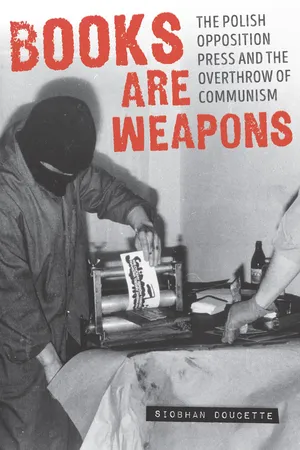
Much attention has been given to the role of intellectual dissidents, labor, and religion in the historic overthrow of communism in Poland during the 1980s. Books Are Weapons presents the first English-language study of that which connected them—the press. Siobhan Doucette provides a comprehensive examination of the Polish opposition's independent, often underground, press and its crucial role in the events leading to the historic Round Table and popular elections of 1989. While other studies have emphasized the role that the Solidarity movement played in bringing about civil society in 1980-1981, Doucette instead argues that the independent press was the essential binding element in the establishment of a true civil society during the mid- to late 1980s.
Based on a thorough investigation of underground publications and interviews with important activists of the period from 1976 to 1989, Doucette shows how the independent press, rooted in the long Polish tradition of well-organized resistance to foreign occupation, reshaped this tradition to embrace nonviolent civil resistance while creating a network that evolved from a small group of dissidents into a broad opposition movement with cross-national ties and millions of sympathizers. It was the galvanizing force in the resistance to communism and the rebuilding of Poland's democratic society.
eBook - ePub
Books Are Weapons
The Polish Opposition Press and the Overthrow of Communism
- English
- ePUB (mobile friendly)
- Available on iOS & Android
eBook - ePub
Books Are Weapons
The Polish Opposition Press and the Overthrow of Communism
About this book
Information
Subtopic
Eastern European HistoryIndex
HistoryPrior to 1976, freedom of expression could only be given; now for the first time people simply took it.
—Stanisław Barańczak
1
GENESIS
THE SUMMER OF 1976 TO THE SUMMER OF 1977
The year 1976 was decisive for the Polish opposition. It was the year that the first long-lasting, widespread independent publishing ventures came into being. Strikingly, this occurred within four milieus: students from the Catholic University of Lublin, activists connected to the Committee for the Defense of Workers, oppositional literary elites, and a group of individuals who would later form the Movement for the Defense of Human and Civil Rights. This multiple birth limited the state’s ability to eradicate publishing, since like a four-headed hydra even if one head was lopped off others remained to sustain further growth. The success of these initial publishing efforts depended on the conjoining of opposition veterans, Poland’s postwar emigration, and a new generation of activists. In just a year the groundwork was laid for the creation of an independent society.
STUDENTS IN LUBLIN
The first printing machine that was smuggled into Poland for independent publishing was brought by a group of students from the Catholic University of Lublin (KUL, Katolicki Uniwersytet Lubelski). In the early 1970s KUL students Janusz Krupski, Piotr Jegliński, and Bogdan Borusewicz agreed to embark on an underground publishing venture.1 These three students had each been raised on Polish national traditions related to the struggle for independence. Krupski was passionate about military history. When he realized that the Polish army was no longer tied to the prewar military traditions he admired, he opted for a career in history.2 Jegliński noted that “already as a child I was infected with history . . . as a fourth- or fifth-generation revolutionary . . . I heard from my family that they conspired, that they were printers in the time of the war, after the war, and so on.”3 Borusewicz (whose father had fought in the Second World War underground) had long been interested in Polish history. He was arrested in 1968 for passing out leaflets about a demonstration to commemorate Poland’s May 3, 1791 Constitution.4
Due to the state’s control of printing materials, the students at first decided to use photography to produce publications. In 1972 Jegliński gained seasonal work in East Germany in order to purchase a camera with which to copy a book. After taking photography classes, Borusewicz and Jegliński photographed a book about the massacres in Katyń during the Second World War. The expense involved in this process was too high for it to become a wide-scale method of reproduction.5
Although Borusewicz, Krupski, and Jegliński were acting alone, due to their access to émigré publications they were not isolated from the ideas of opposition seniors. In 1974 Borusewicz read an article by Jacek Kuroń in the émigré journal Culture; the article had a major impact on his thinking. Poland’s centuries-long tradition of underground organizations and violent uprisings had heretofore fascinated and appealed to Borusewicz (as it did to many of his countrymen). However, he henceforth was convinced by Kuroń’s call for a broad opposition movement that stressed education.6 Borusewicz, Jegliński, and Krupski resolved to create a widespread student group within KUL alongside a small clandestine publishing venture. To that end, they undertook the procurement of a mimeograph from the emigration. In August 1974 Jegliński went to Paris, where the Literary Institute, which published Culture, was based.7
Those at the forefront of the emigration did not endorse the students’ plans. Jerzy Giedroyc and Jan Nowak-Jeziorański, from the Literary Institute, thought that since the government insisted on a monopoly of information, these young people would end up in prison. Nowak-Jeziorański argued that publishing should be left to the emigration.8 Despite Giedroyc’s and Nowak-Jeziorański’s legendary status in Polish opposition circles, the students disregarded their concerns.
Jegliński obtained employment in a restaurant to earn money with which to buy a printer to send to his friends in Poland. In the spring of 1976 Jegliński purchased a small mimeograph that could produce about a hundred copies at a time. He brought it to London, where Wit Wojtowicz, a fellow student from KUL, was participating in an international theater week with the KUL academic theater. Wojtowicz smuggled the printer to Krupski in May 1976 with the theater’s luggage. Years later, Wojtowicz remembered the anxious train trip, during which he sat on part of the machine, which had been disassembled to smuggle it past Poland’s border guards. He reminisced that when he disembarked from the train, Krupski was waiting for him; Wojtowicz nodded that he had the machine, and Krupski broke into a smile.9
The students in Lublin found their opposition seniors in Poland as unsupportive of their plans as the emigration, yet they persisted. Krupski contacted Jacek Kuroń about using a printer (not explaining that they already had one). Kuroń argued that a printer was clearly breaking the law and so would be perceived as a provocation. He believed that samizdat techniques (which were predicated on typing rather than printing) were sufficient and that if something needed to be broadcast further, it could be done through Radio Free Europe, which was widely listened to in Poland, and for which Kuroń was the primary contact in Poland. Undeterred, the students printed a couple of copies of George Orwell’s banned book Animal Farm. Although these were largely illegible, they provided the students with practice in using the machine.10
THE COMMITTEE FOR THE DEFENSE OF WORKERS
The breakthrough in printing came with the formation of the Committee for the Defense of Workers (KOR, Komitet Obrony Robotników). Thanks to KOR, the democratic opposition gained an open organization and a focus for activism. It was KOR that created the first long-lasting independent serials as well as a network for their production and dissemination.
In June 1976 worker strikes and protests erupted across Poland, notably in Radom and Ursus (on the outskirts of Warsaw) in response to the government’s announcement of dramatic price hikes on basic foodstuffs. The state harshly cracked down on the workers involved; as many as twenty thousand lost their jobs, while six thousand were arrested. Physical abuse was used to break the strikes and protests as well as during interrogations. Of the approximately 2,500 workers detained in the immediate aftermath, over 350 were sentenced in summary hearings to jail and had heavy fines imposed.11
Democratic opposition activists Antoni Macierewicz and Jacek Kuroń agreed that concrete help had to be given to the workers. Soon thereafter, the state authorities had Kuroń drafted into the army for reservist training. Macierewicz and other sympathetic intellectuals made contact with workers’ families from Ursus, while additional intellectuals went to Radom to help workers there. Money was collected for the workers. Several activists agreed to form a committee.12
On September 23, 1976, fourteen intellectuals created the Committee for the Defense of Workers to provide legal, financial, and medical aid to those workers being punished by the state.13 Jacek Kuroń, Jan Józef Lipski, and Antoni Macierewicz were at the forefront. KOR broke with previous opposition efforts in a variety of ways. First, it was not avowedly oppositional; rather it was conceived as a social self-defense group and legally justified its actions by referencing the Helsinki Accords.14 Second, KOR was not clandestine; it published the names of all the signatories. This method of openness was a turning point. Although only a limited number of people were actual KOR signatories, a larger number of individuals cooperated with these signatories, making KOR a pluralistic milieu rather than a structured organization. Third, those who were unable or afraid to actively participate could contribute to KOR financially. By focusing on the specific goal of aiding workers from the 1976 protests, KOR attracted individuals from various democratic opposition discussion groups. Bridging generation gaps, KOR signatories included younger people, who tended to be its most energetic activists, as well as older regime opponents who lent their prestige. KOR also spanned political divisions. KOR was often treated as a left-wing milieu; although the majority of its signatories, including Jacek Kuroń, identified with socialism, KOR also contained a minority aligned with Antoni Macierewicz who did not so identify.15
The dissemination of information was focal to KOR. Even before KOR’s founding, on September 7, 1976, a group of future KOR activists met to discuss the production of publications. Disagreements over the use of printers occurred, reflecting what would become the main division within KOR. Antoni Macierewicz endorsed the use of printers, arguing that because workers did not have typewriters, retyping was elitist. In contrast, Jacek Kuroń favored typing as he believed that it helped with distribution, was practically simpler (since the central collection of supplies and printing machines seemed impossible), and would not provoke immediate state repression. Kuroń won the debate. KOR’s initial publications were produced with samizdat printing techniques.16
KOR created Poland’s first enduring independent serials. Although KOR activists had already produced flyers about the workers’ strikes and ensuing state repression, on September 29, 1976, the first KOR serial, Communique, appeared. Also in September KOR began producing Information Bulletin. Against all odds, both KOR’s Communique and Information Bulletin lasted into the 1980s. Information Bulletin extolled its recipients to “read it, copy it, and pass it on.”17 For each issue several copies were typed on onion skin through carbon paper. These were then distributed to friends and colleagues, who in turn were obliged to make copies to pass on. This process was repeated with each new recipient. Within a couple of months this method of production and distribution was running effectively, largely within intellectual circles.18 KOR’s serials were not therefore at first produced differently from the samizdat works that had been produced regularly in the Soviet Union from the 1960s.19

The content of KOR’s Communique and Information Bulletin developed in different directions. Communique was a newsletter that provided concise factual information on state repression and KOR’s activities in response to repression, as well as KOR announcements and the list of KOR signatories with their addresses and phone numbers. It appeared more or less monthly and was several pages long. The articles were unsigned and were intended as the unbiased voice of KOR. Information Bulletin was a regular monthly periodical with an initial length of about five to sixteen single-spaced pages. The first issue of Information Bulletin explained, “the aim of the bulletin is to break the state information monopoly, protected by existing censorship.”20 Although state repression as well as support for the oppressed remained its emphasis, Information Bulletin gradually moved beyond these topics. In January 1977 a polemics section and information on the international scene were included; Information Bulletin also published reprints from Western news sources.
Mirroring KOR’s transparency, KOR’s publications were groundbreaking in their openness. Communique and Information Bulletin, by reporting on state repression, required original reporting; this meant going to courthouses and workers’ homes. A special edition of Information Bulletin in February 1977 included two signed articles, and in March 1977 the editors (Joanna Szczęsna, Seweryn Blumsztajn, and Jan Lityński) were named. The editorial board was publicized after a house search of Lityński and the short-term arrest of the editorial board showed that secrecy was immaterial.21
INDEPENDENCE CURRENT
In 1976, Independence Current (NN, Nurt Niepodległościowy) coalesced as an underground milieu whose adherents actively sought independence. The leaders were Leszek Moczulski and Andrzej Czuma. Moczulski reflected that not only family traditions played a role in his oppositional activism but also personal memories of September 1939.22 Czuma, whose father was a professor at KUL, credited morality as well as family traditions for his decision to actively oppose the regime.23 Independence Current linked Moczulski, Czuma, and his former colleagues in Movement, as well as individuals from various discussion groups, notably a youth discussion group in Gdansk. In 1971 the Dominican Father Ludwik Wiśniewski had begun, through the academic ministry, to hold meetings with students in Gdansk. He introduced these students to a number of senior regime opponents, including Moczulski and Czuma, with whom several of these students cooperated from 1976.24
In the summer of 1976 Piotr Dyk, a student from Gdansk, who had been given credentials from Andrzej Czuma to obtain a printer from the emigration, was on vacation in France. Jerzy Giedroyc gave Dyk several dozen books by the Literary Institute and a mimeograph to deliver to Czuma. In September 1976 Dyk put these gifts into two backpacks and went to Czechoslovakia, where he handed them over to fellow students who were to carry the supplies across the Czechoslovak-Polish border. When inclement weather hit, they hid the backpacks in the mountains and crossed the border legally. A few days later Dyk, with his colleague Aleksander Hall, retrieved the equipment, which they then handed over to those from Independence Current, who in October 1976 began publishing At the Threshold.25
At the Threshold was the first independent periodical produced with a printing machine. Mirroring NN’s secrecy, neither editors (Emil Morgiewicz, Jacek Wegner, Krystian Brodacki, and Adam Wojciechowski) nor authors signed their names. Secrecy was so crucial that editorial meetings were held in a car to avoid bugging, and the editors never knew where the mimeograph was kept. While KOR’s publications tended to focus on government repression and intellectuals’ responses, At the Threshold was more polemic and avowedly antistate.26 Twelve issues were printed, which numbered between four and thirteen pages with print runs of about a thousand. When Czuma took a copy of the first issue to Jacek Kuroń in the fall of 1976, Kuroń maintained his opposition to the use of printing machines. At the Threshold remained in print until the mimeograph broke in the fall of 1977.27
RECORD
The idea for an independent literary journal came under consideration within democratic opposi...
Table of contents
- Cover Page
- Title Page
- Copyright Page
- Dedication
- Contents
- Acknowledgments
- Translations
- Introduction
- 1. Genesis: The Summer of 1976 to the Summer of 1977
- 2. Spread: The Summer of 1977 to the Summer of 1980
- 3. Tactics: 1978–1979
- 4. Burst: The Summer of 1980
- 5. Proliferation: September 1980 to December 13, 1981
- 6. The First Solidarity National Congress, 1981
- 7. Survival: Martial Law, December 1981 to July 1983
- 8. Crisis and Transition: The Mid-1980s
- 9. Pluralism: Late 1986 to 1988
- 10. Victory
- Conclusion
- Notes
- Selected Bibliography
- Index
Trusted by 375,005 students
Access to over 1.5 million titles for a fair monthly price.
Study more efficiently using our study tools.
Frequently asked questions
Yes, you can cancel anytime from the Subscription tab in your account settings on the Perlego website. Your subscription will stay active until the end of your current billing period. Learn how to cancel your subscription
No, books cannot be downloaded as external files, such as PDFs, for use outside of Perlego. However, you can download books within the Perlego app for offline reading on mobile or tablet. Learn how to download books offline
Perlego offers two plans: Essential and Complete
- Essential is ideal for learners and professionals who enjoy exploring a wide range of subjects. Access the Essential Library with 800,000+ trusted titles and best-sellers across business, personal growth, and the humanities. Includes unlimited reading time and Standard Read Aloud voice.
- Complete: Perfect for advanced learners and researchers needing full, unrestricted access. Unlock 1.5M+ books across hundreds of subjects, including academic and specialized titles. The Complete Plan also includes advanced features like Premium Read Aloud and Research Assistant.
We are an online textbook subscription service, where you can get access to an entire online library for less than the price of a single book per month. With over 1.5 million books across 990+ topics, we’ve got you covered! Learn about our mission
Look out for the read-aloud symbol on your next book to see if you can listen to it. The read-aloud tool reads text aloud for you, highlighting the text as it is being read. You can pause it, speed it up and slow it down. Learn more about Read Aloud
Yes! You can use the Perlego app on both iOS and Android devices to read anytime, anywhere — even offline. Perfect for commutes or when you’re on the go.
Please note we cannot support devices running on iOS 13 and Android 7 or earlier. Learn more about using the app
Please note we cannot support devices running on iOS 13 and Android 7 or earlier. Learn more about using the app
Yes, you can access Books Are Weapons by Siobhan Doucette,Siobahn Doucette in PDF and/or ePUB format, as well as other popular books in History & Eastern European History. We have over 1.5 million books available in our catalogue for you to explore.