In preparation for this book, and to better understand our screen-based, digital world, Miller only accessed information online for seven years.
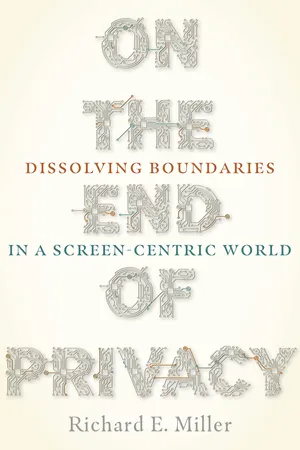
On the End of Privacy explores how literacy is transformed by online technology that lets us instantly publish anything that we can see or hear. Miller examines the 2010 suicide of Tyler Clementi, a young college student who jumped off the George Washington Bridge after he discovered that his roommate spied on him via webcam. With access to the text messages, tweets, and chatroom posts of those directly involved in this tragedy, Miller asks: why did no one intervene to stop the spying? Searching for an answer to that question leads Miller to online porn sites, the invention of Facebook, the court-martial of Chelsea Manning, the contents of Hillary Clinton's email server, Anthony Weiner's sexted images, Chatroulette, and more as he maps out the changing norms governing privacy in the digital age.
- English
- ePUB (mobile friendly)
- Available on iOS & Android
eBook - ePub
About this book
Information
Subtopic
LiteracyChapter One
On Chance, Distraction, and the Prepared Mind
Starting Over
I didn’t have a particular topic in mind when I decided to take a break from paper-based publishing. I just had a vague sense I would use my blog, text2cloud, as a place to think about the emergence of the screen-centric world. From the start, my research question was—and remains—big, baggy, unmanageable: What happens when text moves into the cloud? Before I launched text2cloud.com in 2010, I’d spent a couple of years traveling the country giving talks about how the shift from a paper-based to a screen-centric world was wreaking havoc on the institutions, industries, and social structures that shape how we live and interact. Pick any area of public life—government, military service, homeland security, police protection, banking, commerce—and I could point to profound changes set in motion by mass data collection and mass data leaks. So too in the realm of private life, I could talk about how smart phones and the always-on, interactive Web were changing how we date, make friends, and entertain ourselves; how we are intimate; how we experience the passage of time; how we remember and how we forget. And, with regard to education, I could speak at length about how the technological developments were changing what we learn, how we learn, where we learn, when we learn, and how we show that we’ve learned.
I could see that the trend of all these big picture changes was toward the end of privacy, as more and more data were being accumulated about more and more of us about more and more aspects of our lives—how we shop; what our musical tastes are; what networks of friends we have; and what we search for when we think no one is looking. I could see the significance of these changes at the macro level, but I didn’t really have much of an understanding of how to contend with these issues at the micro level of the individual. I could, for example, talk about how these changes were redefining childhood, but back home, as I would watch my kids gaming on their devices, lost in the rush of computer-generated imagery that seemed more real than reality itself, I had no way of knowing whether there was cause for concern. I would listen as my kids avidly discussed fanfic, RPGs, and AI, only barely able to follow the strings of acronyms and code words. And I marveled at the funky used clothes they’d purchase online, not quite sure what PayPal was, or eBay, or Etsy, or how, really, there was money to be made in running what seemed to be a twenty-four-hour global yard sale. At home, at school, and in the news, there was this endless swirl of digital activity and a running soundtrack of references to memes, YouTube videos, social media, and file-sharing. I could see all these changes—who couldn’t? The evidence was everywhere. But I didn’t know how to get my thoughts about that evidence off the page and onto the Web.
In a word, Dear Reader, I could not post. I could not self-publish. I could not self-promote. And, eventually, the hypocrisy of depending on others to manage my “online presence” became too much for me to bear. If I was going to teach students who were sitting in classes in the twenty-first century how to write for the most powerful publishing network humans have ever created, I’d better learn how to do so myself.

But, where to begin?
I took a seat before my computer, opened my browser, placed my cursor in the search engine box, and waited.
On the other side of that flashing line, the mystery of mysteries. There was anything and everything. Or so I’d been told. And so, I am certain, I must’ve told others.
Blink. Blink.
Or there was nothing.
Nothing but lies. Conspiracy theories. Porn.
Nothing.
And no one to be trusted.
Early in my graduate education, I had a brilliant, quirky teacher who had no patience for the topic sentence. She was exasperated by all the formulaic writing students had been compelled to generate over the years in the service of the topic sentence’s mandatory stance of certainty. Topic sentence pedagogy, one might say, promotes the idea that writing’s principle function is to provide skimmable business reports for busy executives. It values order over insight and, leaving nothing to chance, drives the reader from one evidence-based certainty to the next, bullet by bullet. But “chance,” my teacher declared more than once, “chance favors the prepared mind.”
I was immediately taken with this phrase the first time I heard her say it, and I have quoted it many times since as a shorthand explanation for the essential role serendipity plays in the composing process as I experience it. And over those many years and many repeated citations, I’ve always attributed the saying to a certain famous American Transcendentalist because, well, that’s the way I remembered it and it certainly seemed like something he would have written out in his cabin in Massachusetts.
Imagine my surprise, just now, when I discovered, after typing the phrase into my search engine, that for the past three decades I have been attributing it to the wrong person! It wasn’t the Transcendentalist, alone with his thoughts, quill in hand; it was Louis Pasteur, the chemist whose name is now synonymous with food safety. My first reaction to this discovery was, “Well, there goes my explanation for how I came to spend seven years writing about suicide, voyeurism, and the end of privacy.” But then, digging a little deeper, and with some assistance from Google Translate, I realized that Pasteur’s observation, read in context, offers an even better explanation for how my effort to learn how to read and write using twenty-first-century tools turned into a series of meditations on a young college student’s decision to have the penultimate act of his life be updating his Facebook status to read: “jumping off the gw bridge sorry.”
So, here’s the story.
Louis Pasteur is making his first dean’s address to the science faculty at the newly created University of Lille on December 7, 1854. With the university about to welcome its first class, Dean Pasteur chooses to speak to his faculty about the school’s pedagogical principles. He warns the teachers that there will be constant pressure from outside the school to have the students pursue only research that has clear, and preferably immediate, application for business and industry. Rejecting the idea that education is exclusively for vocational ends, Pasteur argues for an educational approach that “ignites the student’s curiosity and interest,” where all students, regardless of their future employment plans, learn how to think like scientists.
Pasteur warns his teachers they will need to be prepared to defend the value of pursuing scientific research that has no obvious, immediate revenue-generating application. He quotes Ben Franklin who, after demonstrating a “purely scientific discovery,” responded to an observer’s skeptical question, “but what purpose does it serve?” with a question of his own: “What purpose does a newborn child serve?”1
Pasteur then asks his faculty: “Do you know when, exactly, the electric telegraph, one of the most marvelous applications of modern science, first saw the light of day?” After a suitable pause, he continues, “It was in the memorable year of 1822.”2
In that year the Swedish3 physicist and chemist Hans Christian Ørsted ran a battery-powered current through a copper wire near a magnetized needle. Ørsted “suddenly saw, (by chance, you may say, but remember that in the fields of observation chance favors only the prepared mind), he saw all of the sudden the magnetized needle move and point in a direction very different from the one assigned to it by the earth’s magnetic field.” This was the moment, Pasteur maintains, the telegraph was born. But—and this is the point of Pasteur’s extended anecdote—no one knew it at the time: “But what purpose did it serve? Almost twenty years passed before Ørsted’s discovery gave rise to this practical application, nearly supernatural in its effects, of the electric telegraph.”
So chance doesn’t always favor the prepared mind, as I’d been saying for some three decades. The mind in question has to be working in an area where observation is essential. And then the mind working in that area has to be prepared to be surprised. And then, only if the prepared mind observes, is patient and vigilant, it is possible—it just might happen—that something comes into view that may turn out to be important at some time in the future. And whatever that unexpected thing might be and whatever form it might take, the prepared mind has to be open to the possibility that the importance of this unexpected observation might not be clear for a while or for a long time or, perhaps, maybe even ever.
The prepared mind has to know that discoveries don’t arrive wrapped in topic sentences; they manifest as nagging questions, confusing data; they can be cloaked in the ordinary. For skeptics and funders interested only in research with immediate applications, this inconvenient fact about the nature of open-ended thinking is dismissed as a luxury and an indulgence; for bean counters and bureaucrats, it’s just an excuse for low productivity. But for writers who want to think new thoughts, this fact is the foundation for the possibility of slipping the confines of the already known and the already said.
Publishing State Secrets
So, back to me.
There I was, sitting at my desk, a few months into my break from academic publishing. I’d started out looking into the technical hurdles Daniel Ellsberg encountered once he’d decided to leak the Pentagon Papers in 1971. Since Bradley Manning and WikiLeaks were so much in the news over the summer of 2010, reminding myself of what Ellsberg had done seemed like as reasonable a place as any to start an exploration into the differences between the paper-based and the screen-centric worlds.
To make the Pentagon’s multivolume top secret report on the history of covert operations in Vietnam available to the public, Ellsberg first had to get its more than seven thousand pages out of the RAND Corporation’s headquarters in Santa Monica, California, where he worked with the team that originally crafted the report. In October 1969 Ellsberg began moving the report, section by section, from the safe in his office to his briefcase; he then walked the briefcase past security, got in his car, and drove to an offsite copy machine. There Ellsberg and his collaborators worked through the night, collating the copies, and then, early the next morning, Ellsberg would put the original pages back in the briefcase, get in his car, drive back to the RAND Corporation, walk the briefcase back past security, and return the removed section to the safe.
In November 1969 Ellsberg boarded a plane with a portion of the report, flew across the country, and hand-delivered the copied section to Senator William Fulbright. Fulbright contacted the Secretary of Defense, Melvin Laird, requesting that the documents be officially released to him. Laird declined the request.
A year passed.
The war dragged on.
Ellsberg reached out to other senators.
More time passed.
Frustrated by his inability to get the government to respond, Ellsberg contacted Neil Sheehan, a reporter at the New York Times in March 1971. They met in Boston, and Ellsberg made another copy of the entire set of the papers to hand over to Sheehan.
On June 13, 1971, the Times published its first installment on the history of America’s covert operations in Vietnam, as detailed in the Pentagon Papers.
And then, twenty months after Ellsberg began moving the papers out of his office, all hell broke loose.
Ellsberg was arrested.
And this, improbably enough, set in motion the events that led to Richard Nixon’s resignation as president of the United States in August 1974. On September 3, 1971, Nixon’s “special investigations unit,” code-named “The Plumbers,” broke into Ellsberg’s psychiatrist’s office and, using a crowbar, pried open the drawers of the psychiatrist’s file cabinet, hoping to find notes on Ellsberg’s experience in psychoanalysis.
Why?
Because Nixon wanted to pry his way into Ellsberg’s mind and get hold of Ellsberg’s secrets—the dirtier the better—so he could discredit the whistleblower. And the only way he could get his hands on Ellsberg’s private thoughts—his dreams, his fantasies, his anxieties, his fears—was via a crowbar.
Dr. Fielding’s damaged file cabinet has been preserved by the Smithsonian National Museum of American History. In its mute physicality, it memorializes Nixon’s gross abuse of governmental power.
On May 11, 1973, on the eighty-ninth day of Ellsberg’s trial for espionage, theft, and conspiracy, Judge William Bryne Jr. declared a mistrial and dismissed all charges against Ellsberg and his codefendant, Anthony Russo Jr. The trial’s shocking conclusion was triggered by a revelation about the government’s misconduct that came out in two stages. First, two days prior to dismissal, evidence was presented at trial that established the FBI had illegally tapped Ellsberg’s phone. And then, on the day the case was dismissed, the prosecution stated, for the record, that the government records of those illegally recorded phone calls had been lost.
The fact of the crowbarred file cabinet and declaration that the file folders containing the paper transcripts of the illegal wiretaps were missing had, in Bryne’s judgment, made a fair trial impossible. And, just like that, Ellsberg and Russo were free men.
Fast-forward to April 5, 2010.
Everything in the rearview mirror seems to slow to a crawl. The copier scans a page, a copy eases its way into tray number one. A suitcase is filled weeks later. Ellsberg gets on an airplane and flies from the West Coast to the East Coast. Two years later the Plumbers fly from the East Coast to the West Coast. They have surveillance gear supplied by the FBI: defective walkie-talkies, a small camera, a glass cutter. They have a crowbar.
On April 5, 2010, WikiLeaks, the brainchild of Julian Assange, released two videos, both entitled “Collateral Murder,” one a thirty-eight-minute classified video clip from the gun-sight of a U.S. military Apache helicopter on patrol over Baghdad and the other an edited seventeen-minute version of the same clip. The footage “clearly shows” the helicopter gunners killing unarmed civilians, including a person later identified as a journalist and the people who had come to the journalist’s rescue.
Over the next twenty-four hours, the video began to rack up tens of thousands of views on the WikiLeaks site and on YouTube; a Pentagon official, “speaking on condition of anonymity,” confirmed the legitimacy of the footage; and the hunt was on to find the source of this damaging leak.
Eventually, that search would lead to Specialist Bradley Manning, an army intelligence analyst stationed outside Baghdad who had initiated contact with WikiLeaks early in January 2010. Before making contact, Manning copied nearly 500,000 documents from two databases onto a single CD, which he labelled “Lady Gaga.” He subsequently transferred this information to an SD card, placed this fingernail-sized card in his digital camera, and at the end of January, carried the camera and the card with him to the United States for shore leave. Stateside, Manning reached out to the Washington Post and the New York Times to discuss releasing the documents. Getting no response, he uploaded all the documents to WikiLeaks on February 3, 2010. Near the end of the month, he uploaded the Apache helicopter footage. And then on April 10 he passed on an additional 250,000 diplomatic cables.
Manning was arrested on May 27, 2010, and sentenced to thirty-five years in prison on August 21, 2013, for espionage and theft and a host of other charges.
Side by side these two stories about divulging state secrets capture, in miniature, what the shift from the paper-based to the screen-centric world makes possible. On the one side we have the slow movement of physical files and the eventual decision by the news media to reveal the existence of the military’s classified, carefully crafted history of covert operations in Vie...
Table of contents
- Cover Page
- Title Page
- Copyright Page
- Dedication
- Contents
- Preface. Goodbye to All That
- Acknowledgments
- Chapter One. On Chance, Distraction, and the Prepared Mind
- Chapter Two. On the Persistence of the Digital Past
- Chapter Three. On Willful Ignorance
- Chapter Four. On the Private Pleasures of Looking
- Chapter Five. On Getting Caught in the Act
- Chapter Six. On the Mundanity of Cruelty
- Chapter Seven. On Virtual Communities and Embodied Realities
- Chapter Eight. On Viewing Parties
- Chapter Nine. On Suicide
- Chapter Ten. On Bullies, Bullying, and Fault-Finding
- Chapter Eleven. On Guilt
- Chapter Twelve. On Meaningfulness
- Coda. On Already Out-of-Date Updates
- Bibliography by Chapter
- Index
Trusted by 375,005 students
Access to over 1.5 million titles for a fair monthly price.
Study more efficiently using our study tools.
Frequently asked questions
Yes, you can cancel anytime from the Subscription tab in your account settings on the Perlego website. Your subscription will stay active until the end of your current billing period. Learn how to cancel your subscription
No, books cannot be downloaded as external files, such as PDFs, for use outside of Perlego. However, you can download books within the Perlego app for offline reading on mobile or tablet. Learn how to download books offline
Perlego offers two plans: Essential and Complete
- Essential is ideal for learners and professionals who enjoy exploring a wide range of subjects. Access the Essential Library with 800,000+ trusted titles and best-sellers across business, personal growth, and the humanities. Includes unlimited reading time and Standard Read Aloud voice.
- Complete: Perfect for advanced learners and researchers needing full, unrestricted access. Unlock 1.5M+ books across hundreds of subjects, including academic and specialized titles. The Complete Plan also includes advanced features like Premium Read Aloud and Research Assistant.
We are an online textbook subscription service, where you can get access to an entire online library for less than the price of a single book per month. With over 1.5 million books across 990+ topics, we’ve got you covered! Learn about our mission
Look out for the read-aloud symbol on your next book to see if you can listen to it. The read-aloud tool reads text aloud for you, highlighting the text as it is being read. You can pause it, speed it up and slow it down. Learn more about Read Aloud
Yes! You can use the Perlego app on both iOS and Android devices to read anytime, anywhere — even offline. Perfect for commutes or when you’re on the go.
Please note we cannot support devices running on iOS 13 and Android 7 or earlier. Learn more about using the app
Please note we cannot support devices running on iOS 13 and Android 7 or earlier. Learn more about using the app
Yes, you can access On the End of Privacy by Richard E. Miller in PDF and/or ePUB format, as well as other popular books in Languages & Linguistics & Literacy. We have over 1.5 million books available in our catalogue for you to explore.