Political participation rates have declined steadily in Mexico since the 1990s. The decline has been most severe among the poor, producing a stratified pattern that more and more mirrors Mexico's severe socioeconomic inequalities. Poverty of Democracy examines the political marginalization of Mexico's poor despite their key role in the struggle for democracy.
Claudio A. Holzner uses case study evidence drawn from eight years of fieldwork in Oaxaca, and from national surveys to show how the institutionalization of a free-market democracy created a political system that discourages the political participation of Mexico's poor by limiting their access to politicians at the local and national level. Though clean elections bolster political activity, Holzner shows that at the local level, and particularly in Mexico's poorest regions, deeply rooted enclaves of authoritarianism and clientelism still constrict people's political opportunities.
To explain this phenomenon, Holzner develops an institutional theory in which party systems, state-society linkages, and public policies are the key determinants of citizen political activity. These institutions shape patterns of political participation by conferring and distributing resources, motivating or discouraging an interest in politics, and by affecting the incentives citizens from different income groups have for targeting the state with political activity.
Holzner's study sheds light on a disturbing trend in Latin America (and globally), in which neoliberal systems exacerbate political and economic disparities and create institutions that translate economic inequalities into political ones.
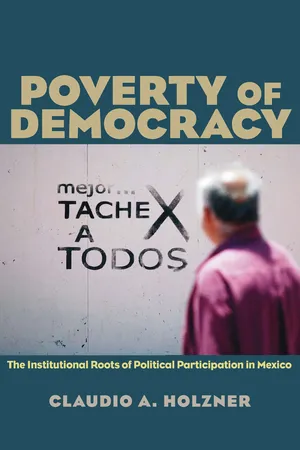
eBook - PDF
Poverty of Democracy
The Institutional Roots of Political Participation in Mexico
- 302 pages
- English
- PDF
- Available on iOS & Android
eBook - PDF
About this book
Information
Subtopic
Mexican HistoryIndex
HistoryTable of contents
- Contents
- Preface
- Chapter 1: The Return of Institutions: Political Opportunities and Political Participation
- Chapter 2: Toward an Institutional Theory of Political Participation
- Chapter 3: Neoliberal Reforms, the State, and Opportunities for Political Participation
- Chapter 4: Political Institutions, Engagement, and Participation
- Chapter 5: Uneven and Incomplete Democratization in Mexico
- Chapter 6: Democratization, Political Competition, and Political Participation
- Chapter 7: Political Equality and Democracy in Mexico
- Appendix A. Survey Questions and Variables
- Appendix B. Regression Results
- Notes
- Bibliography
- Index
Trusted by 375,005 students
Access to over 1.5 million titles for a fair monthly price.
Study more efficiently using our study tools.
Frequently asked questions
Yes, you can cancel anytime from the Subscription tab in your account settings on the Perlego website. Your subscription will stay active until the end of your current billing period. Learn how to cancel your subscription
No, books cannot be downloaded as external files, such as PDFs, for use outside of Perlego. However, you can download books within the Perlego app for offline reading on mobile or tablet. Learn how to download books offline
Perlego offers two plans: Essential and Complete
- Essential is ideal for learners and professionals who enjoy exploring a wide range of subjects. Access the Essential Library with 800,000+ trusted titles and best-sellers across business, personal growth, and the humanities. Includes unlimited reading time and Standard Read Aloud voice.
- Complete: Perfect for advanced learners and researchers needing full, unrestricted access. Unlock 1.5M+ books across hundreds of subjects, including academic and specialized titles. The Complete Plan also includes advanced features like Premium Read Aloud and Research Assistant.
We are an online textbook subscription service, where you can get access to an entire online library for less than the price of a single book per month. With over 1.5 million books across 990+ topics, we’ve got you covered! Learn about our mission
Look out for the read-aloud symbol on your next book to see if you can listen to it. The read-aloud tool reads text aloud for you, highlighting the text as it is being read. You can pause it, speed it up and slow it down. Learn more about Read Aloud
Yes! You can use the Perlego app on both iOS and Android devices to read anytime, anywhere — even offline. Perfect for commutes or when you’re on the go.
Please note we cannot support devices running on iOS 13 and Android 7 or earlier. Learn more about using the app
Please note we cannot support devices running on iOS 13 and Android 7 or earlier. Learn more about using the app
Yes, you can access Poverty of Democracy by Claudio A. Holzner in PDF and/or ePUB format, as well as other popular books in History & Mexican History. We have over 1.5 million books available in our catalogue for you to explore.