Frente a la creencia generalizada de que la violencia organizada experimenta un declive continuo a lo largo de la historia, este libro ofrece un análisis sociológico en profundidad que revela que, en realidad, va en aumento. Malesevic demuestra que la violencia está determinada por la capacidad organizativa, la penetración ideológica y la microsolidaridad, más que por las tendencias biológicas, lo que significa que, a pesar de que las sociedades premodernas están expuestas a espectáculos de crueldad y tortura, no cuentan con los medios organizativos necesarios para matar sistemáticamente a millones de personas. El autor sugiere que la violencia no solo debe analizarse como un acontecimiento o un proceso, sino también a través del cambio en la percepción de esos acontecimientos y procesos. Y expone su argumento principal en torno a la proliferación de la violencia organizada a partir de la vinculación de esta cuestión con otras transformaciones sociales más amplias que se producen en el ámbito de las relaciones entre entidades políticas o entre grupos. Este libro, que se centra en las guerras, las revoluciones, los genocidios y el terrorismo, muestra cómo las organizaciones sociales modernas utilizan la ideología y la microsolidaridad para movilizar el apoyo popular en favor de la violencia a gran escala.
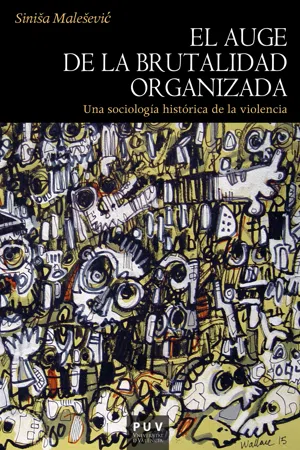
eBook - ePub
El auge de la brutalidad organizada
Una sociología histórica de la violencia
- 426 pages
- English
- ePUB (mobile friendly)
- Available on iOS & Android
eBook - ePub
El auge de la brutalidad organizada
Una sociología histórica de la violencia
About this book
BIBLIOGRAFÍA
ALEXANDER, J. (2004a): «Toward a theory of cultural trauma», en J. C. Alexander, R. Eyerman, B. Giesen, N. J. Smelser y P. Sztompka (eds.): Cultural Trauma and Collective Identity, Berkeley, University of California Press, pp. 1-30.
ALEXANDER, J. (2004b): «From the depths of despair: performance, counterperformance, and “September 11”», Sociological Theory, 22 (1), pp. 88-105.
ALEXANDER, J. (2011): Performance and Power, Cambridge, Polity Press [Trad. esp.: Poder y performance, Madrid, CIS, 2017].
ALLWORTH, E. (1967): Central Asia: A Century of Russian Rule, Nueva York, Columbia University Press.
ALPEROVITZ, G. (1995): The Decision to Use the Atomic Bomb, Nueva York, Knopf.
ANDERSON, F. y A. CAYTON (2005): The Dominion of War: Empire and Liberty in North America, 1500-2000, Nueva York, Viking.
ANDRESKI, S. (1968): Military Organization and Society, Londres, Routledge & Paul.
ARCHER, M. (2000): Being Human: The Problem of Agency, Cambridge, Cambridge University Press.
ARDREY, R. (1976): The Hunting Hypothesis: A Personal Conclusion Concerning the Evolutionary Nature of Man, Nueva York, Atheneum.
ARENDT, H. (1970): On Violence, Nueva York, Harvest [Trad. esp.: Sobre la violencia, Madrid, Alianza Editorial, 2005].
ARMSTRONG, J. (1982): Nations before Nationalism, Chapel Hill, University of North Carolina Press.
ARRIGHI, G. (1994): The Long Twentieth Century: Money, Power, and the Origins of Our Times, Londres, Verso [Trad. esp.: El largo siglo XX: dinero y poder en los orígenes de nuestra época, Madrid, Akal, 2014].
ATRAN, S. (2010): Talking to the Enemy: Violent Extremism, Sacred Values, and What It Means to Be Human, Londres, Penguin.
AYA, R. (2015): «Theories of Revolutions», en J. White (ed.): Encyclopedia of Social and Behavioural Sciences, 2.ª edición, Filadelfia, Elsevier.
AXELROD, A. y J. KINGSTON (2007): Encyclopedia of World War II, Londres, H. W. Fowler.
BAKER, S., J. BURT, D. DONALD, E. FUDGE, G. MARVIN, R. MCKAY, C. PALMER y C. WILBERT (2006): Killing Animals, Urbana-Champaign, University of Illinois Press.
BANDURA, A. (2004): «The origins and consequences of moral disengagement: a social learning perspective», en F. M. Moghaddam y A. J. Marsella (eds.): Understanding Terrorism: Psychosocial Roots, Consequences, and Interventions, Washington, American Psychological Association.
BARAZ, D. (2003): Medieval Cruelty: Changing Perceptions, Late Antiquity to the Early Modern Period, Ítaca, Cornell University Press.
BARRATT, J. (2009): Sieges of the English Civil Wars, Londres, Pen and Sword.
BARTOV, O. (1991): Hitler’s Army: Soldiers, Nazis, and War in the Third Reich, Oxford, Oxford University Press.
BAUMAN, Z. (1989): Modernity and the Holocaust, Cambridge, Polity Press [Trad. esp.: Modernidad y Holocausto, Madrid, Ediciones sequitur, 2011].
BEĆIREVIĆ, E. (2014): Genocide on Drina River, New Haven, Yale University Press.
BEHRENS-ABOUSEIF, D. (2008): Cairo of the Mamluks: A History of Architecture and Its Culture, Nueva York, Macmillan.
BELL, D. (2007): The First Total War: Napoleon’s Europe and the Birth of Warfare as We Know It, Boston, Houghton Mifflin [Trad. esp.: La primera guerra total: la Europa de Napoleón y el nacimiento de la guerra moderna, Madrid, Alianza Editorial, 2012].
BELL-FIALKOFF, A. (1996): Ethnic Cleansing, Nueva York, St. Martin’s Press.
BENESCH, O. (2014): Inventing the Way of the Samurai: Nationalism, Internationalism and Bushido in Modern Japan, Oxford, Oxford University Press.
BERKO, A. (2007): The Path to Paradise. The Inner World of Suicide Bombers and Their Dispatchers, Westport, Greenwood Press.
BERNDT, R. (1962): Excess and Restraint: Social Control among a New Guinea Mountain People, Chicago, University of Chicago Press.
Biblia, en línea: <www.biblegateway.com/>.
BIGGS, M. (2005): «Dying without killing: self-immolations, 1963-2002», en D. Gambetta (ed.): Making Sense of Suicide Missions, Oxford, Oxford University Press [Trad. esp.: El sentido de las misiones suicidas, México, FCE, 2009].
BILLIG, M. et al. (1988): Ideological Dilemmas: A Social Psychology of Everyday Thinking, Londres, Sage.
BILLINGTON, J. (1980): Fire in the Minds of Men: Origins of Revolutionary Faith, Nueva York, Basic Books.
BIRGALIAS, N. (2002): «Helotage and Spartan social organization», en A. Powell y S. Hodkinson (eds.): Sparta: Beyond the Mirage, Londres, IB Taurus.
BLECHER R. (2005): «Citizens without sovereignty: transfer and ethnic cleansing in Israel», Comparative Studies in Society and History 47 (4), pp. 735-750.
BLICKLE, P. (1981): The Revolution of 1525: The German Peasants War from a New Perspective, Nueva York, Johns Hopkins University Press.
BLOCH, M. (1961): Feudal Society, Londres, Routledge and Kegan Paul [Trad. esp.: La sociedad feudal, Madrid, Akal, 2002].
BLUM, R., G. STANTON, S. SAGI y E. RICHTER (2007): «Ethnic cleansing bleaches the atrocities of genocide», European Journal of Public Health, 18 (2), pp. 204-209.
BLUMER, H. (1969): Symbolic Interactionism, Nueva Jersey, Prentice Hall.
BOEHMER, I. (2005): «Postcolonial terrorist: the example of Nelson Mandela», Parallax, 11 (4), pp. 46-55.
BONTA, B. D. (1996): «Conflict resolution among peaceful societies: the culture of peacefulness», Journal of Peace Research, 33 (4), pp. 403-420.
BOOT, M. (2006): War Made New: Technology, Warfare, and the Course of History, 1500 to Today, Nueva York, Gotham.
BOURDIEU, P. (1990): Language and Symbolic Power, Cambridge, Harvard University Press [Trad. esp.: ¿Qué significa hablar? Economía de los intercambios lingüísticos, Madrid, Akal, 2008].
BOURDIEU, P. y L. WACQUANT (1992): An Invitation to Reflexive Sociology, Chicago, Chicago University Press [Trad. esp.: Una invitación a la sociología reflexiva, Buenos Aires, Siglo XXI, 2008].
BOURKE, J. (2000): An Intimate History of Killing, Londres, Granta [Trad. esp: Sed de sangre: historia íntima del combate cuerpo a cuerpo en las guerras del siglo XX, Barcelona, Crítica, 2008].
BOURKE, J. (2011): What It Means to Be Human: Reflections from 1791 to the Present, Londres, Virago.
BOURKE, J. (2015): Deep Violence: Military Violence, War Play and the Social Life of Weapons, Berkley, Counterpoint.
BOWDEN, B. (2013): Civilization an...
Table of contents
- Cubierta
- Anteportada
- Portada
- Página de derechos de autor
- Dedicación
- Índice
- AGRADECIMIENTOS
- INTRODUCCIÓN
- I. ¿QUÉ ENTENDEMOS POR «VIOLENCIA ORGANIZADA»?
- II. VIOLENCIA A LARGO PLAZO
- III. ¿CUÁNTOS AÑOS TIENE LA BRUTALIDAD HUMANA?
- IV. EL ASCENSO CONTINUO DE LA VIOLENCIA ORGANIZADA
- V. GUERRAS
- VI. REVOLUCIONES
- VII. GENOCIDIOS
- VIII. TERRORISMOS
- IX. ¿POR QUÉ LUCHAN LOS HUMANOS?
- CONCLUSIÓN. El futuro de la violencia organizada
- BIBLIOGRAFÍA
- ÍNDICE ANALÍTICO
Trusted by 375,005 students
Access to over 1.5 million titles for a fair monthly price.
Study more efficiently using our study tools.
Frequently asked questions
Yes, you can cancel anytime from the Subscription tab in your account settings on the Perlego website. Your subscription will stay active until the end of your current billing period. Learn how to cancel your subscription
No, books cannot be downloaded as external files, such as PDFs, for use outside of Perlego. However, you can download books within the Perlego app for offline reading on mobile or tablet. Learn how to download books offline
Perlego offers two plans: Essential and Complete
- Essential is ideal for learners and professionals who enjoy exploring a wide range of subjects. Access the Essential Library with 800,000+ trusted titles and best-sellers across business, personal growth, and the humanities. Includes unlimited reading time and Standard Read Aloud voice.
- Complete: Perfect for advanced learners and researchers needing full, unrestricted access. Unlock 1.5M+ books across hundreds of subjects, including academic and specialized titles. The Complete Plan also includes advanced features like Premium Read Aloud and Research Assistant.
We are an online textbook subscription service, where you can get access to an entire online library for less than the price of a single book per month. With over 1.5 million books across 990+ topics, we’ve got you covered! Learn about our mission
Look out for the read-aloud symbol on your next book to see if you can listen to it. The read-aloud tool reads text aloud for you, highlighting the text as it is being read. You can pause it, speed it up and slow it down. Learn more about Read Aloud
Yes! You can use the Perlego app on both iOS and Android devices to read anytime, anywhere — even offline. Perfect for commutes or when you’re on the go.
Please note we cannot support devices running on iOS 13 and Android 7 or earlier. Learn more about using the app
Please note we cannot support devices running on iOS 13 and Android 7 or earlier. Learn more about using the app
Yes, you can access El auge de la brutalidad organizada by Sinisa Malesevic, Mónica Granell Toledo in PDF and/or ePUB format, as well as other popular books in Politics & International Relations & Political Freedom. We have over 1.5 million books available in our catalogue for you to explore.