An innovation agenda for tackling our biggest global societal challenges, including the climate emergency
Written by a top thinker in sustainability and responsible business, Thriving promotes change through innovation and transformation in nature, society, and the economy. It showcases new approaches in economics, business, and leadership to address a wide range of topics, including ecosystem destruction, species extinction, plastic waste, air pollution, gender equality, social justice, physical health, mental well-being, access to technology, job automation, pandemics, and climate change, among others.
Thriving strives to:
• Inform about why change is necessary and how it happens in society, as well as counter prevailing despair and pessimism about the state of the world with hope and optimism
• Inspire with what change is possible and where it is already happening, showing how we can go from problems of breakdown to breakthrough solutions
• Impel by creating a desire to turn information and inspiration into action, adding momentum to the growing regeneration movement
Thriving is not an exercise in blind optimism in technology or other miracle-cure solutions; rather, it is an accessible approach to systems thinking and an offer of pragmatic hope based on purpose-driven creativity and innovation. Whether you’re a professional in the sustainability field or someone who simply wants to be better informed about ways to take positive action, this thorough guide is for you.
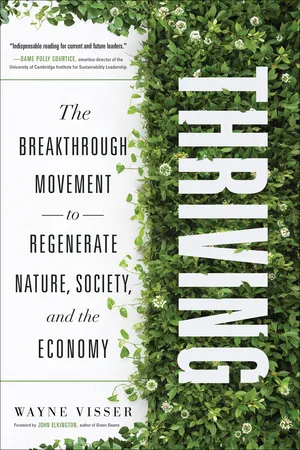
eBook - ePub
Thriving
The Breakthrough Movement to Regenerate Nature, Society, and the Economy
- 362 pages
- English
- ePUB (mobile friendly)
- Available on iOS & Android
eBook - ePub
About this book
Information
CHAPTER 1
Thriving
When we try to pick out anything by itself, we find it
hitched to everything else in the universe.One fancies a
heart like our own must be beating in every crystal and cell.
hitched to everything else in the universe.One fancies a
heart like our own must be beating in every crystal and cell.
—John Muir, My First Summer in the Sierra
A Dream Come True
As I looked out of the window of the small nine-seater, twin-propeller plane, what I saw filled me with an indescribable sense of joy. Stretching from horizon to horizon, for as far as my eyes could see, were vast swaths of uninterrupted tropical rain forest. This was a dream come true. I was flying over the Amazon region of Ecuador from the town of Macas to Tzapapentza, a community of 300 indigenous Achuar people, living in a remote part of the jungle near the border with Peru. We were visiting the area in 2014 as part of a sustainable development program organized by my friend and colleague, Roberto Salazar. Our day trip to Tzapapentza was at the generous invitation of the Achuar president, Jaime Vargas, who was also subsequently elected as president of the Confederation of Indigenous Nationalities of Ecuador.
As we touched down on a rudimentary landing strip, we found the community already assembled under a large open-air pergola. Without delay, President Vargas and the leader of the community took their seats on chairs opposite each other in the middle of the assembled group. Both looked impressive in their regalia of face paint and brightly colored feathered headdresses. The community leader also had a symbolic rifle lying across his lap, a symbol of his role as protector. They entered into a melodic call-and-response greeting, passing on news and asking and granting permission to enter the community, all while drinking chicha, a sour fermented brew, from patterned bowls made from clay. In a gesture of hospitality, bowls of chicha were also passed around to each of us guests.
This is a community that understands thriving. They are living in harmony with nature and its cycles, surrounded by the forest and living almost entirely from what it produces for their shelter, food, and well-being. At the time, they were also engaged in a protracted battle to protect the forest from mining interests. For them, digging for metals or drilling for oil is sacrilegious, because the forest is a living being, a physical manifestation of the spirit Arutam.
I do not want to romanticize the situation. As idyllic as this sounds, the Achuar are not stuck in time or disconnected from the wider world. Our visit was not a performance for tourists or a public relations exercise. The president was there to listen to the needs of his people.
Their most immediate request was to have a road built, which would allow them to get forest produce, such as the delicious star apple fruit, to the national and international market. It still takes as many as 12 days by foot and boat to reach the nearest road. The Achuar live in traditional housing made from timber and have some basic facilities already, including electricity from solar panels and a small information center, which connects them to the internet. They wear Western clothes and have a school and dusty sports field, where they play football and Ecuavoley, a national variant of volleyball. But they want to continue developing.
I tell this story of the Achuar people of Tzapapentza because it is a microcosm of the struggle for thriving. The Achuar are fighting to preserve the regenerative capacity of nature, knowing that they depend on the environment for their physical and spiritual well-being. They remain unimpressed by the rags-to-riches promises of extractive companies, but at the same time, the community is income poor and lacks access to basic health services. There are no clinics or medical professionals in their village, and any emergency cases have to call on the flying doctor. We can learn a great deal from the Achuar about natural thriving and social thriving practices, such as inclusion and equality. But they still need economic regeneration and are missing some elements of social regeneration, such as community health. The challenge is to pursue these without sacrificing nature and eroding the solidarity that is at the heart of their beautiful culture.
Seeing the Forest for the Trees
Choosing life and living over death and decay is the essence of thriving. Thriving is about working with, rather than against, the complex living systems of which we are a part. Thriving means taking the time and making the effort to understand the many interconnections between the parts, and always asking who—or what part of the system—is benefiting or suffering as a result of our actions. Thriving is allowing nature, society, and the economy to all flourish together, rather than trading one off against the other. And ultimately, thriving is about making sure that life on earth, in all its glorious diversity, not only survives but also fulfills its vast potential.
In some ways, thriving is the new sustainability. Sustainable development will not disappear, not least because the Sustainable Development Goals run until 2030. But sustainability as an idea—just surviving and enduring—has always been rather uninspiring. Besides, it is frequently misused by business and government. (Sustainable economic growth is a favorite mantra.) In contrast, thriving is a much more exciting idea. And it’s not new. Thought leaders such as Paul Hawken, Michael Braungart, Bill McDonough, and John Elkington, among others, have been vocal advocates of thriving for years. Hawken also has a new book called Regeneration that I highly recommend.1 The difference now is that we’re starting to see science-based applications emerging, such as regenerative agriculture and restorative design.
To understand thriving, we need only look to nature. Take forests, for example. Without trees, there are no forests. Yet forests are so much more than trees. Forests are complex living systems, but they also serve as a good metaphor for systems thinking. When we say we “can’t see the forest for the trees,” what we mean is that we are too zoomed-in and focused on the parts (the individual trees) to appreciate the larger whole (the forest). In fact, as humans, we are often spectacularly bad at seeing or understanding the bigger picture. We lack the necessary perspective, which requires zooming out and noticing how everything is connected to everything else, not only in space but also in time. The forest is not just a collection of trees; it is a web of relationships between trees and countless other organisms and natural forces.
Even when we look at the whole forest, we are missing much of what makes it work as a living system. For instance, when you dig into the world of mycorrhizae—fine, hairlike filaments of fungus that attach themselves to the roots of plants and trees—a whole other world exists. These mushroom fibers reach out hundreds or thousands of times the length of each tree root, sourcing water and essential nutrients for the plant. They also form a vast underground communications network—which has been called the Wood Wide Web—that allows trees to alert one another to threats and provide intensive care to ailing trees or vulnerable offspring, much like an intravenous drip supplying nutrients.
Everything That Surrounds and Connects Us
When we think in systems, our perspective changes. Imagine a tree in an orchard. How do we ensure a bountiful crop of sumptuous fruits? The secret is to create an environment that enables the tree to flourish: fertile soil, regular water, protection from diseases, shelter from the elements, and enough sunshine. Similarly, when it comes to nature, society, and the economy, thinking in systems encourages us to create enabling environments for all life to flourish.
Key Concept: Environment
The environment is literally everything that encircles us. The word is derived from early 17th-century Old French: en and viron (circle). When it was introduced into the English language in 1828 by Thomas Carlyle, he elaborated the concept to mean “the aggregate of the conditions in which a person or thing lives.”2
The environment comprises nested living systems, including people and all other organisms, as well as their complex and dynamic relationships: the incredible web of life. The notion of living systems being nested is a bit like a Russian doll, where inside each doll is another smaller doll. Similarly, each system exists within another system. In fact, all of life is characterized by nested webs: Cells join together to form organs and other biological systems, which make up our human bodies; we group together into social systems, such as families, communities, organizations, cities, countries, and societies; and we are all part of the earth’s dynamic, self-regulating ecological systems.
At a macro level, we can see that the economy is nested within society, which itself exists within and is entirely dependent on nature. Seeing the whole system means recognizing the earth itself as a living, self-regulating organism, which is what NASA scientist James Lovelock proposed in 1979, calling it the Gaia hypothesis, after the Greek goddess of the earth. At first glance, this is an audacious idea. But the science of complex living systems has continued to develop, and the evidence is increasingly compelling. In the same way that microorganisms contribute to our body’s health—and sometimes its demise—we, too, must decide whether we are a species that is good for the earth’s health or more like a deadly parasite or an infectious virus.
Understanding thriving, rooted in systems thinking, is deceptively easy and fiendishly difficult at the same time. When I first encountered systems science, it wasn’t called that, and I didn’t yet know how it could be applied in practice, but I knew I had discovered something potentially world changing. It came to me by way of Jan Smuts, a South African statesman and naturalist philosopher, who wrote a book in 1926 called Holism and Evolution, in which he claimed to have found nothing less than “the ultimate synthetic, ordering, organising, regulative activity in the universe, which accounts for all the structural groupings and syntheses in it.”3
Smuts began by critiquing the prevailing view of science, the legacy of Isaac Newton’s clockwork universe, which held that a system can be understood by reducing it to its component parts. Smuts saw this reductionistic view of reality, which he called mechanism, as a fixed dogma in which “there could be no more in the effect than there was in the cause; hence creativity and real progress became impossible.”4 By reducing nature to an aggregation of dead parts, science was missing the living wholes that make up the complex web of life.
A Theory of Living Systems
Smuts’s theory of holism suggests that every organism, every plant or animal, is a whole, with a certain internal organization and measure of self-direction and an individual specific character of its own. This is true of the lowest microorganism no less than the most highly developed and complex human personality or society. Smuts also saw holism as the driving force behind evolution, which creatively enables the development of ever more complex and significant wholes.5
Key Concept: Holism
Holism—a term that Jan Smuts coined and derived from the Greek holos—proposes that wholes are “the real units of Nature … a unity of parts which is so close and intense as to become more than the sum of its parts.”6
As an aside, Smuts was involved in drafting the original charter of the League of Nations, which later became the United Nations. He also crossed political swords a number of times with Mahatma Gandhi, when Gandhi was a young lawyer in South Africa advocating for the rights of Indians. Before leaving South Africa in 1914, Gandhi sent Smuts a pair of sandals as a gift, which Smuts returned on Gandhi’s 70th birthday, remarking that “I have worn these sandals for many a summer … even though I may feel that I am not worthy to stand in the shoes of so great a man. It was my fate to be the antagonist of a man for whom even then I had the highest respect.”7
Smuts was not the first systems scientist. That title probably belongs to the genius Leonardo da Vinci, whose studies of nature and society showed a remarkable appreciation for their dynamic processes, whether it was the swirling vortices of water and air currents that he drew or his metabolic designs for cities as living organisms, where people, goods, food, water, and waste need to flow unimpeded. As modern-day systems scientist Fritjof Capra noted, reflecting on the theme of his book The Science of Leonardo, “His science was radically different from the mechanistic science that would emerge 200 years later. It was a science of organic forms, of qualities, of processes of transformation.”8
Capra, an Austrian-born American physicist, has done more than most to help articulate, synthesize, and popularize systems science, recounting its fascinating history and teasing out its fundamental principles in his book The Systems View of Life: A Unifying Vision, coauthored with Italian chemist Pier Luigi Luisi.9 Besides paying tribute to Leonardo da Vinci, Capra traces the roots of systems thinking to various pioneers, movements, and concepts, such as organismic biology, cybernetics, tektology, general systems theory, synergetics, complexity theory, chaos theory, fractal geometry, autopoiesis, and social systems theory.
Key Concept: Systems Thinking
Fritjof Capra describes systems thinking as “thinking in terms of connectedness, relationships, patterns, and context.”10 This is consistent with the root meaning of the word system, from the Greek “to place together.”
In the pages that follow, I weave in many of the ideas behind these rich bodies of work. Together they add lay...
Table of contents
- Cover Page
- Title Page
- Copyright Page
- Dedication
- Contents
- Foreword by John Elkington
- Prologue: Hope
- Section I. The Great Reset
- 1. Thriving
- 2. Paradox
- Section II. Regenerating Nature
- 3. Restoration
- 4. Renewal
- Section III. Regenerating Society
- 5. Responsibility
- 6. Revitalization
- Section IV. Regenerating the Economy
- 7. Rewiring
- 8. Resilience
- Section V. Regenerating Organizations
- 9. Integration
- 10. Leadership
- Epilogue: Witness
- Acknowledgments
- Notes
- Bibliography
- Index
- About the Author
Trusted by 375,005 students
Access to over 1.5 million titles for a fair monthly price.
Study more efficiently using our study tools.
Frequently asked questions
Yes, you can cancel anytime from the Subscription tab in your account settings on the Perlego website. Your subscription will stay active until the end of your current billing period. Learn how to cancel your subscription
No, books cannot be downloaded as external files, such as PDFs, for use outside of Perlego. However, you can download books within the Perlego app for offline reading on mobile or tablet. Learn how to download books offline
Perlego offers two plans: Essential and Complete
- Essential is ideal for learners and professionals who enjoy exploring a wide range of subjects. Access the Essential Library with 800,000+ trusted titles and best-sellers across business, personal growth, and the humanities. Includes unlimited reading time and Standard Read Aloud voice.
- Complete: Perfect for advanced learners and researchers needing full, unrestricted access. Unlock 1.5M+ books across hundreds of subjects, including academic and specialized titles. The Complete Plan also includes advanced features like Premium Read Aloud and Research Assistant.
We are an online textbook subscription service, where you can get access to an entire online library for less than the price of a single book per month. With over 1.5 million books across 990+ topics, we’ve got you covered! Learn about our mission
Look out for the read-aloud symbol on your next book to see if you can listen to it. The read-aloud tool reads text aloud for you, highlighting the text as it is being read. You can pause it, speed it up and slow it down. Learn more about Read Aloud
Yes! You can use the Perlego app on both iOS and Android devices to read anytime, anywhere — even offline. Perfect for commutes or when you’re on the go.
Please note we cannot support devices running on iOS 13 and Android 7 or earlier. Learn more about using the app
Please note we cannot support devices running on iOS 13 and Android 7 or earlier. Learn more about using the app
Yes, you can access Thriving by Wayne Visser in PDF and/or ePUB format, as well as other popular books in Economics & Sustainability in Business. We have over 1.5 million books available in our catalogue for you to explore.