Originally published in 1957, this volume compares the 20th Century transformation of human life to the revolution which swept early man into the first civilized communities. It shows how each radical new stage of human development grew out of changes in human personality and consciousness, such as the invention of language and symbols, the origins of universal religions and the mechanization of everyday life. Despite the threat that the author foresees from an over-reliance on automation, the book maintains that humanity still has the means, spiritual, personal and technological to create a sustainable future for itself, by increasing the usefulness and freedom of all men.
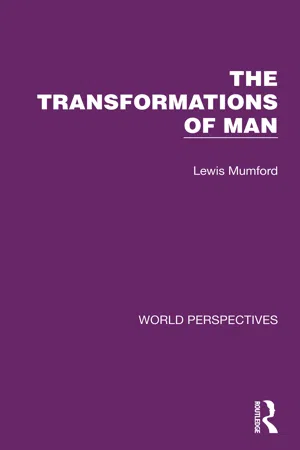
- 186 pages
- English
- ePUB (mobile friendly)
- Available on iOS & Android
eBook - ePub
The Transformations of Man
About this book
Information
1 Animals into Human
1
When we go back to the origins of man, we go back to a time before he left any records except his own bones; and all too few of them. Some day, at the bottom of a sunken ocean bed, or in caves yet unexplored, we may discover richer human relics. But it is doubtful whether material objects, bones, stones, shards, can reveal what we want most to know—by what cunning and daring, by what dreaming and searching, man discovered the germs of his own humanness and nurtured them. What matters most about man’s past will remain in the realm of speculation and fantasy. Teased by this obscurity, almost every people has fashioned a myth about its origin, nature, and destiny, though too often the mythmakers ask themselves only how their kind became Babylonians, Greeks, Jews, Romans, Japanese, and not when and how they became men.
Since none of these old myths does justice to our present knowledge, I purpose to fashion a myth that will be more in keeping with the science of our time, yet more ready to venture into factual quicksand than the scientist, if true to his prudent code, can let himself be. This new myth does not, it goes without saying, profess to come from divine revelation; nor yet can the earlier parts of it be called, even by the most generous stretching of the words, verifiable truth. But in its speculative vagueness, as in its dubious flashes of illumination, it reflects the actual mystery with which it deals. Where the facts are beyond recall, our myth will seek to reconstruct them by reading back from the known into the unknown, since the historic transformation of man is repeated, in effect, with the birth and nurture of every new human being.
In significant ways, the terms of the present myth of man have changed. We no longer ask for some dramatic moment of creation that calls for an external and all-powerful creator. The extension of astronomic and geologic time lessens the need for sudden power: our creative agent is inseparable from the long process of creation itself, slowly gathering purpose and direction over the aeons, gradually ‘making up its mind’ and at last, in man, beginning to achieve the first glimmer of self-consciousness.
Something that may later be identified as life and mind perhaps is present at every stage of the cosmic process, though visible only when one looks backward. Certainly, long before man came on the scene, a multitude of organisms had taken form and invented ways of perpetuating that form and altering it, each after their own kind, within the life cycle of their own species, in relation to environments and organic partnerships that sustained it. Out of this cosmic web of life stepped man: the creature that dared consciously to be a creator, and that found another path to creation than that of biological metamorphosis.
Man seems to have descended from a group of apelike primates that lived in trees, when a large part of the earth boasted a tropical climate. In one or more places, at one or more times, this creature took the first steps toward becoming human. Some alteration in his metabolism, some mutation in his genes—yes, perhaps some inner impetus and need—endowed him with a bigger brain, relatively, than almost any creature but the mouse possesses; and man’s sustained urge to make something of it started him on his long career. That change made it possible for man to live in a more complex world, or rather, to take in more of the complexities and possibilities of the real world: it brought with it the development of greater manual skills, finer co-ordinations, greater sensitiveness to both outer stimuli and inner promptings, a greater aptitude for learning, a more retentive memory and a more wary foresight than any of his ancestors could boast.
The overgrowth of the human brain may signify a more general condition that sets man off from his nearest animal colleagues: an abundance of unused energy not marked for nutrition, reproduction or defence. In other animals, excess vitality runs off mainly in muscular play. In man, it produces a constant undercurrent of sounds, images, exploratory actions. His infantile interest in his own body and its products includes other expressions, though his tendency to blow and bubble and babble and hum has no purpose or direction at the beginning except sheer organic activity. Arnold Gesell has shown that in early infancy a baby will turn to constructive acts, putting one block on another, before anyone instructs him in these possibilities.
In short, the undifferentiated material for symbols and fabrications rises out of man, not waiting for any external challenge, but prompted by his own maturation. And it is surely no accident that the least controllable part of this flow—but eventually the most significant, indeed the very source of significance—wells up from the unconscious. What was uniquely serviceable for man’s development was his ability to fix and formalise these spontaneous images and symbols, and to attach them to objects provided by the external world.
By developing his mind, man lessened the need for other forms of organic specialisation. When Karl Pearson compared man’s brain to a telephone exchange, handling incoming and outgoing calls, he took in only a small part of its activity: it is a power station, a storage warehouse, a library, a theatre, a museum, a hall of archives, a court of justice, a seat of government. The instinctive equipment of most species is sufficient to ensure their survival. By transferring authority to a controlling intelligence, sensitised by feeling, enlarged by imagination, man sometimes endangered his survival, but he opened the possibility of further development.
Nature, Dr. Walter Cannon demonstrated, has practised the ‘economy of abundance’ in fashioning man and many of his ancestors: hence the excess of energy that is stored up, ready for emergencies, the provision of paired organs, the ears, the eyes, the lungs, the kidneys, the breasts, the testicles, so that even if one member is injured the other can take over the burden and keep the organism alive. But this same generosity applies even more magnificently to man’s central nervous system: long before man could count on ten fingers, he had enough neurons at his disposal to make possible the learning of an Aristotle, or an Ibn-Khaldun, the wisdom of a Confucius or an Isaiah, the imagination of a Plato or a Dante. Let us not forget this generosity. The wisdom of the body has further applications to the life of man in our time: for an economy of abundance brings with it, not the duty to consume, but the readiness to create.
Man’s immediate ancestors possibly went halfway on this path of development: man completed it. But the ability to walk on two feet was so lately acquired that it never became part of man’s organic inheritance: he must still be taught how to walk, around the beginning of his second year, and about the same time he adds to his animal vocabulary of signals, gestures, uncouth sounds, another distinctly human trait: the imitation of formalised sounds and presently the use of words to express feelings and meanings. Words pin down man’s associations and multiply them. Without words he could react to environmental pressures and stimuli; but he could not enlarge this milieu into a world that stretches far beyond his immediate sight or reach.
Along with these two outstanding achievements, goes a fact that John Fiske was perhaps the first observer to rate at its full importance: man’s prolonged infancy, sanctioned if not promoted by maternal indulgence. In a sense, man is a retarded animal, for the span between his birth and his maturity, when he is ready to mate, is relatively longer than in most other species. By the time man is old enough to reproduce his kind, the horse is ready to be put to pasture in his old age. This freedom from adult tasks encouraged growth: thanks to his long childhood man found time to play and experiment, time to learn, time to take in not merely the immediate environment but the remembered experience of his kind, time to grope in dream toward a distant future. Escaping in youth the pressure to survive, he had leisure for self-development. This fact sets even primitive man apart from his animal neighbours.
With the utter helplessness of the newborn infant went a prolonged period of breast feeding: this reinforced the common mammalian trait of tenderness. In addition, the shedding of the hairy garment of the apes, particularly in the female, brought about a more intimate and pleasurable contact between mother and babe, to say nothing of her mate. Breasts and lips became instruments of erotic love, and out of that happy association spread more general habits of protection, nurture, and loving attachment. The extension of the period of parental care and childish irresponsibility promoted playfulness; and play was perhaps the earliest realm of human freedom.
In sheer play and make-believe man may have made the first great advances in culture, beginning with human speech: more significant than any acts that could be described as practical invention or work. Man’s use of tools, with their sharpening of his practical intelligence, came early; but the passage from the animal to the human may have been furthered even more by his rich emotional life, coloured by love, hate, fear, anxiety, laughter, tears, demanding outlets of expression and communication. Many insect orders long surpassed man in constructive facility and social organisation; but no other creature shows the faintest capacity for creating durable works of art. It was not alone the Promethean theft of fire but the Orphic gift of music that turned man into a creature so different from his primordial self. One other trait came to mark man off from his animal neighbours besides his playfulness and his artfulness: his propensity to imitate and emulate those around him: to smile when they smile, to be doleful when they are sad, to reproduce their gestures, to articulate the same sounds. Even when the immediate occasion is absent, man’s retentive memory may prompt him to recall a valued moment and repeat it in play; for repetition itself gives him a certain satisfaction and security, as we see in a child’s love of ritual and his insistence upon having a familiar story repeated with every detail in order.
The impulse of imitation, the disposition to make-believe, the habit of lingering over a satisfactory response in memory and working it into a meaningful pattern—these seem to me fundamental contributions to truly human development. They were means by which man detached himself from his organic limitations and from the all-too-slow process of biological change. By daily nurture, he produced a ‘second nature,’ which we now call culture, transmitted by imitation and habit. This culture became more natural and proper to him than his original make-up because it included not merely what he was and is, but what he loves and admires and purposes to be. Of all the labour-saving devices that man has invented, this earliest invention, that of detachment from the organic, seems beyond any doubt the most important. This achievement paved the way for the free development of intelligence long before intelligence devised further tools for its own advancement.
In achieving culture, man’s first steps were doubtless the hardest, like the first pennies that lay the foundation for a fortune. By now, man’s culture has become visible in the outward world, in buildings and cities, in institutions and printed records: but for long the greater part of it was carried in the mind and transmitted only by gesture and word of mouth. Poverty of numbers, poverty of material equipment, poverty of symbols, held back further development: for long his difficulty was to hold fast to the little that he had acquired. After the first steps had been taken, man’s achievement of the specifically human must have been upset by frequent relapses into his naively animal past. Even today violent rage temporarily brings on this result. Would man, with his new potentialities and prospects, manage to retain his adventurous ways—or would he fall back into sleepy animalhood? At the beginning of his ascent, that question may have stirred man’s deepest anxiety. Our present age, beyond any other, should understand the urgency of this question. For man’s humanity is now threatened by the possibility of relapsing into a barbarism more elemental than has ever been encountered in historic times. Though culture itself tends to be cumulative, in the process of taking it over each generation starts from scratch. Without parental love, without filial veneration, without a secure sense of the future, the very effort to become human may miscarry. Through overreliance upon mechanism and automatism our generation has begun to lose the secret of nurturing man’s humanness, since he gives too little care to the conditions that make each member of the community sensitive, tender, imaginative, morally responsible, self-governing, disposed to imitate human ideals and to emulate ideal examples of humanity.
Fortunately for primitive man, he was not, like us, intimidated by the cold perfection of the machine, nor did the universe seem to him a machine. And even more fortunately, perhaps, one of the first objects of his love was himself: indeed, without his excessive vanity and self-love early man might never have explored the principal paths that carried him beyond his original animal concern with survival and reproduction. It is not perhaps by accident that narcissism—preoccupation with one’s bodily image and absorption in one’s own capacities and desires—still marks the passage from adolescence to maturity. If in maturity overweening pride often comes before a fall, at the beginning pride and vanity came before man’s rise and prompted him to greater efforts. When man loses this deep self-respect, the world itself seems corrupt and loathsome.
2
But was there perhaps some more devious path that led to man’s emergency from his purely animal state? His sociability, his industry, his constructive propensities, his amorous excitements, his domestic partnerships and solicitudes—all these he shares with various other species. But there are two traits that, even if they are shared in some dim way by other species, leave no mark on their behaviour, but colour every aspect of man’s existence: they function throughout human history and probably through prehistory, for the greater part unrecorded and unrecordable. One is the capacity to dream and, above all, to transform imagined projections into actual projects. The other is the sense of awe and veneration, not unmixed with anxiety, in the presence of forces that lie beyond the range of man’s intelligence.
Man lives no small part of his life in the presence of the unconscious and the unknown: he is apparently the only creature who ever had the intuition that there is more in nature than meets the eye. In opening up his specific human capacities, the unknown, indeed, the unknowable, has proved an even greater stimulus than the known, while his peculiar fore-consciousness of death has added an enigmatic dimension to his life that has carried him beyond dumb animal acceptance of that terminal event. Infinity, eternity, immortality, potentiality, omniscience, omnipotence, divinity, to say nothing of zero and the square root of minus one, have no counterparts in animal experience.
If the constructive use of dreams differentiates man from other animals, this faculty may have occupied an even greater proportion of early man’s attention and interest than over-rational interpretations ordinarily allow. In the depths of the human personality, the unconscious and the supernatural are united in the form of dynamic images transcending any actual human experience : demons, monsters, dragons, angels, gods take possession of the dreamer and become more obsessively real than the actual world of here and now, to which he confusedly returns. With these overpowering images, independent and autonomous, sometimes as vivid in daylight as in sleep, man went farther in the direction of detachment and projection: detachment from the animal, projection of the super-human and the divine.
The feeling of his cosmic loneliness may have separated dawn-man from the manlike ape, long before he found words to express that feeling; but with it, out of the strange commanding symbols of the unconscious, may have come a sense of being favoured by powers and agents seemingly not his own: powers attached, through his sexuality, to the deepest sources of life. These happy hallucinations may have touched every conscious act with an obsessive insistence. So man’s self-transcending nature prospered in the climate of the supernatural; these fantasies confirmed his own tendency to overvalue his dearest object of love, himself.
All this must have antedated anything that can be called religion. In the beginning was the mysterium tremendum, unfathomable, uncontrollable, indescribable: the source of light and darkness, warmth and cold, delight and dejection, life and death, not yet divided out into nature, man, and God. Man learned to live with this mystery and in time to project it, interpreting the unknown by symbols equally incapable of rational explanation. True, other animals seem at times to have cosmic responses: wolves bay at the moon: elephants perform secret nocturnal ceremonies: chimpanzees have shown something like awe in the presence of the uncanny, be it only the image of a donkey, made of rags and buttons. But in man the sense of wonder and mystery may have been stirred in the first gropings of self-consciousness and even more than his practical intelligence may have helped lift him out of his animal state.
At a later stage, one finds these mysterious promptings surrounded by rationalisations and conceptual supports, translated into rituals, expressed in abstract forms of art; but in the beginning they must have antedated dogma and moral code, perhaps even speech. Out of this cosmic anxiety and awe, in which self-abasement and exaltation both played a part, came the sense of the sacred, which has no animal equivalent: the sacredness of blood and the birth rite, the sacredness of sex, the sacredness of the word: finally the sacredness of death, and with it the impulse to solemnly care for the bodies of the dead, and to dwell in the imagination on their future existence.
This quickening to the unknown, this widening of man’s effective environment to include vistas of time and space beyond any animal need or capacity, this imputation of some more permanent value and significance to the passing moment—all this is, from the standpoint of survival or practical utility, an aberration. Yet in man’s early departures from sensible animal accommodation to his visible environment we may hold a key—perhaps one of the main keys—to what is veritably human. In these reactions, man exposes himself to fearful illusions and self-deceptions that sometimes carry him beyond the borderland of sanity. But precisely because of his readiness for fantasy untouched by the here and now, he penetrates levels of existence and meaning that no other creature seems to approach.
The other source of man’s veritable humanness was his capacity to dream; for this is the forward-moving counterpart to memory. In origin derived perhaps from man’s anxiety, the dream took on a positive function—it became the great instrument of anticipation, invention, projection, creative transformation. Sensitive to outside impressions, which keep reverberating in him long after the stimulus has ceased, man’s hours of sleep, when he is detached from practical needs, are flooded with images. While the outer world supplies the material for these images, under pressure from within they undergo extravagant transformations, which his waking intelligence would reject. Man’s manipulativeness and curiosity, his trial-and-error discoveries, certainly furthered his command over the external world: but the dream has the special sign of art: it expresses the nature of the dreamer and gives him further insight into his own potentialities. This self-expression was an important element in man’s transformation.
Living phenomena differ from the nonliving not only in the fact that they originate in the organism and are in keeping with its general plan of life which brings about successive modifications and transformations in time—growth, maturation, reproduction, death. They likewise differ in that they are directional, anticipatory, preparatory, goal-seeking, though at the organic level the end-in-view has become so completely structured that it cannot be separated from the creature’s own nature. In man, his anticipatory reactions become detached and externalised as conscious purpose; and in his awareness of his desires, he intensifies their expression or by detaching them he may divert them to ends that partly contradict his own original nature. This is one of the functions of dream. Possibility and purposiveness, along with anxiety and prudent anticipation, all seem to cluster around man’s capacity to dream, and to carry this function from the unconscious of sleep to the whole field of his waking life. By detaching purpose from organic structures and functions man both brought it into consciousness and gave it a special human destination.
In following this line, man breaks away from the purely adaptive behaviour of other species: he turns upon nature with counter-proposals of his own, which move toward obscure goals he can never fully understand until he has given them form. In this respect, one can explain the development of human culture in general only by understanding the process of creating a work of art. This act, when it is not purely imitative, transcends the knowledge of the creator and often seems to outrun his powers: it draws on capacities that could not be known till they were summoned forth and externalised. The wish, then, is not merely father to the thought: it is the parent of all man’s creative acts and functions. And because the erotic impulses themselves play a larger part in man’s dreams than sex itself can satisfy, the dream carries into every act and occupation an image of some further fulfilm...
Table of contents
- Cover
- Half Title
- Title Page
- Copyright Page
- Original Title Page
- Original Copyright Page
- Table of Contents
- 1 Animal into Human
- 2 Archaic Man
- 3 Civilised Man
- 4 Axial Man
- 5 Old World Man
- 6 New World Man
- 7 Post-Historic Man
- 8 World Culture
- 9 Human Prospects
Trusted by 375,005 students
Access to over 1.5 million titles for a fair monthly price.
Study more efficiently using our study tools.
Frequently asked questions
Yes, you can cancel anytime from the Subscription tab in your account settings on the Perlego website. Your subscription will stay active until the end of your current billing period. Learn how to cancel your subscription
No, books cannot be downloaded as external files, such as PDFs, for use outside of Perlego. However, you can download books within the Perlego app for offline reading on mobile or tablet. Learn how to download books offline
Perlego offers two plans: Essential and Complete
- Essential is ideal for learners and professionals who enjoy exploring a wide range of subjects. Access the Essential Library with 800,000+ trusted titles and best-sellers across business, personal growth, and the humanities. Includes unlimited reading time and Standard Read Aloud voice.
- Complete: Perfect for advanced learners and researchers needing full, unrestricted access. Unlock 1.5M+ books across hundreds of subjects, including academic and specialized titles. The Complete Plan also includes advanced features like Premium Read Aloud and Research Assistant.
We are an online textbook subscription service, where you can get access to an entire online library for less than the price of a single book per month. With over 1.5 million books across 990+ topics, we’ve got you covered! Learn about our mission
Look out for the read-aloud symbol on your next book to see if you can listen to it. The read-aloud tool reads text aloud for you, highlighting the text as it is being read. You can pause it, speed it up and slow it down. Learn more about Read Aloud
Yes! You can use the Perlego app on both iOS and Android devices to read anytime, anywhere — even offline. Perfect for commutes or when you’re on the go.
Please note we cannot support devices running on iOS 13 and Android 7 or earlier. Learn more about using the app
Please note we cannot support devices running on iOS 13 and Android 7 or earlier. Learn more about using the app
Yes, you can access The Transformations of Man by Lewis Mumford in PDF and/or ePUB format, as well as other popular books in Ciencias sociales & Filosofía social. We have over 1.5 million books available in our catalogue for you to explore.