This volume offers a critical and creative analysis of the innovations of Deathscapes, a transnational digital humanities project that maps the sites and distributions of custodial deaths in locations such as police cells, prisons and immigration detention centres.
An international team of authors take a multidisciplinary approach to questions of race, geographies of state violence and countermaps of resistance across North America, Australia and Europe. The book establishes rich lines of dialogic connection between digital and other media by incorporating both traditional scholarly resources and digital archives, databases and social media. Chapters offer a comprehensive mapping of the key attributes through which racial violence is addressed and contested through digital media and articulate, in the process, the distinctive dimensions of the Deathscapes site.
This interdisciplinary volume will be an important resource for scholars, students and activists working in the areas of Cultural Studies, Media and Visual Studies, Indigenous Studies, Refugee Studies and Law.
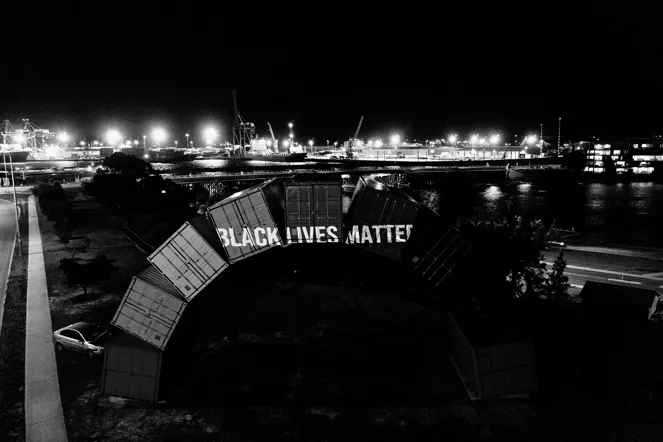
Figure PartI.1Saying Their Names, Walyalup [Fremantle], Australia, June 2020. Installation in solidarity with George Floyd protests. Photo: Anonymous. Reproduced with permission.
The three chapters in this section expand on some of the core concepts and features of the Deathscapes site and draw out their theoretical implications from different disciplinary locations. In Chapter 1, Patricia Hill Collins builds on her distinguished body of work on intersectionality and Black feminist thought to consider violence as “a core mechanism that facilitates interconnections among systems of power.” She makes the key argument that “because violence is simultaneously specific and universal, it provides an important site for analyzing the organization and dynamics of intersecting power relations.” Collins identifies the Deathscapes site, with its documentation of multiple case studies of state violence perpetrated against disparate groups, as providing a framework for understanding the “patterned nature of violence” and how seemingly disparate experiences of violence are in fact interconnected.
Taking as her starting point the Deathscapes case study “At a Lethal Intersection: The Killing of Ms Dhu,” (Bui et al. 2017) Collins identifies how the case study not only documents the lethal factors that intersected to produce Ms Dhu’s death in custody but, in conjunction with other case studies on the site, enables an analysis through which it is possible to perceive how “disparate cases of lethal intersections … are themselves interconnected.” Thus, the Deathscapes site as archive “positions those affected by violence to develop analyses of how political domination of intersecting systems of power works.” A critical feature of Collins’ commentary is her recognition of the importance of centring experiences of the dead, their families and communities in the articulation of an “anti-violence praxis” that refuses a top-down approach:
As a form of critical inquiry and praxis, intersectionality needs to be constructed on the scaffold of anti-violence initiatives, not just on a careful reading of how elites wield power. Viewing violence as hegemonic and omnipotent can frame small actions to resist it as ineffectual and doomed to failure. But conceptualizing anti-violence initiatives as resisting the violence engendered by a specific lethal intersection invites new questions concerning the types of ideas and actions that oppose violence.
Several Deathscapes case studies close with “walls” of community memorials, artworks or protests that emphasize the collective and the coalitional. As Collins notes, in its marking and collating these small embodied responses, the site “broadens the community of practitioners as well as the knowledge they create as a way of doing intersectional analysis.”
In Chapter 2, Maria Giannacopoulos too explores the Deathscapes site’s implications as “both archive and methodology.” As it archives the case studies of Indigenous deaths, the Deathscapes site provides the evidentiary ground for what Giannacopoulos names “the debtscape”: that is, “the foundational debt” of the Australian state to its Indigenous subjects, “incurred through frontier violence, dispossessing land removals and the imposition of a British legal and political order.” This debt, which continues to accrue in the present, is continually obfuscated, Giannacopoulos argues, through the framework of a colonial law that disavows its own colonial status, presenting itself rather as singular, sovereign and above the fray: a “nomopoly.” The deaths documented on the Deathscapes site are decisive refutations of this nomopoly. They reveal, rather, the systemic and constitutive violence of Australian law as it continues to produce and sanction lethal forms of racialized violence.
As the case studies on the Deathscapes site provide a living counter-archive to the nomopoly of Australian colonial law, revealing its ongoing violence towards the Indigenous and refugee bodies who disturb its sovereign authority, the site also offers, Giannacopoulos argues, “a way of writing critical race history.” Drawing on the work of David Garland, she identifies Deathscapes’ genealogical approach as a form of “history of the present”:
the burden assumed by Deathscapes in generating a body of evidence of global state violence is a form of writing history in the present by engaging boldly with “forces active in the present” within “a field of power relations and political struggle” (Garland 2014, 373). Because of this approach, Deathscapes has a profound pedagogical function.
As a scholar teaching “effectively against the criminological grain,” Giannacopoulos expands on the Deathscapes site’s implications for an approach that locates crime in systems of power rather than as individual acts—for example, the death in custody of Ms Dhu after her arrest for unpaid fines.
As Giannacopoulos marks, “the Deathscapes project provides an evidentiary ground for showing how settler colonial states systematically violate targeted populations … at and with the borders.”
Our own chapter, with which this section concludes, focuses on how women in immigration detention are systematically targeted for violence “at and with the border.” The chapter focuses on practices of gender and sexual violence towards women held in immigration detention in two settler colonial states, Australia and the United States. This violence, we argue, must be understood through a genealogical approach, and through an analysis of how similar, if often also different, colonial histories both inform and continue to shape contemporary regimes of detention. Our argument is that the border is a site where these forms of intersectional violence are concentrated and licensed. We signal a number of the axes along which the treatment of illegalized arrivals not only functions to reproduce ongoing forms of settler colonial violence but also ramifies and mutates into new formations: practices that reinscribe formative patterns of racialized punishment directed at enslaved and colonized Indigenous peoples. The technologies and practices of both slavery and continuing Indigenous dispossession, we argue, stage their historical returns in certain practices of immigration detention. The chapter leads into the next part of the volume, which focuses on violence against Indigenous women.
References
Bui, Michelle, Dean Chan, Suvendrini Perera, Joseph Pugliese, Ayman Qwaider and Charandev Singh. 2017. “At a Lethal Intersection: the killing of Ms Dhu.” Deathscapes: Mapping Race and Violence in Settler States. https://www.deathscapes.org/case-studies/ms-dhu.
Garland, David. 2014. “What is a ‘history of the present’? On Foucault’s Genealogies and their Critical Preconditions.” Punishment & Society 16(4): 365–384.
1 Violence and intersecting power relations
Patricia Hill Collins
DOI: 10.4324/9781003200611-4
Violence provides a rich entry point for analysing intersecting power relations. The pervasiveness of violent actions and speech suggests that violence is not just an “add-on” to racism, heteropatriarchy and similar systems of power but rather is essential for each system’s distinctive organizational practices. Gender oppression relies on practices of rape and domestic violence, racial oppression rests on lynching and state-sanctioned terrorism, sexual oppression draws on hate crimes against LGBTQ people, and nationalism has long been associated with the persecution of ethnic and religious minorities. Practices such as these reveal how force constitutes an essential feature of political domination. Yet violence also requires interpretive contexts whose purpose is to solicit cooperation from elites and subordinated groups alike.
These connections between power relations, violent acts and the ideas that explain violence reappear within racism, heteropatriarchy and nationalism. Yet since the 1990s, the emerging discourse of intersectionality posits that systems of power are interlocking, interdependent or intersecting, e.g., racism gains meaning through sexism, and colonialism is tightly linked to capitalism (Collins and Bilge 2020 [2016]). Conceptualizing intersecting power relations as mutually constructing suggests that, just as systems of power are increasingly conceptualized as intersectional, violence may be similarly intersectional. In other words, there is no such thing as “pure” racial violence or “pure” gender violence. Instead, the violence that characterizes political domination is both intersectional and essential to the workings of intersecting systems of power (Collins 2019, 237–240).
This essay explores this relationship between intersectional analyses of violence and the organization of intersecting power relations. It does so by focusing on patterned connections among specific cases of violence, or lethal intersections, where death or the threat of death is prominent. Here, I adopt the term lethal intersection from a case study on one such case (see Bui et al. 2017) on the Deathscapes site to describe how multiple forms of oppression converge to catalyse a particular set of violent practices that fall more heavily on particular groups such as Black people, Indigenous people, women, the young, poor people, immigrants and LBGTQ people. A rich body of knowledge about violence and its lethal intersections currently exists, primarily because feminists, anti-racist activists, journalists, community organizers, researchers and practitioners in education, health care and social work have grappled with violence as a harmful social practice. Armed with awareness of the scope and dynamics of violence as a social problem, activists and scholars working within diverse anti-violence projects have elevated awareness of how violence as a social problem differentially affects people across race, class, gender, age and nation as categories of analysis.
On first glance, cases of lethal intersections may appear to be primarily about one form of oppression over others, for example, lynching as indicative of racial oppression or rape of gender oppression. Yet a closer look at these practices reveals their intersectional contours (Collins 2004, 215–245). Certainly, the globe is awash with seemingly incomprehensible violent acts and patterned practices that, in the absence of analyses of power can seem random, individualized and senseless. Higher rates of maternal and infant mortality for mothers in poor countries, deaths in custody of journalists who uncover government corruption, bodies of African immigrants that wash up on Mediterranean beaches or the deaths from gun violence that disproportionately target young people of colour in the United States seemingly constitute disparate practices. But when recontextualized within a broader context of intersecting power relations, these examples of violence can be seen as lethal intersections that illuminate the centrality of violence in political domination. In other words, violence constitutes a core mechanism that facilitates interconnections among systems of power and lethal intersections provide a navigational tool for analysing these connections.
Violence as patterned lethal intersections
Violence can be a catalyst for analysis and social action that goes far beyond a specific violent act. Different expressions of violence fall more heavily on Black people, Indigenous people, women, immigrant populations, religious minorities, LGBTQ people and young people because they are differentially placed within intersecting systems of power. People who experience political domination are both differently vulnerable to varying forms of violence and also have differing experiences with violence. It is no accident that differently oppressed groups criticize the violence that they encounter and, as a result of their analyses, organize to resist the specific expressions of violence that inform their everyday lives. Much of this bottom-up analysis is implicitly intersectional, often without recognizing itself as such. In other words, political resistance to racism or sexism often begins in response to experiences with violence associated with one form of oppression. But it rarely stops there.
Ironically, narratives advanced by elite actors routinely overemphasize what they see as violence associated with subordinated groups while ignoring and/or or erasing their own culpability in condoning violence as members of dominant groups. Whether science, popular culture or government reports, dominant discourse depicts subordinated groups as either initiating violence or as being so threatening that they require disciplinary violence to keep them in their place. This discourse of blaming the victims of violence for the violence within a given society runs deep. Men who kill their girlfriends, wives, sisters or daughters, especially those who try to leave abusive relationships, send a chilling message to women and girls who are considering a similar decision. Trans-women and trans-men who by their visibility challenge gender norms become targets of hate crimes and unsolved murders. A Black teenager walking home from the store in his racially integrated, middle-class neighbourhood can be killed by a white neighbour who perceives him as a threat. Elderly Asians are pushed to the ground and maligned during the Covid pandemic. Excuses for the violence targeted towards less powerful people are everywhere: “If she hadn’t threatened to leave me, I wouldn’t have needed to kill her”; or “if they simply blended in as men or women, they would not have provoked me”; or “if that Black teenager had just followed my orders, I wouldn’t have shot him”; or “if those Chinese immigrants had not invaded our country, we wouldn’t need to chase them away.” Murdering women, killing trans-people, shooting unarmed Black teenagers and harassing people of Asian descent set chilling examples for all women, LGBTQ people, Black people, young people and racialized ethnic groups who seemingly question authority by their very presence. In this context, the threat of resistance to prevailing power hierarchies typically provokes more powerful social actors to turn to violence, not the other way around. From the perspective of dominant groups, subordinated groups must be contained in order to protect those in power from the threat that subordinated groups seemingly present.
When elite actors punish small acts of defiance by members of subordinate groups, they aim to suppress disse...
Table of contents
Cover
Half Title
Series Page
Title Page
Copyright Page
Table of Contents
Dedication
List of figures
Acknowledgements
List of contributors
Introduction: Mapping Deathscapes
Part I Deathscapes intersectionalities
Part II Making Indigenous women visible in the deathscape
Part III Refugees in the deathscape: Crimes of peace
Part IV Aesthetic witnessing in the deathscape
Part V Afterwords
Index
Trusted by 375,005 students
Access to over 1.5 million titles for a fair monthly price.
Study more efficiently using our study tools.
Frequently asked questions
Yes, you can cancel anytime from the Subscription tab in your account settings on the Perlego website. Your subscription will stay active until the end of your current billing period. Learn how to cancel your subscription
No, books cannot be downloaded as external files, such as PDFs, for use outside of Perlego. However, you can download books within the Perlego app for offline reading on mobile or tablet. Learn how to download books offline
Perlego offers two plans: Essential and Complete
Essential is ideal for learners and professionals who enjoy exploring a wide range of subjects. Access the Essential Library with 800,000+ trusted titles and best-sellers across business, personal growth, and the humanities. Includes unlimited reading time and Standard Read Aloud voice.
Complete: Perfect for advanced learners and researchers needing full, unrestricted access. Unlock 1.5M+ books across hundreds of subjects, including academic and specialized titles. The Complete Plan also includes advanced features like Premium Read Aloud and Research Assistant.
Both plans are available with monthly, semester, or annual billing cycles.
We are an online textbook subscription service, where you can get access to an entire online library for less than the price of a single book per month. With over 1.5 million books across 990+ topics, we’ve got you covered! Learn about our mission
Look out for the read-aloud symbol on your next book to see if you can listen to it. The read-aloud tool reads text aloud for you, highlighting the text as it is being read. You can pause it, speed it up and slow it down. Learn more about Read Aloud
Yes! You can use the Perlego app on both iOS and Android devices to read anytime, anywhere — even offline. Perfect for commutes or when you’re on the go. Please note we cannot support devices running on iOS 13 and Android 7 or earlier. Learn more about using the app
Yes, you can access Mapping Deathscapes by Suvendrini Perera, Joseph Pugliese, Suvendrini Perera,Joseph Pugliese in PDF and/or ePUB format, as well as other popular books in Social Sciences & Colonialism & Post-Colonialism. We have over 1.5 million books available in our catalogue for you to explore.