CHAPTER 1
Living Madagascar
A black and white lemur sings high in the trees of a rainforest in the east while a tiny brown chameleon falls on its side and freezes on the ground far below, perfectly camouflaged as a dead leaf; a bird in glorious plumage glides between the tips of branches reaching for the bluest of skies above a spiny forest in the south; a baobab tree stands sentinel in a western deciduous forest, its massive trunk a personal water reservoir. This is Madagascar, crucible for the evolution of a grand diversity of life, for plants and animals found nowhere else on Earth.
When I began working there fifty years ago, few people outside the country even knew where it was. Responding to an anxious phone call about me made by my mother in 1970, a Foreign Office official in London inquired whether Madagascar was located in Europe. Things are very different today. The island is now recognised as one of the hottest of biodiversity hotspots in the world, along with regions like Amazonia and the rainforests of Central Africa, and as a poster child for climate change. Through films, television documentaries, newspaper articles and the pages of the National Geographic, Madagascar lives in the public imagination as, at once, a treasure of nature and an environmental disaster. Captivating photographs of unique plants and wildlife sit alongside dire ones of burning forests, eroding soils, and headlines announcing the imminent extinction of rare species. Although the island’s location is widely known now, what is happening there is less clear.
The delight of almost everyone I encounter who has actually been to Madagascar is palpable. Their pleasure and excitement always puzzle me a little. They are mostly a self-selected group of people with an interest in natural history, and the island harbours many unique plants and animals, to be sure. But it is far from being a fully-fledged tourist destination. Accommodations are often quite basic, and travel is slow, exhausting and fraught. Scattered through this book are sights and reveries during hours scrunched up in an assortment of four-wheel-drive vehicles and, indeed, it sometimes feels as if I have spent more time getting between places than in them. Madagascar lacks great herds of zebra and wildebeest, prowling lions and leopards, or giraffes and elephants to marvel at. Its animals come mostly in small packages, and the sense of sheer good fortune and privilege at catching a glimpse of them doubtless contributes to their magic. But the enchantment goes far beyond that. A closer look at the lemur, chameleon, bird and baobab with which I began helps explain why.
The singing black and white lemur (Indri indri) is called babakoto, literally ‘father of Koto’ in the Malagasy language. Some individuals are actually black all over, although those in my mind as I write look like ‘a primate version of a giant panda’. They are the largest living lemurs, with exceptionally long hindlimbs that power leaps between tree trunks up to 10 metres apart. A babakoto has no tail, just a stubby stump. Lemur tails come in many forms – whip-like, foxy, striped – and it is hard not to feel sorry for babakoto, the only species without one. There is no good explanation for the absence.
Babakoto live in family groups – a female, male and their young – in northerly areas of the eastern rainforest. The female lords it over the male, as in many other lemur species. A couple will often stay together for many years while successive offspring grow up and eventually move away in search of mates of their own. Babakoto spend much of the day munching leaves and fruit, moving from one food tree to another, or resting. And they sing. A communal roar announces the song, most often in the morning. When the real song begins, the adult couple are the lead singers. The first bars are long notes. After them come wailing stanzas, beginning high and tumbling through several notes to lower wails. The couple sing in duet, although everyone except the youngest animals joins in, and a song may last for several minutes. The sound carries for kilometres across the treetops, and neighbouring groups break into songs of their own in response. Echoes fill the forest with a ghostly lament.
Why do babakoto sing? The song is almost certainly a territorial proclamation: ‘we are here, stay away’. But it seems to be more than that. The adult female’s repertoire includes more notes than the male’s, and she moves from one note to the next more quickly. To listeners in other groups, the song in its entirety may communicate who is present – how many individuals, how many males and females. Perhaps it is a way for neighbours to become better acquainted, because direct encounters are rare. Whatever the song’s function for babakoto, it is surely spellbinding for people who hear it.
Far down below on the forest floor, the brown leaf chameleon (Brookesia superciliaris) draws no attention whatsoever to its presence. Ramilaheloka, as they are called in some places, are found in many forests in the east, although actually seeing one takes a modicum of luck and a keen eye for small reptiles or, if you are me, being in the company of a good spotter. They have less trouble seeing us, one suspects: like all chameleons, ramilaheloka have the uncanny ability to swivel their eyes backwards and forwards in opposite directions at the same time.
Ramilaheloka are tiny. With bodies no more than 5 centimetres long, they would fit on your thumb. A newly discovered relative, B. nana, is even smaller – it would fit on your thumb print! With a vertically flattened body, a ramilaheloka looks as if someone had stepped on it sideways. Lying curled up on one side with legs tucked in, it bears a remarkable resemblance to a dead, brown leaf. That is just as well. The forest floor where it spends much of the day catching insects with a long, sticky tongue is a dangerous place for a very small chameleon. A horn sticking up above each eye and spines thrust out from its body may intimidate potential predators close to its own size, but they are no impediment for a hungry bird or snake.
Chameleons are famed for their ability to turn from one bright colour to another. Ramilaheloka stay mostly brown or beige. Best not to be noticed. Madagascar is home to many chameleon species, all of them bewitching and many of them larger and easier to see and watch than ramiloheloka and its close relatives. The particular attraction of this species, for me anyway, is not just the wonder of an animal passing itself off as a leaf but the mystery still attached to this elusive little creature and the joyful excitement that comes with finding one in the forest.
The crested coua (Coua cristata) is called tivoka in Malagasy in the south, where I have seen it most often. This vagabond of a bird is quite big, 40–44 centimetres long, and lives in forests of many descriptions up and down the island. It is the most widespread and common of the nine coua species found in Madagascar – and nowhere else in the world. There are no accolades for spotting tivoka, and a sighting will not set a serious ornithologist’s heart thudding. But they are creatures of great beauty and grace, decked out in a painter’s palette of colours. Here is how a distinguished ornithologist describes them: ‘pearl gray crested head, neck, chin, and throat. Violet skin around eyes, pearly sky-blue behind eye and surrounded by black line … Upperparts green-gray … underparts white except for orangey fawn lower chest and maroon upper chest … Green-gray wings, midnight blue tail with purple-violet metallic sheen, broadly tipped with white on external tail feathers’. Imagine all that, sailing through the air!
Tivoka sunbathe, and the silhouette of a large bird with ruffled feathers and drooping wings atop a spiny tree limb is a common sight on early mornings in the south. Often, it is alone, and I have never seen more than two together. A tivoka is a shimmering singularity, not a flock. It feeds on a cornucopia of insects, and also berries, seeds, snails, and even poor unsuspecting chameleons. The loud, clear calls of tivoka belong with late afternoons watching lemurs. ‘Coy coy coy coy …’ calls one, each syllable a little quieter than the last, and ‘coy coy coy coy …’ reply others from different parts of the forest. An evening lullaby for me, what do these calls mean to the birds themselves? Like a bird’s version of the babakoto song, the call may lay claim to a patch of forest or advertise the caller’s availability – but that is surmise.
Referring to a baobab as a ‘small package’ is a stretch, I agree. These iconic denizens of the forest can be giants, soaring 20–25 metres high, with a trunk reputed to hold up to 120,000 litres of water. Australia hosts a single baobab species, and so does Africa. Madagascar far outdoes these continents. It is home to six species of its own, scattered through forests the length of the island’s western flank, in addition to the African species that made its way over at some point in the past. Baobab trees (Adansonia spp.) are called by several names in the Malagasy language – bozy, fony, renala, ringy … Here, I call them all za, the name by which they are known in the southwest.
Za are designed like no other tree. Short, fat, gnarly branches sprout in an improbable topknot on a smooth, silvery trunk of vast girth. The leaves fluttering on branches during the wet season are undistinguished. Great white, trumpet-like flowers up to 29 centimetres long, tinted pink, red or orange, are this tree’s real adornment. With sufficient patience, one also realises that they are hives of industry. Flowers open at dusk, taking as little as a minute or as long as 15 minutes to do so, and only for a single night are they fertile. Glimpses of an array of visitors are the reward for a night-long vigil beside a za in flower. Bats (probably Eidolon dupreanum) and lemurs (Phaner pallescens, Cheirogaleus medius) visit flowers to feast on their copious nectar, carrying pollen from one flower to another while leaving each flower intact. Non-pollinating visitors arrive too, including sunbirds (Nectarinia spp.) and a variety of hawkmoths. Sunbirds plunge into the flower and sup nectar through curved beaks while hawkmoths hover at its mouth, using a long proboscis to siphon nectar from deep within. A za in bloom is a busy place indeed.
These particular animals and plants offer glimpses of the sometimes secretive, always marvellous diversity of life in Madagascar, and they also happen to delight me. In other words, a mix of scientific interest and entirely unscientific enchantment drove my choices. I am not alone in my fascination. Except for the roustabout tivoka – generally seen as fair game especially by small boys with catapults – each is special too in the eyes of Malagasy people living in their midst. But the stories they tell about babakoto, ramilaheloka and za are quite different from my own.
Madagascar is rich in folklore linking people to the wildlife around them – as bringers of bad luck or death, sources of occult power, or fellow creatures to be protected and left in peace. Some stories are about the past, and the origins of Malagasy people. The babakoto is a central figure in many stories told by people in the eastern forests. One holds that human ancestors and babakoto were brothers long ago, but then one of the brothers decided to come to the ground, live outside the forest and cultivate the land. In another, babakoto occupy a special place in human hearts because long ago they helped a child lost in the forest.
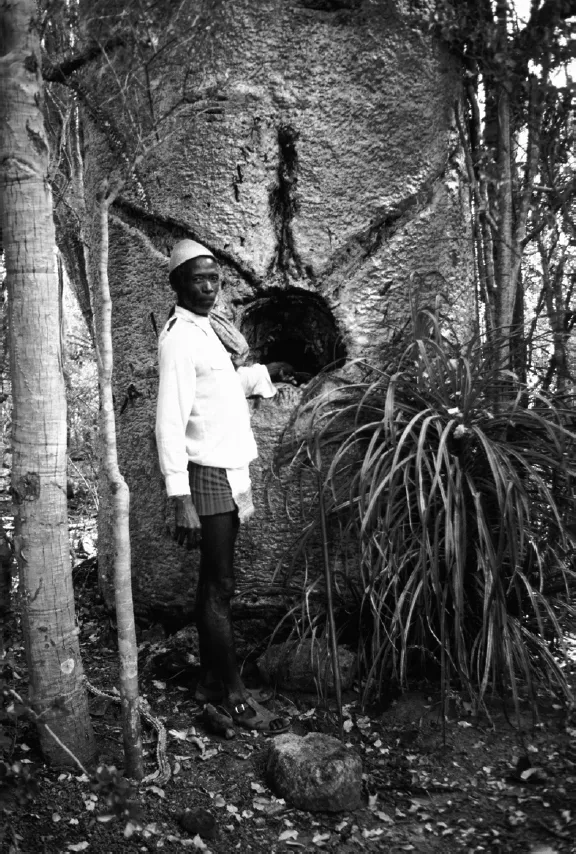
Chameleons figure frequently in Malagasy proverbs: ‘Hataovy dian-tana ny fiainana, hatreo ny eo aloha ary todiho ny any afara’, admonishes one – ‘go about life the way a chameleon walks: face what is in front and look back at what is behind’. A symbol of wisdom and intelligence for some people, they are emblems of bad character for others, and plain scary for many. Ramilaheloka are certainly viewed with suspicion – their name means ‘troublemaker’ in Malagasy. As for za, the Creator made a mistake and planted them upside down, and what seem to be branches are actually roots. Gardening mishaps aside, they are revered everywhere and a lone za will be left standing when the rest of a forest is cut down. They are trees of special mystery and magic, and being a source of water adds to this aura. A small hollow carved in the trunk quickly fills with fluid, I learned from a friend as we walked through the forest around the small southern village of Hazafotsy together one day and stopped at a za to quench our thirst.
Tohombinta beside a baobab with a hollow carved in its trunk, 1971
(photograph by author)
Long days watching lemurs often ended sitting around with friends on the mats in my hut in Hazafotsy, my night-time home for months at a time during my PhD research. One evening, as a bottle of local rum passed from hand to hand, the conversation turned to radiated tortoises (Astrochelys radiata). These beautiful great creatures, unique to Madagascar, were common in the forest. I asked why they were so fady (taboo) that people would not even touch them, let alone pick them up. The answer was that long ago someone was boiling a tortoise in a pot over a fire and the pot cracked. No one had touched or eaten them since.
Returning to Hazafotsy a few years later, the topic came up again and I sagely repeated what I had been told. Much laughter greeted my account. ‘Oh, we didn’t know you very well then and were too embarrassed to say what really happened, which was that the tortoise rose up out of the pot and bit off the penis of the man tending the fire. That’s why no one touches or eats them’. Today I remain perplexed about the origins of the tortoise fady, but very clear about the sensibilities of my Hazafotsy friends and also, perhaps, the pleasure they take in teasing.
Story-telling is a human characteristic and those told by Malagasy people are part of a web of stories that span the globe. Stories are important. They are how we interpret and make sense of the world. They reflect our values and beliefs, and filter what we choose to highlight from the evidence around us. Take our planet’s future prospects as an example. The same body of evidence about current global trends fuels stories with very different endings. Their tellers come in many stripes – scientists, leaders of government and business, not-for-profit organisations and, simply, individuals who care. The darkest stories take the fatalistic view that our species is inexorably destroying other life on Earth and will eventually destroy itself. Our biological destiny is self-destruction. Triumphalist stories strike an optimistic note: human ingenuity and advances in technology will find a way through. Not-as-bad-as-you-think stories emphasise that species have always come and gone and that this crank of the wheel, with our hand on it, is giving rise to the evolution of new species as well as extinctions. Most environmentalists and conservationists embrace yet another theme, one of muted hope and deter...