- 154 pages
- English
- ePUB (mobile friendly)
- Available on iOS & Android
eBook - ePub
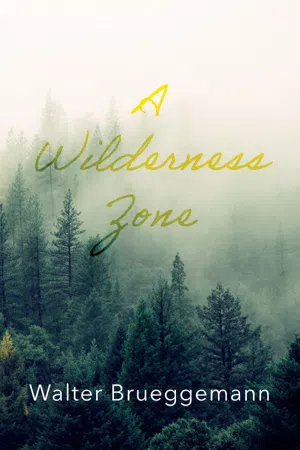
A Wilderness Zone
About this book
In these several pieces I have worked to trace out possible interfaces between specific scripture references and matters at the forefront of our common social life. It is my hunch that, almost without fail, such an interface creates a very different angle of vision for any element of our common social life, because it situates such a topic in the context of the biblical narrative that is occupied by the holy agency of God. Such an alternative angle of vision helps to defamiliarize us from our usual discernment according to the master narrative of democratic capitalism that is most widely shared across the spectrum of conservatives and progressives. Because our common angle of vision shared by progressives and conservatives has a very low ceiling of human ultimacy, we (all of us!) easily come to think that our particular reading of social reality is absolute and beyond question, even if dominated by a tacit ideology. It is my bet that an interface with biblical testimony can and will deabsolutize our excessive certitude and permit us to look again at the social "facts" that are in front of us. I do not think and do not suggest that such interfaces with scripture are inevitable; they are rather suggestive, impressionistic, and fleeting, the kind of linkage that is available in the matrix of faith that is not fixed on certitude.
Information
Topic
Theologie & ReligionSubtopic
Bibelkritik & -auslegung1
A Wilderness Zone
The narrative of faith is characteristically about a journey in and through the wilderness. That theme seems particularly pertinent among us now in our present social crisis. We are “into the wilderness” as so many of our old social certitudes are now in acute jeopardy. (I write this on the day of the funeral in Houston for George Floyd who was murdered by police in Minneapolis.)1 That crisis is deep, thick, and complex, but it has three faces of presentation:
•the virus that for now has outflanked our scientific capacity;
•the economic meltdown in the wake of the virus; and
•a skewed criminal justice system for which police misconduct is the visible front.
These three dimensions of the crisis together have a huge impact on the body politic:
•the virus leaves us variously vulnerable in its not yet understood danger;
•the economic meltdown leaves many people in deep dislocation; and
•the crisis in criminal justice evokes anger and fear.
When I thought about these poignant social realities of vulnerability, dislocation, plus fear and anger, it occurred to me that in the Bible the context that presents a like lived experience is the wilderness sojourn of Israel after the slaves had departed Pharaoh’s Egypt. Thus, I suggest that in the face of our crisis we may do well to consider the wilderness tradition in the Bible as a context in which faith may be powerfully pertinent. We in our current circumstance have an opportunity to bring that tradition close to our own experience. That narrative, I suggest, is marked by three remembered realities.

Escape to the wilderness from Egypt meant that Israel had moved beyond the reach and governance of Pharaoh. His control did not extend to that untamed territory. This meant for the newly emancipated slaves that they freed, at last, from the coercive demands of Pharaoh that served his hunger for a monopoly grain.2 Pharaoh’s requirements were unending and insatiable (see Exod 5), and now the slaves no longer had to answer for unreasonable brick quotas, a harbinger first of unreasonable quotas for chopping cotton and now unreasonable requirements for meat-packing workers! It is no wonder that just as the slaves crossed the waters into the wilderness away from the reach of Pharaoh’s demand economy that Miriam and the other women took tambourines, danced, and sang:
Sing to the Lord, for he has triumphed gloriously;
horse and rider he has thrown into the sea. (Exod 15:21)
Their action was the performance of bodily freedom, for their bodies had long ached with unbearable work. As I pondered their song and dance of freedom, I noted the contemporary parallel as the protestors danced in the streets in DC where the huge yellow letters spelled out, “Black Lives Matter.” It was as though the protestors sensed that they had, at least for now, escaped and moved beyond the coercive fear and greed of the predatory economy of US patriarchal capitalism. That dance, like that of the earlier dance of Miriam, gave bodily articulation for bodies now permitted their full joyous freedom, even if under the all-seeing eye of Pharaoh’s surveillance.
At the same time, however, a move beyond the reach and governance of Pharaoh meant that the erstwhile slaves could no longer count on the certitudes and predictabilities of Pharaoh; as a result the wilderness felt like a free-fall into risk. Without Pharaoh’s jobs, how will we pay the rent? It is for that reason that as soon as the slaves crossed out of Exodus 15 and Egypt into Exodus 16 and the wilderness, in that moment they wished for a prompt return to Pharaoh, ready to trade-off their newly found freedom for the certitude of Pharaoh’s bread supply:
If only we had died by the hand of the Lord in the land of Egypt, when we sat by the fleshpots and ate our fill of bread; for you have brought us out into this wilderness to kill this whole assembly with hunger. (Exod 16:3)
Our circumstance is like that now as the loss of Pharaoh’s jobs generates great risk. Wilderness evokes great soberness and a wish for return to the way it was “back there.” The wilderness marked by great joy can readily enough turn to anxiety and nostalgia for the old security:
If only we had meat to eat! We remember the fish we used to eat in Egypt for nothing, the cucumbers, the melons, the leeks, the onions, and the garlic; but now our strength is dried up, and there is nothing at all but his manna to look at. (Num 11:4–5)
Some soon wearied of their new circumstance and wished for the regularities of the old system of coercion. I suppose the contemporary appeal to “law and order” is designed to call attention to the fact that emancipation for some feels like anarchy to others.
The wilderness is a new liminal environment that requires fresh constructive thinking and action. So now in the moment of emancipated bodies, the wilderness requires hard thinking and bold action for the sake of an alternative social apparatus. It is one thing to cross the water into freedom. It is quite another thing to morph from the dance of freedom to a viable shared life there. In the memory of ancient Israel that is the burden of the wilderness-like moment of exile when Israel a new world now void of city, king, and temple:
Build houses and live in them; plant gardens and eat what they produce. Take wives and have sons and daughters; take wives for your sons, and give your daughters in marriage, that they may have sons and daughters; multiply there, and do not decrease. (Jer 29:5–6)
The prophetic tradition of Israel exhibits poetic-prophetic efforts at such imagination outside the sphere of the coercive regime of Jerusalem and beyond the reach of imperial Babylon, a stand-in for Pharaoh. Thus Isaiah can imagine a new alternative city (Isa 65:17–25). Jeremiah can evoke a new grace-laden covenant (Jer 31:31–34). And Ezekiel can sketch out a new symmetrical city with abiding holiness at its center (Ezek 48:1–35). Actual social reality may take the form of none of these poetic offers, but the wilderness inhabitants cannot short-cut the imaginative efforts that run beyond anything thinkable or imaginable amid the coercion of Pharaoh. (It is for the same reason that Jesus told parables, acts of imagination beyond administered reality in the Roman Empire). It is the work to be done after the first flush of dancing in order to be sure that there is no reembrace of Pharaoh, because Pharaoh, despite all hopes, has not and will not change. Pharaoh will continue to be coercive and predatory. Wilderness is the hard work of alternative!
Pharaoh’s monopoly of grain assured that there as in Egypt a steady supply of food. In contrast to Pharaoh’s Egypt, the wilderness is a place without visible life-supports. While the Israelites were eager to escape Egypt, they inescapably found the wilderness to be a place bereft of life’s sustenance—bread, meat, water. It did not take long to discover that they faced in the wilderness a mo...
Table of contents
- Title Page
- Preface
- Chapter 1: A Wilderness Zone
- Chapter 2: Abandoned!
- Chapter 3: Alabaster Cities?
- Chapter 4: An Alternative Politics
- Chapter 5: An Unwelcome Read of History
- Chapter 6: Borders and Homo migratio
- Chapter 7: Call for Mrs. Thompson!
- Chapter 8: Cheap Labor!
- Chapter 9: Clued to the Big Moment
- Chapter 10: Destiny, not Fate
- Chapter 11: Discipleship That Inconveniences
- Chapter 12: Do the Numbers!
- Chapter 13: Turn, Change, Remember
- Chapter 14: Food Secure!
- Chapter 15: For Terry
- Chapter 16: Possibility and Reality
- Chapter 17: How Long Is “a Moment”?
- Chapter 18: God’s Stunning Reversal
- Chapter 19: Gratitude as Subversion
- Chapter 20: Emancipation, Restoration, Homecoming
- Bibliography
Trusted by 375,005 students
Access to over 1.5 million titles for a fair monthly price.
Study more efficiently using our study tools.
Frequently asked questions
Yes, you can cancel anytime from the Subscription tab in your account settings on the Perlego website. Your subscription will stay active until the end of your current billing period. Learn how to cancel your subscription
No, books cannot be downloaded as external files, such as PDFs, for use outside of Perlego. However, you can download books within the Perlego app for offline reading on mobile or tablet. Learn how to download books offline
Perlego offers two plans: Essential and Complete
- Essential is ideal for learners and professionals who enjoy exploring a wide range of subjects. Access the Essential Library with 800,000+ trusted titles and best-sellers across business, personal growth, and the humanities. Includes unlimited reading time and Standard Read Aloud voice.
- Complete: Perfect for advanced learners and researchers needing full, unrestricted access. Unlock 1.5M+ books across hundreds of subjects, including academic and specialized titles. The Complete Plan also includes advanced features like Premium Read Aloud and Research Assistant.
We are an online textbook subscription service, where you can get access to an entire online library for less than the price of a single book per month. With over 1.5 million books across 990+ topics, we’ve got you covered! Learn about our mission
Look out for the read-aloud symbol on your next book to see if you can listen to it. The read-aloud tool reads text aloud for you, highlighting the text as it is being read. You can pause it, speed it up and slow it down. Learn more about Read Aloud
Yes! You can use the Perlego app on both iOS and Android devices to read anytime, anywhere — even offline. Perfect for commutes or when you’re on the go.
Please note we cannot support devices running on iOS 13 and Android 7 or earlier. Learn more about using the app
Please note we cannot support devices running on iOS 13 and Android 7 or earlier. Learn more about using the app
Yes, you can access A Wilderness Zone by Walter Brueggemann in PDF and/or ePUB format, as well as other popular books in Theologie & Religion & Bibelkritik & -auslegung. We have over 1.5 million books available in our catalogue for you to explore.