- 90 pages
- English
- ePUB (mobile friendly)
- Available on iOS & Android
eBook - ePub
About this book
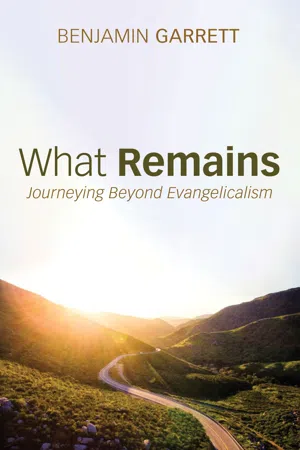
What Remains describes the damaging psychological and sociological effects of white American Evangelical discipleship. This book lays out the kind of behaviors the Evangelical discipleship process hopes to foster and the desires that motivate and are instilled by this process.
This book offers a different perspective from existing "exiting Evangelicalism"-type narratives. Most of these books focus heavily on theological, philosophical, or historical arguments about why Evangelical Christianity is wrong and offer alternative beliefs. What Remains intentionally and explicitly avoids conversations about beliefs. Instead, because desire directs belief, the focus is on how different kinds of spiritual formation direct a person's desire towards what is life-destroying or life-affirming.
This leads to a description of what an alternative spiritual formation process could look like for people who feel betrayed by Evangelicalism. This counter-formation is drawn from the author's faith-based community development work in Chicago and Atlanta, as well as with social enterprises across the world. These experiences offer a vision for respecting the difference of our neighbors, resilience, and justice, and are offered to the reader to explore for their own faith development in the wake of their experience of Evangelicalism's failure.
Information
Topic
Theology & ReligionSubtopic
Christian MinistryPart I
Made to Be
1
Believers
Safety Through Certainty
Over the next few chapters, I am going to borrow others’ voices to tell you my story. This might seem strange at first. We imagine that as we spin the narratives of our lives we are speaking largely with our own voices. Perhaps we name a mentor or influence here or there, but overall we tend to think we are the authors of our own tale.
I have come to believe that the ability to tell one’s own story is not our default position. It is a hard-won achievement. We come into the world swaddled in the desires of others. Often there is overlap between these desires and our well-being. And yet, each person, community, and institution we encounter is operating with a story about what well-being means, what the world is like, what people should be like. These stories of desire offer invitations for us to participate. They desire our desire and offer us pleasure in exchange. Think back to school with trips to the treasure box as a reward for sitting quietly, or trophies for success in sports, or later a paycheck for a job well done. These pleasures can be so enticing that we learn not to distinguish between our desires and the desire outside of us. We become agents of an external desire, living in someone else’s dreams.1
There might be moments where we sense a conflict between what we want and what they want, but in many cases these outer desires and inner desires blur. Until they don’t. These moments of divergent desire are a crisis. Maybe we enter adolescence, fight with our family, break up with a partner, or quit a job. Desires diverge and certain pleasures evaporate. Again, this open conflict is the exception. Most of the time we believe our lives will be more bearable if our insides and our outsides cohere.
There are many different names for this process: education, discipleship, spiritual formation, ideological formation, learning to be part of a family, etc. Regardless of what they are called, these efforts seek to create people with certain desires and the beliefs and practices necessary to fulfill those desires. I call this combination of stories, beliefs, practices, and pleasures a formation process.
I hope this description of the formation process makes you uncomfortable. Perhaps you are beginning to reflect on some of the desires that have laid hold of your body, your mind, your desires. The first portion of this book is my reflections on the desires that have shaped me.
I enlist Francis Schaeffer2 to give voice to these desires, particularly through the words in his book How Should We Then Live? The Rise and Decline of Western Thought and Culture, along with the words in Is Your Church Ready?, a book edited by Ravi Zacharias and Norman Geisler.3 Taken together, these two texts describe a way to be human and a picture of what human well-being looks like. The kind of life described in these texts, the desires they express, were once my desires. In fact, the formation process laid out by these authors was so powerful I took on an internship at Ravi Zacharias International Ministries (RZIM) one summer with the hopes of becoming an apologist like Ravi.4 Their world was my world.
What kind of world was it? Into what kind of person were they shaping me? And what was so compelling about this way of life? Don’t ever let anyone tell you that evangelicals are prudish. They offer a rich menu of pleasures. The first of these pleasures is an incredibly clear picture of being human. It is with this picture that we begin our journey into the kind of life I was offered.
Human beings are believers.5 Schaeffer puts it this way, “People are unique in the inner life of the mind—what they are in their thought-world determines how they act.”6 There is a direct connection between what people believe and what they choose to do.
Immediately worries emerge. Where do our ideas come from? How can we have the right thoughts? What happens when we don’t? What happens when our neighbors don’t?
These are the problems Evangelicalism promises to answer. The external world provides us with ideas. Indeed, Schaeffer suggests we get our formative thoughts and beliefs from external forces, “the way a child catches measles.”7 This measles metaphor indirectly carries through the descriptions of the human mind in these texts and implies that the natural state of our mental world is diseased. Ravi warns, “The worldview of the average person is an ad hoc way of approaching every opportunity. There is no seamless way of thinking, and the result is a breakdown of life’s meaning at its deepest level of need.”8 Schaeffer goes further and postulates that Nietzsche’s madness was due to his inability to hold together a meaningful worldview.9
Evangelicalism sees the problem as being not just that we are wrong about the world. Ravi says the average person lacks a “seamless way of thinking.” The problem people have is not just that their ideas are incorrect but that those ideas are less a professional map and more an ill-fitting puzzle held together by Elmer’s Glue. This produces all sorts of doubts, uncertainties, and a lack of direction.10 And this confusion is not about abstract things: No, we are talking about the most meaningful parts of our lives—things like love, right and wrong, raising children, voting, what to do with our money, and how to treat our friends and enemies. Our ad hoc worldview cannot give us solid answers about how to live. We are lost.
Before we move on to Evangelicalism’s solution to this problem, allow yourself to feel this lack of direction in life. Recall some of the conversations you’ve had where you’ve dived deeply into a crucial topic of the day only to hit a point at which resolution seems impossible, where no conclusion has been reached but there is also nothing else to say. What about your most valuable relationships? Don’t you screw up? Don’t you hurt people? Isn’t there an alarming inevitability to these injuries we cause? Aren’t you lost? I am.
There is a way out of this lostness, says Evangelicalism. There is a map. It was written by human hands but ultimately comes from an infallible source. This map is the Bible. The all-knowing, all present, all powerful creator of the universe sees our desperate need for direction, clarity, and certainty and gives us everything we need to know in order to thrive.11 The Bible is God’s Word to us and we can rest secure in its clear description of the world and the way that we ought to live our lives.
This belief doesn’t exist in a vacuum. A whole host of practices support it. By attending a private, Christian school from preschool through college, I experienced perhaps more of these practices than most people, but I suspect if you grew up Evangelical at all, you encountered some combination of these activities too: Bible memory verse quizzes, Sword Drills,12 endless encouragement to read the Bible daily, an unceasing tide of “biblically-based” sermons—and this was just to support the normal, daily life of a Christian. When things were not going well in your life the Bible was especially crucial.
The Bible, say Evangelicals, contains all the answers to the challenges a person could face. The exhortation to read the Bible daily was ramped up during times of struggle or doubt. This was further supported by prayer seeking God’s (sometimes) literal voice to speak into the situation.
Crucial to understanding this set of beliefs and practices is belief in the immediacy of God’s presence and words. At no point in How Shall We Then Live? or Is Your Church Ready? do the authors suggest they are interpreting Scripture. Instead, they talk about the Bible as if it is a fully transparent rule of life for believers.
Now, I am confident that if you asked, each of these authors would say the Bible does indeed need to be interpreted and they do gesture to this reality. For instance, Schaeffer notes multiple times the various ways that Christianity and its self-understanding came to be polluted by “humanistic elements”. Furthermore, in practice I learned about various interpretations of certain controversial texts (Sodom and Gomorrah for example). Indeed, as a senior in high school we were explicitly taught hermeneutics. There are recognitions throughout Evangelicalism’s practices that the Bible can be misunderstood.
At the same time, these function as exceptions that prove the rule that the Bible is clear. Interpretation comes into play when someone needs to be corrected. It is almost as if interpretation is something that is done b...
Table of contents
- Title Page
- Preface
- Acknowledgments
- Introduction
- Part I: Made to Be
- Part II: Outside
- Bibliography
Trusted by 375,005 students
Access to over 1.5 million titles for a fair monthly price.
Study more efficiently using our study tools.
Frequently asked questions
Yes, you can cancel anytime from the Subscription tab in your account settings on the Perlego website. Your subscription will stay active until the end of your current billing period. Learn how to cancel your subscription
No, books cannot be downloaded as external files, such as PDFs, for use outside of Perlego. However, you can download books within the Perlego app for offline reading on mobile or tablet. Learn how to download books offline
Perlego offers two plans: Essential and Complete
- Essential is ideal for learners and professionals who enjoy exploring a wide range of subjects. Access the Essential Library with 800,000+ trusted titles and best-sellers across business, personal growth, and the humanities. Includes unlimited reading time and Standard Read Aloud voice.
- Complete: Perfect for advanced learners and researchers needing full, unrestricted access. Unlock 1.5M+ books across hundreds of subjects, including academic and specialized titles. The Complete Plan also includes advanced features like Premium Read Aloud and Research Assistant.
We are an online textbook subscription service, where you can get access to an entire online library for less than the price of a single book per month. With over 1.5 million books across 990+ topics, we’ve got you covered! Learn about our mission
Look out for the read-aloud symbol on your next book to see if you can listen to it. The read-aloud tool reads text aloud for you, highlighting the text as it is being read. You can pause it, speed it up and slow it down. Learn more about Read Aloud
Yes! You can use the Perlego app on both iOS and Android devices to read anytime, anywhere — even offline. Perfect for commutes or when you’re on the go.
Please note we cannot support devices running on iOS 13 and Android 7 or earlier. Learn more about using the app
Please note we cannot support devices running on iOS 13 and Android 7 or earlier. Learn more about using the app
Yes, you can access What Remains by Benjamin Garrett in PDF and/or ePUB format, as well as other popular books in Theology & Religion & Christian Ministry. We have over 1.5 million books available in our catalogue for you to explore.