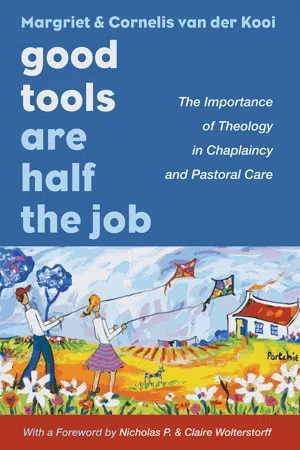
eBook - ePub
Good Tools Are Half the Job
The Importance of Theology in Chaplaincy and Pastoral Care
- 152 pages
- English
- ePUB (mobile friendly)
- Available on iOS & Android
eBook - ePub
Good Tools Are Half the Job
The Importance of Theology in Chaplaincy and Pastoral Care
About this book
This book argues that sound theological foundations are essential for sound pastoral care--and that pastoral care provides a rich resource for fresh, even profound theological reflection.
The chapters present a series of case studies. Each begins with a chaplain's encounter with a patient in crisis, whether from pain, loss, abandonment, trauma, or guilt. The quest for God in these circumstances may be overt but is more often indirect or simply absent. In any case, the chaplain must react, intervene, ask a question, and provide hints as to God's possible presence. Her responses are always theologically driven and pose a challenge to the reader. Do we agree with her response? Would we have chosen a different approach? Should her own faith have been more obvious, or less? Her narrative is then followed by an essay of theological reflection showing what is theologically at stake in each case and what kind of theological tools are available. The book concludes with a theoretical consideration of the benefits of an interdisciplinary conversation between practical and systematic theology, fields that too often remain separate.
Accessible and inspiring, this book itself embodies the combination of sensitivity, wisdom, and mature theology that goes into effective pastoral care.
Information
Topic
Theology & ReligionSubtopic
Christian MinistryChapter 1
Mr. Çakir and the Salvation of the World
Once again Mr. Çakir has been admitted to our psychiatric ward. He is a Muslim, but he always attends church services when he is with us. Now besides that he wants a face-to-face meeting with me since—so he says—God, or rather Allah, has given him a special assignment. We set up a meeting which he starts by telling me about his vision and how it has been met with disbelief or indifference. “I have a big scar on my back from a serious car accident,” Mr. Çakir explains. “The meaning of that scar has now been revealed to me.” He gets up from his chair and declares with a solemn voice: “I am the reincarnation of Jesus Christ and of Mohammed, in one body. I have been told to save the world. I will bring peace to the entire world.”
Then he looks at me very intently. “There is something else. Women with a name starting with the letter M are special. As, for instance, Maryam, whom you call Mary, the mother of Jesus. It has been revealed to me that, since your name starts with an M, you will have an important part in this divine work.” He takes a deep breath: “You will be called the mother.”1
I am neither a psychologist nor a psychiatrist. I know what people will say about Mr. Çakir, and they may be right. Psychotic. Megalomaniac. So it appears. But as a hospital chaplain I have a different role in this case. I need a different sort of diagnostic tool. Among other things, my toolkit has some good theology that helps me to listen closely to what Mr. Çakir is saying.
This man is raising an important issue that I do not want to ignore: the desire for peace and justice, for wholeness, for a world without wounds. I hear the psychosis and megalomania in his words. But I would miss something important if these were the only things I noticed, or if I asked him whether he has taken his medication. There is something very healthy in what Mr. Çakir says: a sorrow that something has gone terribly wrong in the world, which needs to be healed.
I opened my toolkit and responded: “Mr. Çakir, I hear what you are saying. Thanks for sharing your thoughts with me and for your important insight that something must be done to heal and save the world. I fully agree with you. Just like you, I passionately long for peace and justice. And, like you, I do what I can to bring that about.
“Here is what I have to say with regard to your invitation to become the mother of the reincarnation of Jesus and Mohammed. In your tradition of Islam and mine in Christianity, we both believe that, if God calls me for a particular task, he will not only reveal this to you but also to me. So far he has not done so. But I promise you that I will try to listen closely to his voice when I read my Bible and pray.
“My second response is that I believe that the work you so passionately want to do has already been done by Jesus Christ. I also believe that God has promised that he himself will complete this work at the end of time. That is the good news. God is on your side when you say that the world must be recreated and renewed. I trust that God is on his way with this work. You and I can do what lies within our abilities, here and now, in the places where God has placed us. Nothing more and nothing less. You and I cannot bring the world to its final destination. God will bring peace and justice. I fully share that longing with you. Tomorrow I will give you a text that is almost two thousand years old about the coming of God’s kingdom.”
The next day I gave him a magnificent paraphrase of Revelation 21 written by a friend of ours, a great theologian, describing the new heavens and the new earth. I encouraged Mr. Çakir to cherish his desire and not to be distracted or discouraged by others—to hope and work and pray.
He accepted my gift and said, “You really think I can just leave this to God?”
I replied, “I truly believe that we must pray for the coming of God’s kingdom.”
“That is very important,” he answered. As I was leaving he took my hand, laid it on his forehead, and then kissed it.
Walking away, I realized how grateful I am for the tools of my own profession. For the good news that God does not save us from the world but with the world. For his promise about the coming of justice and peace, about goodness, beauty, and truth.
This good news gave me a word for a vulnerable, psychotic person whose heart cherished a wholesome desire. It enabled me to do something different from the task of the doctors. Both tasks are needed but they are different things and must not be confused.
Reflection
Theology and multi-contextuality
Before we deal with the guiding role of the theology that we—consciously or subconsciously—carry with us, we need to say something about the present context of theological reflection as well as pastoral work. Where do we carry out these jobs? Just in church? Or should we broaden out beyond established religious institutions? To ask the question is to answer it. The context of theology has always been broader than the church. In this story it is carried out in a hospital—more precisely, in a closed ward at a psychiatric center. Here we find ourselves far outside the walls of the church, in a medical-care establishment. So in thinking about the importance and meaning of theology, especially of systematic theology, we must not only think of the church, sermons, or formal religious instruction. Systematic theology gets a startling new importance when we, once again, use it to look at the varied domains of real life.
Systematic theology, or dogmatics, is typically regarded as a discipline to be carried out in and about the church. And rightly so: the church and its proclamation are important points of reference. The term “dogmatics” stems from this relationship, for “dogma” first of all means those teachings that the church has determined to be the non-negotiable content of the Christian faith.2 This determination came by way of a process of discovery that grew out of the church’s early core confession regarding Jesus Christ, that “Jesus is Lord.” This confession is the seed from which all Christian dogma has grown. It is also a confession that sheds its light on all aspects of life—on “real life” in its full breadth and diversity. Thus theology and ethics must be linked to a whole range of social realities: our work and professions, sports, medical care, entertainment, and media old and new. Our society in its many dimensions and contexts thus comes into the theological spotlight and makes us come to grips with one the most important functions of dogmatics or systematic theology: to give us orientation, direction, and purpose for navigating the complexities of life.
We will return to this matter at this end of this chapter. But first let’s turn to Margriet’s conversation with Mr. Çakir.
The universality of the living God
In that conversation theological insights clearly exert a guiding influence. First, we notice that Mr. Çakir initiates the conversation. He is a Muslim, and he knows that the chaplain comes from a Christian background. This does not inhibit him from asking to talk; in his view the two religions have enough in common. Both honor Abraham, both assign a role to Jesus or Isa, and both have great respect for the woman Mary, or Maryam. This degree of openness on the part of a Muslim may seem strange to some Christians in light of the question of whether the God they worship is identical with Allah. Some answer this question with a strong “no”: Allah is not the Father of Jesus Christ. What does it mean that Mr. Çakir is not troubled by this?
The actual conversation brings to the surface what the Christian faith and Islam have in common. Both religions worship a personal God, who can act. Both belong to the category of prophetic religions. The Reformed tradition in Christian theology has always offered a clear framework for understanding these and other striking similarities, even the degree of mutual recognition between the two religions. That framework is its doctrine of general revelation.3 Of late this doctrine has received bad press in theological discussions and so has receded into the background. General revelation was rather easily identified with natural theology, that is, as an attempt to arrive at knowledge about God outside of God’s revelation. But traditionally the doctrine of general revelation did not carry this connotation. General revelation was always taken to be the revelation of the living God, of the same God who revealed himself to Israel and in Jesus Christ. He, the living One, was precisely the One who also made himself known in his majesty and glory outside of the stream of salvation history. Therefore, it is better no longer to speak of general revelation but rather of the universality of God. More precisely, of how the working of God’s Spirit touches people and makes them realize what they are missing: completeness, fulfillment. As one of my professors once put it: “God feeds his dearest children with hunger.” That was the case with Mr. Çakir.
Theological tools
Hunger, longing—this is what Mr. Çakir feels amid all his misery: an overpowering, nerve-wracking hunger for a healed world. All the suffering in the world, the destroyed lives, the tragedies, the lack of fulfillment, the endless violations of persons and nature—it seems to spell chaos.
Mr. Çakir is the victim of chaos. He is being treated in the psychiatric ward because his own environment apparently could no longer cope with him. Perhaps he was a danger to himself and had lost touch with reality. The medical experts in this ward are sure of their diagnosis that he is suffering from psychoses. And that is what he is being treated for.
What can a chaplain do in such circumstances? She may be inclined to simply go along with the psychiatrist’s assessment: this is a case of psychosis which has robbed the patient of his contact with reality, and his mental problems are expressing themselves through his delusions. Look at his grandiose “calling”: the world is in trouble and he must play a crucial role in its salvation! The unique and perhaps also surprising element in the chaplain’s interaction with Mr. Çakir is that she ignores the medical and psychiatric aspects of the situation. As a theologian she has her own instruments. She does not enter the field of psychiatric evaluation, but listens to Mr. Çakir’s story with the ears of her own discipline, relying on what theology may offer her. Put another way, she does not join in the exclusive medicalization of the problem but taps some religious and theological resources.
We have gradually become accustomed to the medicalization of a great many of our problems. Dying, suffering, profound weari...
Table of contents
- Title Page
- Foreword
- Introduction
- Chapter 1: Mr. Çakir and the Salvation of the World
- Chapter 2: Stones for Bread
- Chapter 3: The Child Who Steps Up
- Chapter 4: We Are Yours, Evil as We Are
- Chapter 5: Ibrahim
- Chapter 6: It Was Never Enough
- Chapter 7: Voices
- Chapter 8: Is It Never Enough?
- Chapter 9: Secrets
- Chapter 10: Dave
- Chapter 11: On Prophecy, True and False
- Chapter 12: Mary, the Mother of the Lord
- Chapter 13: In the Circle of Light
- Chapter 14: Everything Must Have a Reason
- Chapter 15: Lethal Injection
- Chapter 16: Using the Theological Toolkit
- Acknowledgements
- Bibliography
Trusted by 375,005 students
Access to over 1.5 million titles for a fair monthly price.
Study more efficiently using our study tools.
Frequently asked questions
Yes, you can cancel anytime from the Subscription tab in your account settings on the Perlego website. Your subscription will stay active until the end of your current billing period. Learn how to cancel your subscription
No, books cannot be downloaded as external files, such as PDFs, for use outside of Perlego. However, you can download books within the Perlego app for offline reading on mobile or tablet. Learn how to download books offline
Perlego offers two plans: Essential and Complete
- Essential is ideal for learners and professionals who enjoy exploring a wide range of subjects. Access the Essential Library with 800,000+ trusted titles and best-sellers across business, personal growth, and the humanities. Includes unlimited reading time and Standard Read Aloud voice.
- Complete: Perfect for advanced learners and researchers needing full, unrestricted access. Unlock 1.5M+ books across hundreds of subjects, including academic and specialized titles. The Complete Plan also includes advanced features like Premium Read Aloud and Research Assistant.
We are an online textbook subscription service, where you can get access to an entire online library for less than the price of a single book per month. With over 1.5 million books across 990+ topics, we’ve got you covered! Learn about our mission
Look out for the read-aloud symbol on your next book to see if you can listen to it. The read-aloud tool reads text aloud for you, highlighting the text as it is being read. You can pause it, speed it up and slow it down. Learn more about Read Aloud
Yes! You can use the Perlego app on both iOS and Android devices to read anytime, anywhere — even offline. Perfect for commutes or when you’re on the go.
Please note we cannot support devices running on iOS 13 and Android 7 or earlier. Learn more about using the app
Please note we cannot support devices running on iOS 13 and Android 7 or earlier. Learn more about using the app
Yes, you can access Good Tools Are Half the Job by Margriet van der Kooi,Cornelis van der Kooi in PDF and/or ePUB format, as well as other popular books in Theology & Religion & Christian Ministry. We have over 1.5 million books available in our catalogue for you to explore.