eBook - ePub
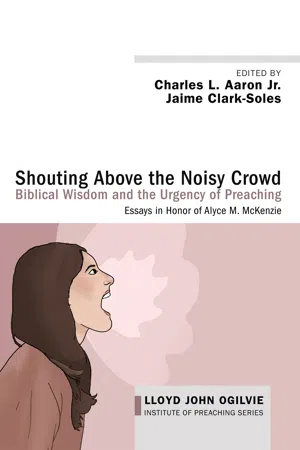
Shouting Above the Noisy Crowd: Biblical Wisdom and the Urgency of Preaching
Essays in Honor of Alyce M. McKenzie
- 132 pages
- English
- ePUB (mobile friendly)
- Available on iOS & Android
eBook - ePub
Shouting Above the Noisy Crowd: Biblical Wisdom and the Urgency of Preaching
Essays in Honor of Alyce M. McKenzie
About this book
What could we accomplish if only we acted more wisely? Could we mitigate the effects of diseases; help the vulnerable feel safer; make progress on justice; cooperate on common problems? We don't see enough wisdom, but neither did Woman Wisdom herself, who cried out in the streets wanting to gain attention. For every preacher who feels the urgency for more wisdom, this book has heard you. We know the urgency and we want to help.
Information
Topic
Teología y religiónSubtopic
Ministerio cristiano1
Wisdom’s Cry and the Task of Preaching
What does the striking image of Woman Wisdom calling out in the streets in Prov 1:20–21 have to say to preachers about the nature and urgency of the preaching task? Exploration of this question builds on and honors the work of Alyce McKenzie, who has written extensively on models of preaching derived from the wisdom literature in Scripture. McKenzie encourages wisdom preachers to adopt the role of the sage, and to nurture the virtues they extol: reverence for God, attentiveness, self-discipline, and a capacity for subversiveness.1 She argues that the metaphor of the preacher as sage is particularly suited to our times, in which people are seeking wisdom and often finding it in self-help books and the like, whereas Christian preachers can offer deeper and more sustaining wisdom from the wisdom literature in Scripture, and by modeling themselves after the sages who speak in this literature.
In general, McKenzie derives the characteristics of wisdom preachers from the sages themselves, and the traits they commend in wisdom literature, suggesting that preachers model themselves after these traits. However, she also considers the possibility that contemporary preachers could model themselves after Woman Wisdom herself. She notes that some dismiss Woman Wisdom as a model for preachers, pointing to the fact that she speaks only to young men, that she personifies Folly as a woman, and that some of the proverbs attributed to her are misogynist. For these reasons, some consider Woman Wisdom too allied with elitist interests and with the status quo to inform our understanding and practice of preaching. However, McKenzie maintains that there is a subversive element in the metaphor of Woman Wisdom, an element that influenced Jesus and that can continue to influence preachers today.
Building on this suggestion, in this essay I will argue that Woman Wisdom is at her most subversive in her first appearance in Proverbs, in Prov 1:20–33, when she raises her voice in the public square and calls out for followers, condemning in no uncertain terms those who reject her invitation. At this moment in particular, Woman Wisdom disrupts patriarchal culture and its expectations for women’s behavior. She uses the fullness of her voice to claim the right to speak in public, breaking taboos both ancient and modern against women’s public speech. Not only does she speak in public, but she does so with urgency and prophetic fervor, again rejecting common expectations about what a woman “ought” to sound like. This first utterance of Woman Wisdom offers a galvanizing and empowering image not only for women, but for preachers in general, providing them with a mandate to similarly break taboos against public speech, and to claim a powerful and urgent voice in the public square, as Woman Wisdom does.
I. Woman Wisdom: Resonances of the Metaphor
In the strongly patriarchal society of ancient Israel, it is surprising that wisdom literature personifies wisdom as female, establishing Woman Wisdom as a central and powerful figure in Proverbs and other wisdom literature. There had to have been significant benefits in this symbolization of wisdom as female to overcome the cultural forces that would have made such a choice unlikely. Claudia Camp investigates the reasons for this choice, exploring the resonance that accrues to the metaphor of Woman Wisdom by virtue of her being female. Camp points out that metaphors work by “conjoin[ing] the semantic field of two words in such a way as to create new meaning.”2 One of the two words is better known than the other, and becomes the “focus” through which the lesser known word, the “frame,” is interpreted. In this instance, “woman” is the better known term, through which “wisdom,” which is an abstract quality and thus less immediately well known, is interpreted. Camp then notes: “To claim that ‘woman’ is the better known term, however, already begs the question, ‘what exactly is it that is known about her?’”3 Camp’s project, then, is to elucidate both the social roles and the literary images attached to women in postexilic Israel, so as to suggest how these roles and images shape the meaning of the term “woman” in the metaphor, through which the idea of “wisdom” is interpreted.
Camp argues that the meaning of the metaphorical relationship between “woman” and “wisdom” derives from the social roles that women filled in postexilic Israel. As the idealized portrait of the “woman of worth” in Prov 31 attests, women functioned as the anchor of the home: they were the house-builders, providers, counselors, hostesses, and the teachers of wisdom to their own children. Their authority was in the domestic sphere, at a time when that domestic sphere was attaining greater importance, with the decline of other societal institutions: “with the collapse of the nation-state, the household became, for the first time in five hundred years, the focus of Israelite identity.”4 The focus on the household shifted a certain amount of societal power to women; women became the glue that held together a society in crisis. As Ellen Davis notes:
In sum, the woman was to a great extent responsible for maintaining faithful living in Israel. She had assumed many of the mediating, instructional, and guiding functions once performed by the important national figures of priest, prophet, and king. No wonder, then, that when Wisdom came to be personified, it was as a woman, builder and sustainer of the household.5
The wisdom tradition sought to stabilize a society in crisis, and did so by personifying Wisdom as a woman, that figure who was a primary stabilizing force in the society itself.
Comparing Woman Wisdom to the social situation of women in postexilic Israel helps the sages describe how wisdom works. For instance, wisdom teaching is grounded in the private and domestic spheres, just as women are in postexilic Israel; their society-sustaining influence goes beyond the home only indirectly. The “woman of worth” in Prov 31 functions predominantly in her home, but her works there are of such quality that they praise her “in the gates.” In Prov 9, likewise, Woman Wisdom builds a house for herself and then invites others into it; she herself does not venture out into the public square, although her invitation does. This depiction of Woman Wisdom as operating chiefly in private domains symbolizes the way that the wisdom tradition exerts its influence: it is not grand, public theology, but rather a set of home truths that speak directly to everyday domestic life, and which only from there indirectly influence the public sphere.
In general, wisdom rules by indirection, in the way women do in patriarchal societies such as ancient Israel. Camp notes that “the exclusion of women (as of any disenfranchised group) from the established hierarchies of authority and power in a society obviously must lead them to utilize less direct means to achieve their goals.”6 She points to various women throughout the Bible who exercise power by indirect means, such as Sarah, Rebekah, Ruth, and Naomi. Taken together, these examples suggest a theological motif of “female initiative on God’s behalf by indirect means.”7 In each case, a woman operates without guidance from God, yet achieves God’s purposes; moreover, “that purpose accomplished by the women includes the disruption of the established hierarchies of society which inhibit both human life and Yahweh’s action and the creation of a new order of life and freedom for...
Table of contents
- Title Page
- Preface
- Biography
- Contributors
- Chapter 1: Wisdom’s Cry and the Task of Preaching
- Chapter 2: When Worldviews Collide
- Chapter 3: Is Preaching Political?
- Chapter 4: Postmodern Wisdom Homiletics
- Chapter 4: Preaching and the Wisdom of God
- Chapter 6: Ephobounto gar
- Chapter 7: “Simpletons, Scoffers, and Fools”
- Chapter 8: Born of Zion
- Chapter 9: God’s Holy Place
- Chapter 10: “The Wisdom to Know the Difference”
- Chapter 11: “Embodying Wisdom Under Imperial Duress”
- Chapter 12: Wisdom and Social Media
- Bibliography
Trusted by 375,005 students
Access to over 1.5 million titles for a fair monthly price.
Study more efficiently using our study tools.
Frequently asked questions
Yes, you can cancel anytime from the Subscription tab in your account settings on the Perlego website. Your subscription will stay active until the end of your current billing period. Learn how to cancel your subscription
No, books cannot be downloaded as external files, such as PDFs, for use outside of Perlego. However, you can download books within the Perlego app for offline reading on mobile or tablet. Learn how to download books offline
Perlego offers two plans: Essential and Complete
- Essential is ideal for learners and professionals who enjoy exploring a wide range of subjects. Access the Essential Library with 800,000+ trusted titles and best-sellers across business, personal growth, and the humanities. Includes unlimited reading time and Standard Read Aloud voice.
- Complete: Perfect for advanced learners and researchers needing full, unrestricted access. Unlock 1.5M+ books across hundreds of subjects, including academic and specialized titles. The Complete Plan also includes advanced features like Premium Read Aloud and Research Assistant.
We are an online textbook subscription service, where you can get access to an entire online library for less than the price of a single book per month. With over 1.5 million books across 990+ topics, we’ve got you covered! Learn about our mission
Look out for the read-aloud symbol on your next book to see if you can listen to it. The read-aloud tool reads text aloud for you, highlighting the text as it is being read. You can pause it, speed it up and slow it down. Learn more about Read Aloud
Yes! You can use the Perlego app on both iOS and Android devices to read anytime, anywhere — even offline. Perfect for commutes or when you’re on the go.
Please note we cannot support devices running on iOS 13 and Android 7 or earlier. Learn more about using the app
Please note we cannot support devices running on iOS 13 and Android 7 or earlier. Learn more about using the app
Yes, you can access Shouting Above the Noisy Crowd: Biblical Wisdom and the Urgency of Preaching by Charles L. Aaron Jr.,Dr. Jaime Clark-Soles, Charles L. Aaron, Jaime Clark-Soles in PDF and/or ePUB format, as well as other popular books in Teología y religión & Ministerio cristiano. We have over 1.5 million books available in our catalogue for you to explore.