- 126 pages
- English
- ePUB (mobile friendly)
- Available on iOS & Android
eBook - ePub
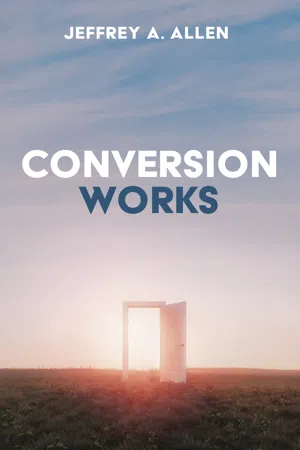
Conversion Works
About this book
In this book, conversion means abandoning a world view and starting over. Using this definition of conversion, the book examines four works: Augustine of Hippo's Confessions, Rene Descartes's Meditations on First Philosophy, Bernard Lonergan's Insight: A Study of Human Understanding, and Peter Weir's The Truman Show. The main argument of this book is that all four works contain and induce conversion. That is, all four works feature an individual who abandons a worldview and starts over, and all four works exhort their engager to do the same. This book also explores the works' requirement of cognitive imitation, wherein a person replicates the mental activities of the individual who has a conversion in the work, and of private engagement, wherein a person reads or views the work while alone. The book concludes with an argument for the educational value of the four works that appropriates Ernest Becker's The Denial of Death.
Information
Topic
PhilosophySubtopic
Ethics & Moral Philosophy1
Conversion in Book VII of Augustine of Hippo’s Confessions
Background
Augustine was born on November 13, 354 in the town of Thagaste (present-day Souk Ahras, Algeria). In adulthood, he would become bishop of Hippo (present-day Annaba, Algeria), thus he is typically referred to in English as Augustine of Hippo. Augustine’s parents, Patrick and Monica, owned farmland and were of modest economic standing.1 Patrick was a pagan; Monica was a devout Christian. Patrick died in 372, converting to Christianity on his deathbed.
Around the time his father died, Augustine went away to Carthage for the present-day equivalent of university. While there, he read Cicero’s Hortensius, which warns that happiness is found in the pursuit of truth rather than in the pursuit of pleasure.2 This raised deep philosophical and religious questions in Augustine’s mind.3 Having attended church with Monica, the answers provided by the Bible were known to Augustine, but they did not intellectually satisfy him.4 At Carthage, Augustine was also exposed to Manichaeism, a relatively new religion. Manichaeism stemmed from Mani, who was born c. 216 in Babylonia. As Kevin Coyle explains, Mani believed that “previous revelations from God, especially to Buddha, Zoroaster, and Jesus [were] authentic but incomplete”—and that he should “bring divine revelation in full to the world.”5 Manichees held that a battle between light and darkness was being waged throughout the universe. The victory of the light would come in part through the denial of human pleasure, thus Manichaeism had a certain affinity to the warning of Cicero in Hortensius. Augustine eventually joined the religion as a Hearer. A Hearer had fewer strictures than the Elect; for example, a Hearer could marry, whereas the Elect could not.6 Augustine would remain a Hearer for nine years—specifically, from the ages of nineteen to twenty-eight.7
Augustine commenced a teaching career in 375 that included literature, rhetoric, and dialectic. He taught in his birthplace of Thagaste, as well as in Carthage, Rome, and Milan. When he arrived in Milan in 384, his belief in Manichaeism had significantly waned; this opened up the possibility of conversion.8 At this crucial juncture, Augustine met Ambrose, the bishop of Milan. Ambrose appropriated elements of Neoplatonism into his preaching and put the Bible in a new light for Augustine.9 Peter Brown holds that it is hard to determine the precise level of Ambrose’s influence on what this book refers to as Augustine’s conversion.10 What is clear is that Ambrose bolstered Augustine’s decision to give Christianity a new hearing.11 The ultimate outcome of that new hearing was an affirmation of Christianity in 386 and baptism by Ambrose in 387. Monica, who had hoped for this moment for so long, passed away not long after it occurred.
In 391 Augustine was ordained a priest. The details of his ordination are startling to our sensibilities today. While Augustine was attending Sunday church service, Valerius, bishop of Hippo, said that he was in need of a new priest and that Augustine would be good for the role.12 This did not result in a long period of reflection by Augustine. Instead, as Henry Chadwick writes, ordination was “forced upon [him] by the coercion of the congregation. Augustine was allowed no escape, and had to submit.”13 B...
Table of contents
- Title Page
- Introduction
- Chapter 1: Conversion in Book VII of Augustine of Hippo’s Confessions
- Chapter 2: Conversion in the First and Second Meditation in René Descartes’s Meditations
- Chapter 3: Conversion in Chapters 1 to 11 of Bernard Lonergan’s Insight
- Chapter 4: Conversion in Peter Weir’s The Truman Show
- Chapter 5: Conversion Works, Ernest Becker’s The Denial of Death, and Education
- Bibliography
Trusted by 375,005 students
Access to over 1.5 million titles for a fair monthly price.
Study more efficiently using our study tools.
Frequently asked questions
Yes, you can cancel anytime from the Subscription tab in your account settings on the Perlego website. Your subscription will stay active until the end of your current billing period. Learn how to cancel your subscription
No, books cannot be downloaded as external files, such as PDFs, for use outside of Perlego. However, you can download books within the Perlego app for offline reading on mobile or tablet. Learn how to download books offline
Perlego offers two plans: Essential and Complete
- Essential is ideal for learners and professionals who enjoy exploring a wide range of subjects. Access the Essential Library with 800,000+ trusted titles and best-sellers across business, personal growth, and the humanities. Includes unlimited reading time and Standard Read Aloud voice.
- Complete: Perfect for advanced learners and researchers needing full, unrestricted access. Unlock 1.5M+ books across hundreds of subjects, including academic and specialized titles. The Complete Plan also includes advanced features like Premium Read Aloud and Research Assistant.
We are an online textbook subscription service, where you can get access to an entire online library for less than the price of a single book per month. With over 1.5 million books across 990+ topics, we’ve got you covered! Learn about our mission
Look out for the read-aloud symbol on your next book to see if you can listen to it. The read-aloud tool reads text aloud for you, highlighting the text as it is being read. You can pause it, speed it up and slow it down. Learn more about Read Aloud
Yes! You can use the Perlego app on both iOS and Android devices to read anytime, anywhere — even offline. Perfect for commutes or when you’re on the go.
Please note we cannot support devices running on iOS 13 and Android 7 or earlier. Learn more about using the app
Please note we cannot support devices running on iOS 13 and Android 7 or earlier. Learn more about using the app
Yes, you can access Conversion Works by Jeffrey A. Allen in PDF and/or ePUB format, as well as other popular books in Philosophy & Ethics & Moral Philosophy. We have over 1.5 million books available in our catalogue for you to explore.