- 408 pages
- English
- ePUB (mobile friendly)
- Available on iOS & Android
eBook - ePub
About this book
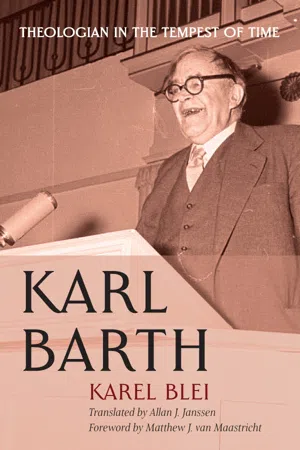
The Swiss theologian Karl Barth (1886-1968) was one of the greatest theologians of the twentieth century. This book shows how German and European history of that century--the First World War, the rise of Hitler, the German church struggle--resonates in the theological work of Barth. He opposed National Socialism and criticized the naturalness with which the West got carried away in the Cold War rhetoric after the Second World War. A beautiful, accessible overview work for anyone who wants to get to know Barth better.
Information
Topic
Theology & ReligionSubtopic
Christian Denominations1
Introduction
1.1 Then It Happened
Sometimes the voice of the church speaks from an unexpected quarter. Articulated not by church leaders (pope, bishops, synods) but by ordinary church members. Not by virtue of official mandate but from a particular initiative, under the press of need. People appear in the time of crisis who advance something that clarifies the situation and points a way forward. That which is so convincing, so in sync with the biblical message that others hear and recognize what must be said today in the name of the church. Or put more strongly, the authentic voice of the church itself is recognized in these words. Recognition will become widespread at a later time.
Something like that occurred in Germany in 1934. Adolf Hitler had very recently come to power to massive acclamation. From the outset he left no doubt as to what he intended—the aim of his Kampf. For him and his compatriots in the National-Socialist movement, it was about the purity and the possibilities of the German race embodied in the German people. That must be strengthened and maintained. To that end, every element alien to this race must be eliminated, including, specifically, the Jews. As representatives of a different race, they should have no home in Hitler’s Germany.
Among his efforts, Hitler intended to involve the churches, beginning with the Protestants. He succeeded. A unified structure was instituted. The German Evangelical Church (an umbrella organization of a number of regional churches) came under the control of the state. A “bishop,” a henchman of Hitler, became the central leader. A new ecclesiastical rule was instituted on the order of the new powers, one that determined that Jews (Jewish Christians) could no longer be church members in a real sense. Enthusiasm for the “new Germany” also reigned among German Protestants. A group who called themselves “German Christians” (and of whom representatives had in the meantime taken all the leading positions via ecclesiastical elections) declared the complete agreement between Christian faith and National Socialism. Had the difference between races not been given in God’s creation? In the rise of Hitler, one saw a great event, a new opportunity given by God, for the German people and for the church.
Still, this did not happen without resistance. A church conflict broke out in Germany. A small minority protested. They organized themselves within the German Evangelical Church as a particular, alternative church body: the “Confessing Church.” In May 1934, this “Confessing Church” held a first synod, in Barmen. There a declaration was accepted in which the view of the “German Christians”—and hence implicitly National Socialism—was rejected. The declaration consisted of six theses, each beginning with a positive confession and continuing with the rejection of what was called a “false teaching.”
The main author of the declaration was the Swiss theologian Karl Barth, active in Germany beginning in 1921.
1.2 The Barmen Declaration
The first thesis puts it strikingly:
Jesus Christ, as he is testified to us in the Holy Scripture, is the one Word of God, whom we are to hear, whom we are to trust and obey in life and in death. We repudiate the false teaching that the church can and must recognize yet other happenings and powers, images and truths as divine revelation alongside this one Word of God, as a source of her preaching.1
It is not said in so many words that the events of 1934 with the rise of Hitler as the new leader (Führer) are what is meant concretely by the last part. But at the time it would have been clear to everyone.
Consequences are drawn in the theses that follow. They speak of obedience to Christ as valid for all of life, the organization of the church, the relation of church and state, and the freedom of the church in the fulfillment of her task. No area falls outside obedience to Christ, including politics and society. The organization of the church, or the formation of its leadership, cannot and may not be left to a particular politics or worldviews that may dominate at a given moment. The state, an instrument given by God in the aid of justice and peace, exceeds its authority if it would regulate all of life and society and thus, as it were, itself becomes “church.” The church retains its peculiar task over and against the state reminding rulers (and the ruled!) of God’s kingdom and command; it may not allow itself to be co-opted by political powers as an “organ of the state.”
However generally formulated, the conditions of the time stand in the background of these theses. It was the pretension of the National Socialist state to regulate all of life and society, including one’s philosophy of life. State policy had as its goal, the co-optation of the church. And there was a readiness within the church itself to allow that to happen. A church that allows itself to be co-opted apparently gets wonderful opportunities and an influential position in the society. But it has become speechless as far as its real task is concerned. In 1934 that was the case.
We already saw that the synod of Barmen represented only a small minority of the German Evangelical Church and of the German people as a whole. Afterwards, the German resistance to Hitler found in it its source of inspiration, but that resistance was never very successful. Only later, was the Barmen Declaration recognized by many as a clarifying and guiding word, as an authentic witness of the Church of Christ and thus also as important in new situations.
1.3 The Theology of Karl Barth
As said before, the main author of the draft Barmen text was Karl Barth.
The first thesis, especially, is a concise summary of his theology. It also shows how much that theology, as real theology, was committed to the trend of the time. Theology, as Barth had stated it before and as he would continue saying, totally lives on God’s Word, God revealing himself in Jesus Christ. One should refrain from looking for bridges through which people could come from themselves in the direction of God. One should stop looking for clues in humans themselves to understand who “God” is. The idea that bridges or clues would exist is an illusion. God is different; not just greater or more powerful or wiser than we are, but completely different. In theology, as in faith, we simply have to bow before the Word, which authoritatively comes to us; before Jesus Christ in Whom God has already mercifully come to us.
Barth’s concentration on Jesus Christ as “the one Word of God,” where over and against or where alongside nothing other can count as God’s revelation, sounds strong, cold. Can human religious effort and feelings be simply, radically cut off? Is this not in essence a seriously narrow outlook? Does that not enclose Christians as if they alone are right, in the midst of a world that is completely mistaken religiously? So, it was questioned, and still is. Certainly, in a time like our own where alongside Christianity (other) world religions emphatically manifest themselves and all sorts of private forms of religiosity bloom lushly, a theology like Barth’s appears to have little more to say. It certainly hardly appears to be appropriate in the interreligious discussion as that is the order of the day.
Despite these and other reservations, old and new, it is good to note that Barth’s radical concentration on Jesus Christ as “the one Word of God,” was not an arm-chair theology in the Germany of 1934; not the thinking of a scholar isolated in his ivory tower. His thought was directly related to what was going on in society and in the church. It warned of threatening dangers, and it pointed a way out of the confusion.
In some situations, matters cannot be left open. Decisions and choices must then be made. That was the situation in Germany, 1934. Barth did not shrink from speaking decisively. Not everyone praised him, even then. Later, few would find that to be unnecessary, and there were even voices that argued that it should have been still more radical.
1.4 Relevance
The question, however, is whether decisiveness in theology and in the church is not always necessary, in other contexts as well and precisely in times of meeting with those who think and believe differently. Does not the Christian faith in its particularity threaten to be overwhelmed in an (inter)religious vagueness? That question makes clear that Barth’s theology cannot be written off for good.
A number of churches have referred to the Barmen Declaration in their church order. That is the case with the Protestant Church in the Netherlands. Article 1-5 of its church order reads: “The church acknowledges the significance of the theological Declaration of Barmen for confessing today.” It is true: this is very carefully formulated. It is not said in what significance this declaration consists. Still it says a great deal that the declaration is referred to here. “Barmen” obtains as a model for how confession can (could) occur in the modern era (in the twentieth century). Does that not say something about the significance that Karl Barth’s theology itself still has today?
This theologian and this theology still deserve consideration. No other theologian has so dominated (Protestant) theology of the twentieth century. This is certainly the case in the Netherlands. His influence on ecclesiastical life in that country has been immense. He inspired the ecclesiastical resistance to Hitler, not only in Germany but also in the Netherlands (and elsewhere). Moreover, the renewal that took place in the Netherlands Reformed Church in and after the Second World War—in the ...
Table of contents
- Title Page
- Foreword
- Note on the Translation
- Abbreviations
- Chapter 1: Introduction
- 1.1 Then It Happened
- 1.2 The Barmen Declaration
- 1.3 The Theology of Karl Barth
- 1.4 Relevance
- 1.5 The Aim of This Book
- Chapter 2: Early Years
- 2.1 Youth and Education
- 2.2 Ministry: Geneva, Safenwil
- 2.3 The Outbreak of the First World War
- 2.4 Meeting with Blumhardt
- 2.5 Reading the Bible Anew: The Epistle to the Romans
- 2.6 The Christian’s Place in Society
- 2.7 Towards the Second Edition of The Epistle to the Romans
- 2.8 The Accidental Bell-ringer
- Chapter 3: Dialectical Theology
- 3.1 From Pulpit to Lectern
- 3.2 Göttingen
- 3.3 Honorary Doctorate
- 3.4 The Task of Theology
- 3.5 The Impossibility of Theology
- 3.6 Clashes, Reservations
- 3.7 Associates
- Chapter 4: Towards His Own Dogmatics
- 4.1 Theology as Footnote
- 4.2 Problems in Göttingen
- 4.3 A Path through the Jungle
- 4.4 Acquaintance with Reformed Orthodoxy
- 4.5 The Church Fathers and Scholasticism
- 4.6 Münster
- 4.7 Accountability to the Nineteenth Century
- 4.8 “Church and Culture.” The Speech at Amsterdam
- 4.9 Dutch Reactions
- 4.10 Dogmatics in Service of Preaching
- 4.11 A Dogmatics in Draft
- 4.12 Charlotte von Kirschbaum
- Chapter 5: The 1930s: On a Definite Theological Course
- 5.1 Anselm as Crown’s Witness and Ally
- 5.2 Anselm’s Proof for the Existence of God
- 5.3 On Anselm’s Theological Program
- 5.4 Anselm: No Apologete but Witness
- 5.5 Theology of the Name
- 5.6 New Beginning: The Church Dogmatics
- 5.7 Self-correction
- Chapter 6: The German Church Conflict
- 6.1 Hitler Comes to Power
- 6.2 “The Need of the Evangelical Church”
- 6.3 Dogmatics over and against the Self-Consciousness of the Church
- 6.4 In Continuing Discussion with Schleiermacher
- 6.5 The Church Following Hitler
- 6.6 “Theological Existence Today!”
- 6.7 The “German Christians” and the Vulnerability of the Church
- 6.8 Tensions among Comrades
- Chapter 7: Barmen 1934 and Consequences
- 7.1 The Onset of Ecclesiastical Protest
- 7.2 The Barmen-Gemarke Declaration
- 7.3 The Barmen Theses
- 7.4 Barmen and the Jews
- 7.5 Barmen and National Socialism
- 7.6 Leaving Bonn
- 7.7 Utrecht Lectures on the Apostles’ Creed
- 7.8 The Situation in Germany Compared with That in the Netherlands
- 7.9 Back to Switzerland
- Chapter 8: A More Radical Rejection of National Socialism
- 8.1 Parting Words to Germany: “Gospel and Law”
- 8.2 Further with the Dogmatics. On God’s Revelation
- 8.3 Sympathy for Germany
- 8.4 Appeal for Political Resistance: A Letter to Former Students
- Chapter 9: On the Eve of the Second World War
- 9.1 Solidarity with Czechoslovakia: Letter to Josef Hromádka
- 9.2 On the Scots Confession: Armed Resistance May be Necessary
- 9.3 On the Relation of Church and State
- 9.4 Criticism Focused: The Jewish Question as a Question of Faith
- 9.5 In the Netherlands. Christian Faith and Threatened Humanity
- 9.6 The Problem of Infant Baptism
- 9.7 Speaking of “God” in a Catastrophic Time
- Chapter 10: A Voice from Switzerland in the War Years
- 10.1 Advice on Personal Authority
- 10.2 The First Months of the War. Letter to France
- 10.3 It is about Life, Including for the German People
- 10.4 Following the French Defeat: The Facts and the Word
- 10.5 Letter to Great Britain
- 10.6 Faith in Christ as the Deepest Reason to Struggle
- 10.7 Christmas Greetings to Germany
- 10.8 Radio Message to Norway
- 10.9 Questions from the Netherlands
- 10.10 The “Illegal” as the Genuinely Legal
- 10.11 The Neutrality of Switzerland: A Matter of Principle
- 10.12 A New Part of the Dogmatics: On God as an Electing God
- 10.13 Israel and the Church: Distinct but Together
- 10.14 “Then Shall I Know Fully . . .”
- Chapter 11: 1944–1945: “How Can the Germans be cured?”
- 11.1 A Period of Silence on the War
- 11.2 “The Teaching of the Church Regarding Baptism”
- 11.3 The War Changes. What the Church is in a Position to Do Now
- 11.4 Striking a New Key. “The Germans and Ourselves”
- 11.5 “How Can the Germans be Cured?”
- 11.6 Direct Contact with Germany Renewed
- 11.7 First Post-war Visit to Germany: New Beginnings of the German Church
- 11.8 Necessary Steps for a New Way of Being Church
- 11.9 The Stuttgart Confession of Guilt, a Compromise Text
- 11.10 Again in Germany: “A Word to the Germans”
- 11.11 Further with the Dogmatics. The Doctrine of Creation
- Chapter 12: Guest Professor in Post-war Germany
- 12.1 Summer, 1946: Guest Professor at Bonn
- 12.2 “Dogmatics in Outline”
- 12.3 “Christian Community and Civil Community”
- 12.4 Frustrations with the German Church
- 12.5 A Contribution to the Ecumenical Reflection on the Church
- 12.6 Summer 1947. Again in Bonn
- 12.7 The Christian Doctrine According to the Heidelberg Catechism
- 12.8 Again with the Apostles’ Creed
- 12.9 On the Sacraments
- 12.10 “Protestant Theology in the Nineteenth Century”
- Chapter 13: Further with the Dogmatics. On the human
- 13.1 A Critical Look at the German Church
- 13.2 The Darmstadt Declaration
- 13.3 Reactions
- 13.4 Dogmatic Reflection on Human Existence: Jesus as the True Human
- 13.5 Human Nature: In Relation to God and the Fellow Human.
- 13.6 The Human as Soul and Body
- 13.7 The Human, Living in Time
- Chapter 14: Between East and West
- 14.1 Continuing to Live and Work in Basel
- 14.2 Visit to Hungary, March-April, 1948
- 14.3 The Church and the Changing Structures in the State
- 14.4 Concrete Questions
- 14.5 Reportage to the Swiss Homefront
- 14.6 The Critical Reaction of Emil Brunner
- 14.7 Again: Theological Existence Today
- 14.8 Amsterdam, Summer 1948: Founding Assembly of the World Council of Churches
- 14.9 The Church between East and West
- 14.10 “Now No Choice of Parties!”
- Chapter 15: Does Life Stand under God’s Leading? The Doctrine of Providence
- 15.1 Church Dogmatics Continued
- 15.2 The “Christological Thread” of Belief in Providence
- 15.3 The King of Israel is the King of the World
- 15.4 The Jews as Sign
- 15.5 Reactions. Questions
- 15.6 The Reality of Evil
- Chapter 16: Swimming against the Tide
- 16.1 The 1950s. Discussion of German Rearmament
- 16.2 Rumor in the Swiss Media
- 16.3 The Accusation of Politician Markus Feldmann
- 16.4 Again on “Christian Community and Civil Community”
- 16.5 A Short Retrospect: Democracy or Theocracy?
- 16.6 Distance from Pro-Communist Standpoints. Letter to Albert Bereczky
- 16.7 “Political Decisions in the Unity of Faith”
- Chapter 17: Ethical Reflection: The Command of God the Creator
- 17.1 Ethics as Part of Dogmatics
- 17.2 The Human as Creature under God’s Command
- 17.3 Called to Freedom Before God. Sabbath
- 17.4 Called to Freedom in Co-humanity. Man and Woman
- 17.5 Called to Freedom to Live
- 17.6 Called to the Protection of Life: Limit Cases
- 17.7 War: Not Normal, but Sometimes Necessary
- 17.8 Called to Active Life: The Meaning of Work
- 17.9 The Social Question
- 17.10 Affinity with Socialism
- 17.11 Called to Freedom within Limits
- Chapter 18: The Heart of the Dogmatics: The Doctrine of Reconciliation
- 18.1 Still not Retired
- 18.2 Reconciliation as a Dogmatic Theme? Rudolf Bultmann
- 18.3 Critical Questions to Bultmann
- 18.4 The Doctrine of Reconciliation: Incomplete, Last Great Undertaking
- 18.5 Reconciliation as Fulfillment of the Covenant
- 18.6 Jesus Christ, the Mediator
- 18.7 Christ’s Humiliation and Exaltation
- 18.8 A Different Doctrine of Reconciliation than that of Anselm
- 18.9 The Way of God’s Son into the Depths, “Into the Far Country.” Jesus, the Jew
- 18.10 The Way of Obedience. The Unity of God
- 18.11 Reconciliation: God as the Triune God in Action
- 18.12 The Judge Judged in Our Place
- 18.13 The Judgment of the Father: The Resurrection of Christ.
- Chapter 19: The Doctrine of Reconciliation from Another Perspective
- 19.1 Continuing Concentration on Reconciliation
- 19.2 The Human is also the Subject of Reconciliation
- 19.3 Jesus Christ: The Exalted Human
- 19.4 Again, the Meaning of Easter
- 19.5 A Paragraph on the Life of Jesus
- 19.6 Dogmatics as Re-narration of the Gospel Story. Jesus, the Royal Human
- 19.7 Jesus’ Royal Speech
- 19.8 Jesus’ Royal Action
- 19.9 The Cross as Coronation
- 19.10 Jesus’ Human Nature and Ours
- 19.11 Sin as Pride and as Sloth
- 19.12 Reconciliation Focused: Justification, Sanctification
- Chapter 20: Other Activities. Current Discussions
- 20.1 Lecture on “Freedom,” September 1953
- 20.2 “In theology, begin at the beginning, with God”
- 20.3 Wiesbaden, November 1954: Speech in Memory of Victims of War
- 20.4 Involvement in Ecumenical Work. “Continental” vis-à-vis “Anglo-Saxon” Theology
- 20.5 The Discussion of Christian Hope
- 20.6 The Commission Report on Christian Hope
- 20.7 Missing: Hope for Israel
- 20.8 Critical Voices. Dietrich Bonhoeffer on Barth’s “Revelation Positivism”
- 20.9 The Dutch Neo-Calvinists. The New Barth Interpretation of G.C. Berkouwer
- Chapter 21: New Accent on the Humanity of God
- 21.1 The Doctrine of Reconciliation: Still Incomplete
- 21.2 Seventieth Birthday. The Festschrift Answer
- 21.3 “The Humanity of God”
- 21.4 Protestant Theology in the Nineteenth Century: A Revaluation.
- 21.5 Rising Tensions between East and West. The Hungarian Crisis of 1956
- 21.6 Letter to a Preacher in the German Democratic Republic (DDR)
- 21.7 The Letter as Theology-in-Action
- Chapter 22: The Doctrine of Reconciliation as a Theology of Hope
- 22.1 The Doctrine of Reconciliation Thus Far
- 22.2 Reconciliation as a Communicative Event
- 22.3 Jesus Christ, the Living, the Resurrected
- 22.4 Jesus and the Old Testament
- 22.5 Note: Judaism Unfruitful?
- 22.6 The Light and Other Lights
- 22.7 True Words from the Profane World, Recognized in Faith
- 22.8 Reconciliation as Victory
- 22.9 The Battle Is not Illusory
- 22.10 Reconciliation Intends to Be Acknowledged and Accepted
- 22.11 Revelation as Already and Not Yet. The Doctrine of Reconciliation as a Theology of Hope
- 22.12 Sin as Lie
- 22.13 Reconciliation Focused: Call, Mission
- 22.14 Again, the Jews
- Chapter 23: Towards an Ethics of Reconciliation
- 23.1 Again on the Path of Ethics
- 23.2 Lectures on “The Christian Life”
- 23.3 “Zeal for the Honor of God”
- 23.4 “The Battle for Human Justice”
- 23.5 Seventy-fifth Birthday. “The Idol Falters”
- 23.6 Work on the Church Dogmatics Broken Off
- 23.7 Swan Song: Retirement as Professor
- Chapter 24: Retired, in a Changing Theological Landscape
- 24.1 Trip to America
- 24.2 Panel Discussion on the Relation Between Jews and Christians
- 24.3 The Conclusion of the American Trip
- 24.4 Discussion of Being Church in a Totalitarian State
- 24.5 “The Time for Big Lectures Is Past”
- 24.6 Confrontation with “God Is Dead” Theology
- 24.7 Searching a “Top-class” Contradiction
- 24.8 Organized Opposition: “No Other Gospel!”
- 24.9 Difficult Years. Eightieth Birthday
- Chapter 25: In Discussion with Rome
- 25.1 Visit to the Vatican
- 25.2 From Early On: Objections to Roman Catholicism
- 25.3 Rome and the Ecumenè:Discussion with Jean Daniélou
- 25.4 Ecumenical Approach? Hans Urs von Balthasar
- 25.5 Hans Küng, an Ecumenical Mayfly?
- 25.6 Encounters in Rome
- 25.7 Critical Questions
- 25.8 God’s Mills Grind Slowly
- Chapter 26: A Late Dogmatic Fragment on Baptism
- 26.1 Plea for the De-Sacramentalization of the Church
- 26.2 Sacraments: Indispensable Means of Grace? Early Views
- 26.3 “Jesus Christ, the One and Only Sacrament”
- 26.5 Late Dogmatic Fragment on Baptism
- 26.7 Basis, Goal, and Meaning of Baptism
- 26.8 No Place for Child Baptism
- 26.9 Questions with this New Conception of Baptism
- Chapter 27: The Close of a Life
- 27.1 The Church Dogmatics as an Unfinished Symphony
- 27.2 Nonetheless, Back to Academic Work
- 27.3 Again: Schleiermacher . . . and Bultmann
- 27.4 A Dream of the Future
- 27.6 “My Theology Always Had a Strong Political Component”
- 27.7 Orthodox or Liberal?
- 27.8 Life’s End
- Appendix 1: Overview of Karl Barth’s Life and Career
- Appendix 2: Literature: Karl Barth’s Works
- Appendix 3: Literature concerning Karl Barth
- Bibliography
Trusted by 375,005 students
Access to over 1.5 million titles for a fair monthly price.
Study more efficiently using our study tools.
Frequently asked questions
Yes, you can cancel anytime from the Subscription tab in your account settings on the Perlego website. Your subscription will stay active until the end of your current billing period. Learn how to cancel your subscription
No, books cannot be downloaded as external files, such as PDFs, for use outside of Perlego. However, you can download books within the Perlego app for offline reading on mobile or tablet. Learn how to download books offline
Perlego offers two plans: Essential and Complete
- Essential is ideal for learners and professionals who enjoy exploring a wide range of subjects. Access the Essential Library with 800,000+ trusted titles and best-sellers across business, personal growth, and the humanities. Includes unlimited reading time and Standard Read Aloud voice.
- Complete: Perfect for advanced learners and researchers needing full, unrestricted access. Unlock 1.5M+ books across hundreds of subjects, including academic and specialized titles. The Complete Plan also includes advanced features like Premium Read Aloud and Research Assistant.
We are an online textbook subscription service, where you can get access to an entire online library for less than the price of a single book per month. With over 1.5 million books across 990+ topics, we’ve got you covered! Learn about our mission
Look out for the read-aloud symbol on your next book to see if you can listen to it. The read-aloud tool reads text aloud for you, highlighting the text as it is being read. You can pause it, speed it up and slow it down. Learn more about Read Aloud
Yes! You can use the Perlego app on both iOS and Android devices to read anytime, anywhere — even offline. Perfect for commutes or when you’re on the go.
Please note we cannot support devices running on iOS 13 and Android 7 or earlier. Learn more about using the app
Please note we cannot support devices running on iOS 13 and Android 7 or earlier. Learn more about using the app
Yes, you can access Karl Barth by Karel Blei, Allan J. Janssen in PDF and/or ePUB format, as well as other popular books in Theology & Religion & Christian Denominations. We have over 1.5 million books available in our catalogue for you to explore.