- 204 pages
- English
- ePUB (mobile friendly)
- Available on iOS & Android
eBook - ePub
About this book
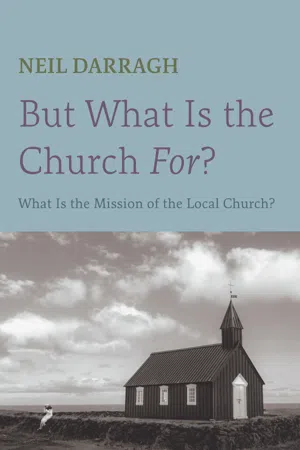
What is the church really for? Some people are members of the church because it's part of their family tradition or their culture or their identity. Others have left the church because that's all it is in fact. Is it the best way to salvation or a way of coming closer to God? In any case, the church is not just for us or the benefits we get out of it. Very few of us would say that this is what the church is really for. There is surely something more here, something more generous, life-giving, outgoing, and gracious than what we personally get out of it.
This book is about the church's outreach beyond itself--its purpose beyond any benefits for those already its members. This book is not about a church looking inwards and worrying about itself, but about a church looking outwards. The local Christian community that we belong to is part of that much bigger, much more exhilarating project of the evolving realm of God.
Information
Topic
Theology & ReligionSubtopic
Christian MinistryPart I
Perspectives
This book seeks an answer to the question: What is the church for? What is its purpose? What is its mission?
People become members of a Christian church and remain members of the church for a variety of reasons. For some, it is something integrated within their own traditional family life or their culture; it is already part of their identity. For others, membership in the church is a way of becoming closer to God, of maintaining contact with the divine, of becoming holier. For others it is the surest way to salvation, both in this world and especially in life after death. For others, it is a duty, something they are obliged to do by divine call or divine command. Others are attracted by the other people who belong to the church, by the way they relate to one another, or by their liturgy. Others are attracted by the church’s teaching, its understanding of the world and of life’s purpose.
These and, no doubt, many other motivations for belonging to the Christian church are personal ones. These are the things we get out of the church through our membership in it. These are what we might call the “benefits” of membership. Yet, while we might be grateful for these benefits, very few of us, I think, would regard these as an adequate statement of what the Christian church is for. If these personal benefits are all there is, it would make us simply “consumers” of holy “goodies.” There is surely something more here, something more generous, life-giving, outgoing, and gracious than just our own spiritual wellbeing.
Nearly all Christians, I think, would agree with this. Certainly, nearly all missionaries, missiologists, and theologians would agree.
This book is a study in what would traditionally be called “missiology.” As traditionally understood, missiology is concerned with the church’s outreach beyond itself—the objectives and activities of the church beyond its benefits for those already its members. The church has benefits for its own members, of course, but it does not exist just for itself and its current members. It also has a purpose beyond itself, its mission.1
There is little debate today that what an investigator sees depends upon the standpoint of the investigator. Every investigation has a starting point that sets up a particular point of view on the subject of the investigation. An academic theologian’s point of view is not likely to be that of an active missionary in the field; and an active missionary’s point of view is not likely to be the same as that of the person who is the recipient of missionary activity. The choice of the starting point affects everything else that follows.
“Part I: Perspectives” of this book explains the starting point of this investigation. It also has a preliminary look at the language we use in talking and writing about mission. The traditional language that theologians commonly use among themselves doesn’t quite work here because talking about “mission” is about the interface between church and society. Theological language that is commonly used in church and theological institutions needs to be adjusted so that it easily communicates outwards to the wider society and can itself absorb the wider society’s communications inwards to the church. Moreover, there are some ideas, and the idea of “the realm of God” is one of these, which are central in this investigation and are best explained from the very start.
Part I, then, is intended to deal with these preliminary matters. Effectively, it sets out the approach to Christian mission adopted in this book.
1. Other terms such as “evangelization” or “outreach” are often used where I have used the term “mission.” These terms are each a little different in meaning, but for most practical purposes and within the parameters of this book, they should be considered similar or at least overlapping. I do not normally use the term “evangelization” in this book except where quoting or paraphrasing someone else. This is partly because, within the Catholic Church, the term has come to mean almost everything, and so loses its capacity to pinpoint priorities. Partly, too, it is a neologism that is quite difficult to use both in local church discussions and in the public forum where, in my experience, it needs to be repeatedly explained. This is an issue of public communication which I address in the next chapter.
1
What Is the Church For?
The particular way we approach mission, the perspective we adopt in the first place, is very important in any investigation into mission or church.2
The perspective on mission and church adopted in this book is best explained by calling attention to five distinct, but interrelated, strands in contemporary understandings of mission and church:
•God’s mission,
•the missionary nature of the church,
•the distinction between the church and the realm of God,
•the question of who are missionaries, and
•the particular viewpoint of the local church.
This chapter proposes a point of view on each of these five strands.
God’s Mission
The idea that the church has a mission, that is, that the church has a purpose, an outward objective to which church members are committed, is probably the most common understanding of the relationship between church and mission. It was the more common perspective among theologians and missiologists for several centuries up until the mid-twentieth century and it remains common among church members today.
The idea that the mission has a church is less common and is perhaps clearer when expanded to the following: God has a mission in the world and the church is one of the means by which that mission is carried out. In this sense, mission is God’s action in the world and this mission then has a church (a community of believers) which is called to play an important role (we think) in that action. In this case, the priority is placed firmly on mission, that is, God’s action in the world. The church comes subsequently and its nature results from the role it is expected to play in God’s mission. The emphasis on God’s mission within which the church has a part to play, rather than the idea that the church itself has a mission in the world in its own right, so to speak, was an important shift in mission thinking in the mid-twentieth century for both Protestants and Catholics.
In Protestant mission theology, this shift in emphasis is usually dated back to the International Missionary Council meeting in Willingen, West Germany, in 1952. It was this council that re-conceptualized mission as primarily the mission of God (“missio Dei”). This was a fundamental shift from an understanding of the church continuing the mission of Christ in the world (a Christology-based mission) to a Trinitarian-based understanding of God’s mission in the world in which the church is called to participate.3
The concept of “missio Dei” is very common in mission theology today. Yet it has been given a variety of interpretations. The mission of the church could in fact become opposed to God’s mission. This could be the case, for instance, if a church body decided to use mission illegitimately to further its own institutional interests or merely to bolster membership rolls.4 Some interpretations of the “mission of God” laid emphasis on the sending of the Son by the Father without equal emphasis on the role of the Spirit, while Pentecostal mission theologies more commonly emphasized the role of...
Table of contents
- Title Page
- Part I: Perspectives
- Part II: Mission in Contemporary Society
- Part III: Mission in a Pluralist Society
- Bibliography
Trusted by 375,005 students
Access to over 1.5 million titles for a fair monthly price.
Study more efficiently using our study tools.
Frequently asked questions
Yes, you can cancel anytime from the Subscription tab in your account settings on the Perlego website. Your subscription will stay active until the end of your current billing period. Learn how to cancel your subscription
No, books cannot be downloaded as external files, such as PDFs, for use outside of Perlego. However, you can download books within the Perlego app for offline reading on mobile or tablet. Learn how to download books offline
Perlego offers two plans: Essential and Complete
- Essential is ideal for learners and professionals who enjoy exploring a wide range of subjects. Access the Essential Library with 800,000+ trusted titles and best-sellers across business, personal growth, and the humanities. Includes unlimited reading time and Standard Read Aloud voice.
- Complete: Perfect for advanced learners and researchers needing full, unrestricted access. Unlock 1.5M+ books across hundreds of subjects, including academic and specialized titles. The Complete Plan also includes advanced features like Premium Read Aloud and Research Assistant.
We are an online textbook subscription service, where you can get access to an entire online library for less than the price of a single book per month. With over 1.5 million books across 990+ topics, we’ve got you covered! Learn about our mission
Look out for the read-aloud symbol on your next book to see if you can listen to it. The read-aloud tool reads text aloud for you, highlighting the text as it is being read. You can pause it, speed it up and slow it down. Learn more about Read Aloud
Yes! You can use the Perlego app on both iOS and Android devices to read anytime, anywhere — even offline. Perfect for commutes or when you’re on the go.
Please note we cannot support devices running on iOS 13 and Android 7 or earlier. Learn more about using the app
Please note we cannot support devices running on iOS 13 and Android 7 or earlier. Learn more about using the app
Yes, you can access But What Is the Church For? by Neil Darragh in PDF and/or ePUB format, as well as other popular books in Theology & Religion & Christian Ministry. We have over 1.5 million books available in our catalogue for you to explore.