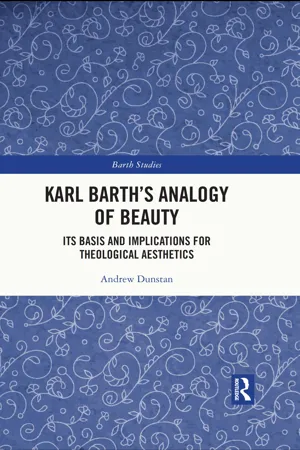
eBook - ePub
Karl Barth's Analogy of Beauty
Its Basis and Implications for Theological Aesthetics
- 234 pages
- English
- ePUB (mobile friendly)
- Available on iOS & Android
eBook - ePub
About this book
This book provides the first comprehensive examination of Karl Barth's view of beauty. For over fifty years, scholars have assumed Barth recovered traditional belief in God's beauty but refused to entertain any relationship between this and more familiar natural and artistic beauties. Hans Urs von Balthasar was the first to offer this interpretation, and his conclusion has been echoed ever since, rendering Barth's view of beauty irrelevant to work in theological aesthetics. This volume continues the late-twentieth-century revision of Balthasar's interpretation of Barth by arguing that this too is a significant misunderstanding of his theology. Andrew Dunstan demonstrates that, through an encounter with fatalistic forms of Reformed theology, Brunner's charges that his dogmatics were irrelevant and medieval thought, Barth gradually developed an analogy of divine, ecclesial and worldly beauty with all the theological, christocentric and actualistic hallmarks of his previous forms of analogy. This not only yields valuable new insight into Barth's view of analogy but also provides a much-needed foundation for a distinctively Protestant and post-Barthian approach to theological aesthetics.
Information
Part I Analogia gloriae
1Barth’s concept of analogy (1919–1968)
DOI: 10.4324/9781003217855-3
1.1 Introduction
It will inevitably seem brazen to question Balthasar’s appraisal of the integrity of Barth’s concept of analogy. The Swiss Jesuit was one of the greatest Christian thinkers of the twentieth century. Of all the themes of Barth’s theology with which he was familiar, Barth’s view of analogy was the area of his greatest expertise.1 And Barth himself publicly feted him as one of the most astute of his contemporary interpreters.2 Yet, for all of Barth’s commendation, he still did not regard Balthasar as an especially ‘good’ interpreter of his work. In fact, he privately declined to formally endorse an English translation of his work for precisely this reason.3 Moreover, since Balthasar first publicised his concerns about the coherence of Barth’s concept of analogy, a host of new primary resources by Barth have become available and these, in turn, have triggered an increasing reappraisal of his interpretation of Barth’s thought.4 But above all, as we have seen, it now seems clear that Balthasar’s scepticism has come to have a deleterious effect on the discipline of theological aesthetics leading many to doubt that Barth even could postulate an analogy of beauty. And so, for this reason, especially, we simply must take up the task of responding to it.
In this chapter, we will begin this endeavour by arguing that, in fact, Barth consistently articulates a plausible form of analogy between God and redeemed humanity throughout the entire course of his career. We will substantiate this argument in two stages. First, we will construct a thorough genealogy of the suspicion that Barth does not have a coherent concept of analogy that currently pervades theological aesthetics. Here we will seek to thoroughly comprehend not only the origin of this critique but its substance as well. Then we will offer a comprehensive response to these concerns. Above all, by surveying the relevant points in Barth’s development of analogy throughout his career, we will demonstrate that such anxieties are ill-founded.
But before proceeding any further, it is vital that we make some definite limitations to the scope of our ambition in this chapter. Since the publication of the first edition of Romans (1919), there has been, of course, a vast array of criticisms of various elements of the form of Barth’s theology. There are important ongoing discussions, for instance, about the virtues of Barth’s determinate and actualistic concept of human agency.5 Similarly, there is significant debate about the relation of the form of his thought to the pioneers of postmodern theory.6 However, as we have already suggested, the purpose of this chapter is simply to begin the process of reassuring those in the field of theological aesthetics that Barth has a plausible form of analogy and thus could, in principle, espouse an analogy of beauty in his work. Rather than trying to respond to all of these concerns about the form of his theology, we will therefore restrict ourselves to the specific set of them which continues to exercise those in the field of theological aesthetics. And although it would be nice if we could persuade some in the process, our aim is not to argue the merits of Barth’s distinctive form of analogy but simply its plausibility. If this chapter fulfils these admittedly more modest objectives, then it will serve its purpose in this work.
1.2 Genealogy of suspicion about Barth’s concept of analogy in contemporary theological aesthetics
Having already briefly established that there is widespread apprehension about the integrity of Barth’s concept of analogy in contemporary theological aesthetics we must begin by getting to the root of it, determining both its origin and content, so that we can fashion a response that is truly equal to it. In what follows, we shall argue that this peculiar anxiety has its origins in Erich Przywara’s highly polemical interpretation of Barth’s theology. Przywara was motivated to this interpretation by a belief that Barth’s theology encouraged the Church to withdraw from culture and thus posed a direct obstacle to his own agenda for ecclesial reform. He claims that Barth’s theology embraces a series of doctrinal commitments, which means that just like Luther, he can only conceptualise human religion as a form of ‘theopanism’: a divine-human ‘relation’ (if one can call it that) in which God is and does everything.7 According to Przywara, Barth rejects the traditional concept of the analogia entis: the belief in an analogy between God, the causa prima, and the causae secundae of the world. Instead, he assumes a metaphysical dialectic between the two. Since this effectively places divine and human activity in competition with each other, Barth can only think of religion as an act of God alone. And ironically, this means that it ultimately takes the form of a metaphysical identity between God and creatures. Przywara’s interpretation was then mediated into the field of contemporary theological aesthetics, although without any malicious intent, by von Balthasar, where it continues to exert an influence and at times quite clearly conditions interpretations of Barth’s understanding of beauty: prima facie ruling out the possibility that he advocates an analogy of beauty. In sum, then, in this section, we will argue that it is Przywara’s highly polemical interpretation of Barth that continues to cast its shadow across many who interpret Barth’s concept of beauty in the field of theological aesthetics today.
The suspicion of the formal character of Barth’s theology, which lingers in theological aesthetics today, originally began its life in a very different milieu. It arose in response to a very specific historical difficulty that confronted the early twentieth-century German Jesuit scholar Erich Przywara. Przywara was not just a theologian but a consummate Renaissance man. His more than 800 publications include works of philosophy, theology, poetry and hymnology.8 Few would dispute John’s Betz’s assessment that ‘[s]imply put, there is no German Catholic theologian of the first half of the twentieth century who can match the range of Przywara’s erudition or the remarkable acuity of his intellect’.9 His almost complete neglect in English-language theology to date is thus a remarkable omission that is now thankfully being rectified.10 Yet, there was undoubtedly a centre to Przywara’s diverse interests as well. Above all things, Przywara was a missionary to modern European culture.11 His raison d’être was to see the German Catholic Church realise its mission to engage modern culture with the Christian gospel. And it was precisely because of this consuming ambition that he was inevitably destined for a showdown with the work of Karl Barth.
The German society in which Przywara was raised was swollen with an unusually totalising form of secular modernism which could countenance no quarter to the Catholic religion. By 1848, Catholic missions had made significant inroads into the Protestant German states, at times even garnering high profile converts. This growing threat provoked two decades of intense anti-Catholic paranoia and hostility in the German states, led perhaps most of all by its vocal intelligentsia, who feared that the proliferation of monasteries threatened to plunge the modern German nation into a renewed dark age.12 In 1871, in Prussia at least, this sentiment gained state backing when the Chancellor of the newly unified German Empire, Otto von Bismarck, implemented his Kulturkampf: a raft of aggressive policies and measures designed to rout the influence of the Catholic religion in the nation. The ‘iron chancellor’, a devout Lutheran, had a purely pragmatic motivation for the sanctions.13 When in 1870 the alien influence began to organise itself politically, he began to perceive that it posed a direct threat to the fledgling unity of the empire, which he had fought so hard to achieve. However, secular intellectuals exploited his legislation for their own war on religion in general.14 The measures included the demolition of Catholic representation in political life; a prohibition of clergy speaking on matters of state; a ban on religious teachers in government schools; laws permitting the government to monitor both the education and employment of Catholic clergy and the expulsion of the entire Jesuit order from the German Empire.15 At their height, half of Prussian Catholic bishops were imprisoned or in exile, a quarter of parishes were without a priest, half of all monks and nuns had fled Prussia, a third of monasteries and convents were closed, 1800 parish priests were imprisoned or exiled, and thousands of laypeople were imprisoned for aiding the clergy.16 Though the campaign officially ended in 1878, many of its laws remained in effect for decades after.17 Przywara, who was born in the Prussian province of Upper Silesia in 1889, consequently grew up in a society still suffering the dizzy aftermath of this protracted assault of social and state hostility.18
But the German Catholic Church of the time, for its part, shackled to the official directives of Rome, could only respond with an equally absolute antimodernism which would tolerate no mix of the sacred with the profane. From 1870 onwards, the Holy See responded to attempts at modern reform of the Church by a raft of uncompromising ‘integralist’ measures. Generally speaking, these censured the use of modern philosophy and theology and prescribed a renewed study of scholastic theology ...
Table of contents
- Cover Page
- Endorsements Page
- Half Title Page
- Series Page
- Title Page
- Copyright Page
- Dedication Page
- Contents
- Preface
- Introduction
- PART I Analogia gloriae
- PART II Analogia pulchritudinis
- PART III Significance
- Conclusion
- Index
Trusted by 375,005 students
Access to over 1.5 million titles for a fair monthly price.
Study more efficiently using our study tools.
Frequently asked questions
Yes, you can cancel anytime from the Subscription tab in your account settings on the Perlego website. Your subscription will stay active until the end of your current billing period. Learn how to cancel your subscription
No, books cannot be downloaded as external files, such as PDFs, for use outside of Perlego. However, you can download books within the Perlego app for offline reading on mobile or tablet. Learn how to download books offline
Perlego offers two plans: Essential and Complete
- Essential is ideal for learners and professionals who enjoy exploring a wide range of subjects. Access the Essential Library with 800,000+ trusted titles and best-sellers across business, personal growth, and the humanities. Includes unlimited reading time and Standard Read Aloud voice.
- Complete: Perfect for advanced learners and researchers needing full, unrestricted access. Unlock 1.5M+ books across hundreds of subjects, including academic and specialized titles. The Complete Plan also includes advanced features like Premium Read Aloud and Research Assistant.
We are an online textbook subscription service, where you can get access to an entire online library for less than the price of a single book per month. With over 1.5 million books across 990+ topics, we’ve got you covered! Learn about our mission
Look out for the read-aloud symbol on your next book to see if you can listen to it. The read-aloud tool reads text aloud for you, highlighting the text as it is being read. You can pause it, speed it up and slow it down. Learn more about Read Aloud
Yes! You can use the Perlego app on both iOS and Android devices to read anytime, anywhere — even offline. Perfect for commutes or when you’re on the go.
Please note we cannot support devices running on iOS 13 and Android 7 or earlier. Learn more about using the app
Please note we cannot support devices running on iOS 13 and Android 7 or earlier. Learn more about using the app
Yes, you can access Karl Barth's Analogy of Beauty by Andrew Dunstan in PDF and/or ePUB format, as well as other popular books in Theology & Religion & Religion. We have over 1.5 million books available in our catalogue for you to explore.