First published in 1777, Abbe Guillaume Thomas Francois Raynal (1713-96) was a French Philosopher, historian and priest. On leaving his parish in Paris, he devoted himself to writing and the society of philosophes. He produced a number of historical works, including this famous history of the European colonies (part of which some modern scholars attribute to Diderot). This is Volume one of a collection of six volumes of his work Settlements and Trade of the Europeans in the East and West Indies.
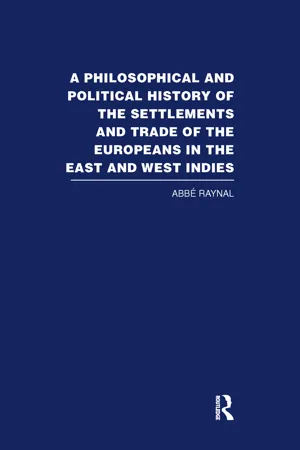
eBook - ePub
A Philosophical and Political History of the Settlements and Trade of the Europeans in the East and West Indies
Vol. 1
- 484 pages
- English
- ePUB (mobile friendly)
- Available on iOS & Android
eBook - ePub
A Philosophical and Political History of the Settlements and Trade of the Europeans in the East and West Indies
Vol. 1
About this book
Information
BOOK III. Settlements, Trade, and conquells of the English in the East Indies.
DOI: 10.4324/9781003101901-3
WE know nothing either of the period in which the British isles were peopled, nor of the origin of their first inhabitants. All we can learn from the molt authentic historical records is, that they were successively visited by the Phœnicians, the Carthaginians, and the Gauls, The traders of these nations used to go there to exchange earthen vessels, salt, all kinds of iron, and copper instruments, for skins, slaues, hounds, and bull-dogs, and especially for tin. Their profits were just what they pleased in their dealings with savages equally ignorant of the value of what they sold or bought.
Sketch of the ancient state of the English commerce.
A LOOSE speculation would lead us to imagine, that islanders have been the first civilized people among mankind. Nothing puts a flop to the excursions of people living on a continent: they may get their livelihood and avoid fighting at the same time. In islands, war, and the inconveniences of a too limited society, should sooner make laws and treaties necessary. But whatever is the reason of it, we generally see the manners and the government of islanders formed later and more imperfectly than others. All the traditions refspecting Britain, particularly confirm this assertion.
THE Roman empire was not sufficiently durable, and too eagerly disputed, to improve in any considerable degree the industry of the Britons. Even the small progress that husbandry and the arts had made during this period, was lost as soon as that haughty power had determined to abandon this conquest. The spirit of slavery which the fouthern inhabitants of Britain had contracted, deprived them of the courage necessary to resist at first the overflowings of their neighbours the Picts, who had saved themselves from the yoke by flying towards the north of the island, and prevented them afterwards from being able to oppose the more destructive, more obftinate and more numerous expeditions of plunderers that poured in swarms from the more northern parts of Europe.
ALL nations were affected with this dreadful plague, the most destrudive, perhaps, that ever was recorded in the annals of the world; but the calamities which Great Britain particularly experienced are inexpressible. Every year, several times even in a year, her countries were ravaged, her houses burnt, her women ravished, her temples stripped, her inhabitants massacred, put to torture, or enslaved. All these misfortunes succeeded each other with inconceivable rapidity. When the country was so far destroyed that nothing remained to glut the avidity of these barbarians, they seized on the land itself. One nation succeeded another. One troop supervening, expelled or exterminated the one that was already established; and this succession of revolutions constantly kept up indolente, mistrust and misery. In these dispiriting times, the Britons had scarce any commercial connection with the continent. Exchanges were even so rare amongst them, that it was necessary to have witnesses for the sale of the least trifle.
IT might have been expected that the union of the two kingdoms would have put a slop to these calamities; when William the Conqueror subdued Great Britain a little while after the middle of the eleventh century. His followers came from countries rather more civilized, more active, and more industrious, than those they came to settle in. Such a communication ought naturally to have rectified and enlarged the ideas of the conquered people. The introduction of the feudal government occasioned so speedy and so complete a revolution in matters of property, that every thing was thrown into confusion.
THE minds of men were scarcely settled, and the conquerors and the conquered had but just begun to consider themselves as one and the same people, when the abilities and strength of the nation were engaged in supporting the pretensions of their sovereigns to the crown of France. In these obstinate wars, the English displayed military talents and courage; but after several great efforts, and considerable success, they were forced back into their sland, where domestic troubles exposed them to fresh calamities.
DURING these different periods, the whole commerce was in the hands of the Jews and the bankers of Lombardy, who were alternately favoured and robbed, considered as useful persons, and condemned to death, expelled and recalled: these tumults were increased by the audacity of the pirates, who being sometimes protected by the government, with which they shared their spoils, attacked all ships indiscriminately, and frequently sank their crews. The interest of money was at fifty per cent. Leather, furs, butter, lead, and tin were the only things exported from England at a very moderate rate, and thirty thousand sacks of wool, which returned annually a more considerable sum. As the English were then totally unacquainted with the art of dying this wool, and manusasturing it with elegance, the greatest part of this money returned. To remedy this inconvenience, foreign manufacturers were invited, and the people were prohibited from wearing any cloaths that were not of home manufacture. At the same time, the exportation of manufactured wool and wrought iron was forbidden; two laws altogether worthy of the age in which they were instituted.
HENRY VII. permitted the barons to dispose of their lands, and the common people to buy them. This regulation diminished the inequality which subsisted before between the fortunes of the lords and their vassals; it made the latter more independent, and inspired the people with the desire of enriching themselves, and with the hope of enjoying their riches. There were many obstacles to this wish, and this hope; some of which were removed. The company of merchants sitablished at London was prevented from exacting in future the sum of one thousand five hundred and seventy-five livres* from each of the other merchants in the kingdom, desirous of trading at the great fairs of the Low countries. In order to fix a greater number of people to the labours of husbandry, it was enacted, that no person should put his son or daughter out to any kind of apprenticeship, without being possessed of a rent of twenty-two livres ten fols † in landed property: this absurd law was afterwards mitigated.
UNFORTUNATELY that law which regulated the price of all forts of provisions, of woollens, of workmen’s wages, of fluffs, and of cloathing, was maintained in its full force. Other impediments even were thrown in the way of commerce, on account of some pernicious combinations that were set on foot. The loan of money at interest, and the profits of exchange were strictly prohibited, as usurious in themselves, or calculated to introduce usury. The exportation of money in any kind of coin was forbidden; and, in order to prevent foreign merchants from carrying it clan-destinely away, they were compelled to change into English merchandise the entire produce of the goods they had brought into England. The exportation of horses was likewise prohibited; and the people were not sufficiently enlightened to discover that such a prohibition would necessarily cause the propagation and improvement of the species to be neglected. At length corporations were established in all the towns; that is to say, the state authorised all persons of the fame profession, to make fach regulations as they should think necessary for their exclusive preservation and success. The nation is still oppressed with a regulation so contrary to general industry, and which reduces every thing to a kind of monopoly.
UPON considering such a number of strange laws, we might be induced to think that Henry was either indifferent about the prosperity of his kingdom, or that he was totally deficient in understanding, Nevertheless, it is certain that this prince, notwithstanding his extreme avarice, often lent considerable sums of money, without interest, to merchants who had not property sufficient to carry on the schemes they had planned: besides, the wisdom of his government is so well confirmed, that he is accounted, with reason, one of the greatest monarchs that ever filled the throne of England. But, notwithstanding all the efforts of genius, it requires a succession of several ages before any science can be reduced to simple principles. It is the fame thing with theories as with machines, which are always very complicated at first, and which are only freed in the course of time by observation and experience, from those useless wheels which served merely to increase their friction.
THE knowledge of the succeeding reigns was not much more extensive upon those matters we are treating of. Some Flemings, fettled in England, were the only good workmen in that country; they were almost always insulted and oppressed by the English workmen, who were jealous without emulation; they complained that all the customers went to the Flemings, and they raised the price of corn. The government adopted these popular prejudices, and forbad all strangers to employ more than two workmen in their shops. The merchants were not better treated than the workmen, and these even who were naturalized, were obliged to pay the lame duties as aliens. Ignorance was so general, that the cultivation of the best lands was neglected, in order to convert them into pasture lands, even at the time that the number of sheep, which might be in one flock, was restrained by the laws to two thousand. All mercantile correspondences were confined in the Low countries. The inhabitants of these provinces bought the English commodities, and circulated them through the different parts of Europe. It is probable that the nation would not have made any considerable figure for a long time, without a concurrence of favourable circumstances.
THE Duke of Alva’s cruelties drove several able manufacturers into England, who carried the art of the fine Flemish manufactures to London. The persecutions which the Protestants suffered in France supplied England with workmen of all kinds. Elizabeth, impatient of contradiction, but knowing and desirous of doing what was right, at once despotic and popular, with the advantages of a good understanding, and of being properly obeyed, availed herself of the fermentation of people’s minds, as prevalent throughout all her dominions as through the rest of Europe; and while this fermentation produced among other people nothing but theological disputes, and civil or foreign wars; in England, it gave rife to a lively emulation for commerce, and for the improvement of navigation.
THE English learned to build their ships at home, which they bought before of the merchants of Lubec and Hamburgh. They were soon the only persons who traded to Muscovy by the way of Archangel just discovered; and they presently became competitors with the Hanfe towns in Germany, and in the north. They began to trade with Turky. Several of their navigators attempted, though in vain, to discover a passage to India by the northern seas. At length Drake, Stephens, Cavendish, and some others, readied that place, some by the south sea, and others by doubling the Cape of Good Hope.
First voyages of the English to India.
THE Success of these voyages was sufficient to determine the most able merchants of London to establish a company in the year 1600; which obtained an exclusive privilege of trading to the East Indies. The act which granted this privilege, fixed it for fifteen years: it declared, that if it should prove injurious to the state, it should be annulled, and the company suppressed, by giving two years previous notice to its members.
THIS clause of reserve was owing to the displeasure the commons had lately shewn on account of a grant, the novelty of which might possibly offend them. The queen had returned to the house, and had spoken on this occasion in a manner worthy to serve as a lesson to all sovereigns.
“GENTLEMEN,” Said she to the members of the house commissioned to return her thanks, “I am extremely sensible of your attachment, and of the care you have taken to give me an authentic testimony of it. This affection for my person had determined you to apprize me of a fault I had inadvertently fallen into from ignorance, but in which my will had no share. If your vigilance had not discovered to me the mischiefs which my mistake might have produced, what pain should I not have felt—I, who have nothing dearer to me than the affection and preservation of my people? May my hand suddenly wither, may my heart be struck at once with a deadly blow, before I shall ever grant particular privileges that my subjects may have reason to complain of! The splendour of the throne has not so far dazzled my eyes, that I should prefer the abuse of an unbounded authority to the use of a power exercised by justice. The brilliancy of royalty blinds only those princes who are ignorant of the duties that the crown imposes. I dare believe that I shall not be ranked among such monarchs. I know that I hold not the scepter for my own proper advantage, and that I am entirely devoted to the society, which has put its confidence in me. It is my happiness to fee that the (tare has hitherto prospered under my government; and that my subjects are worthy that I should yield up my crown and my life for their fakes. Impute not to me the improper measures I may be engaged in, nor the irregularities which may be committed under the fanétion of my name. You know that the ministers of princes are too often guided by private interests, that truth seldom reaches the ears of kings, and that obliged as they are, from the multiplicity of affairs they are laden with, to fix their attention on those which are of the greatest importance, it is impossble they should see every thing with their own eyes.”
THE funds of this company were, at first, far from being considerable. Part of them was expended in fitting out a fleet of four ships which failed in the beginning of the war 1601; and the rest was sent abroad in money and merchandise.
LANCASTER, who commanded the expedition, arrived the year following at the port of Achen, which was at that time a celebrated mart. Intelligence was received of the victories gained by the English over the Spaniards at sea; and this intelligence procured him a very distinguished reception. The king behaved to him in the same manner as if he had been his equal; he ordered that his own wives richly habited, should play several airs in his presence, on a variety of instruments. This favour was followed by all the compliances that could be wished for to facilitate the establishment of a safe and advantageous commerce, The English admiral was received at Bantam in the fame manner as at the place where he first landed; and a ship which he had dispatched to the Molucca islands, brought him a considerable cargo of cloves and nutmegs. With these valuable spices, and the pepper he took in at Java and Sumatra, he returned safe to Europe.
THIS early success determined the society who had intrusted their interests in the hands of this able man, to form settlements in India; but not without the consent of the natives. They did n...
Table of contents
- Cover Page
- Half Title Page
- Title Page
- Copyright Page
- Original Title Page
- Table of Contents
- Book I. Introduction
- Book II. The settlement, wars, policy, and trade of the Dutch in the East Indies
- Book III. Settlements, Trade, and conquests of the English in the East Indies
Trusted by 375,005 students
Access to over 1.5 million titles for a fair monthly price.
Study more efficiently using our study tools.
Frequently asked questions
Yes, you can cancel anytime from the Subscription tab in your account settings on the Perlego website. Your subscription will stay active until the end of your current billing period. Learn how to cancel your subscription
No, books cannot be downloaded as external files, such as PDFs, for use outside of Perlego. However, you can download books within the Perlego app for offline reading on mobile or tablet. Learn how to download books offline
Perlego offers two plans: Essential and Complete
- Essential is ideal for learners and professionals who enjoy exploring a wide range of subjects. Access the Essential Library with 800,000+ trusted titles and best-sellers across business, personal growth, and the humanities. Includes unlimited reading time and Standard Read Aloud voice.
- Complete: Perfect for advanced learners and researchers needing full, unrestricted access. Unlock 1.5M+ books across hundreds of subjects, including academic and specialized titles. The Complete Plan also includes advanced features like Premium Read Aloud and Research Assistant.
We are an online textbook subscription service, where you can get access to an entire online library for less than the price of a single book per month. With over 1.5 million books across 990+ topics, we’ve got you covered! Learn about our mission
Look out for the read-aloud symbol on your next book to see if you can listen to it. The read-aloud tool reads text aloud for you, highlighting the text as it is being read. You can pause it, speed it up and slow it down. Learn more about Read Aloud
Yes! You can use the Perlego app on both iOS and Android devices to read anytime, anywhere — even offline. Perfect for commutes or when you’re on the go.
Please note we cannot support devices running on iOS 13 and Android 7 or earlier. Learn more about using the app
Please note we cannot support devices running on iOS 13 and Android 7 or earlier. Learn more about using the app
Yes, you can access A Philosophical and Political History of the Settlements and Trade of the Europeans in the East and West Indies by Abbe Raynal in PDF and/or ePUB format, as well as other popular books in Politics & International Relations & World History. We have over 1.5 million books available in our catalogue for you to explore.