This book explores the causes and implications of the Libyan crisis since the anti-Gaddafi uprisings of 2011 from the perspective of the EU and NATO.
It asks the question of why those organizations failed to stabilize the country despite the serious challenges posed by the protracted crisis to European and transatlantic stakes in the region. This book argues that such failure originated in a twofold problem common to both organizations: their prioritization of legitimacy over strategy, and their path dependence – the insufficient degree of adaptation to meet the different needs of the crisis. Through a critical and integrated analysis of official sources and extensive interviews with EU, NATO, UN, and national government officials and militaries, as well as from NGO personnel, Libyan institutions and civil society, and media, the volume brings the perspective of both state and non-state actors to the fore. It reveals how wrong assumptions and centrifugal forces within the EU and NATO hampered initiatives, and how the inability to use hard power judiciously and effectively in an increasingly complex and multifaceted scenario worsened the crisis. This allowed for unprecedented influence of regional and global competitors such as Egypt, the United Arab Emirates (UAE), Turkey and Russia in the richest African country.
This book will be of key interest for scholars and students of Libya and North Africa, NATO, the European Union, security and conflict studies, Middle East studies, migration, terrorism, peacebuilding and, more broadly, international relations.
1 The EU and NATO on the eve of the Libyan warStrategy and institutions
DOI: 10.4324/9781003091271-3
We tend to sort of react to the last war, so the reaction to Afghanistan is no boots on the ground, and often you cannot do what you need to do with no boots on the ground.
A NATO officer1
At the turn of 2021, two documents, one published by the EU High Representative for Foreign Affairs and Security Policy, and Vice President of the EU Commission (HRVP) Josep Borrell, and the other endorsed by NATO’s Secretary-General Jens Stoltenberg, reviewed EU and NATO’s action over recent years. Although both volumes covered a variety of topics, from Covid-19-related issues to crisis management, Libya was key in the reflections of both EU and NATO authorities. In particular, they identified strategic and institutional problems in EU and NATO responses to crises but put forward concrete proposals to address only the institutional issues. This chapter highlights the limits of such an interpretation, arguing that both organizations were handicapped primarily by a strategy problem. The chapter then takes a step back to excavate the origin of that problem in the evolution of EU and of NATO, and of their relationship since the end of the Cold War. This provides the background for EU-NATO approaches to the 2011 Libyan crisis.
1.1 Libya ten years on: sketching remedies to EU and NATO shortfalls
Borrell’s volume, edited by the European External Action Service (EEAS), came out on 15 February 2021, exactly ten years after the anti-Gaddafi uprisings that ignited the decade-long Libyan crisis. Libya was mentioned 76 times across Borrell’s volume. By comparison, other countries engulfed in crises such as Syria, Belarus, Mali, Somalia and Yemen were mentioned 47, 49, ten, four, and two times, respectively. Libya was explicitly referred to as ‘a priority’ and a ‘major concern’ for the EU since 2011 (Borrell 2021: 148, 188). Notwithstanding this, the HRVP acknowledged that the Libyan crisis had deteriorated over the years, with only a ‘glimmer of hope’ emerging very recently (ibid.); the EU’s efforts at rebuilding Libya after the 2011 conflict, and at helping it ‘preserve its territorial integrity … free from external interference’ have ‘not yet led to sustainable agreements and peace’ (ibid.: 189, 191).
Weighing up explanations for the EU’s limited performance – in Libya and elsewhere – Borrell made two notable remarks: first that Europe must ‘learn to speak the language of power’, and second that it must find an institutional mechanism to overcome member state divisions that had, for years, ‘slowed down or paralyzed EU decision-making’ (ibid.: 16, 28). Borrell remained rather airy on concrete proposals on the first issue. He mentioned the need to create ‘a common strategic culture’ combining ‘the variety of the European Union’s resources in a way that maximizes their geopolitical impact’. But, he continued, ‘let’s be clear, our might is not the military component. The EU is not a military alliance and it was even built against the very idea of power politics’ (ibid.: 16). Instead, the HRVP had stressed in an interview a few months earlier, ‘I strongly believe that the “power” of the EU will come from its ability to use its economic tools in a coordinated way’ (Borrell 2020). Borrell was clearer on the institutional problem: ‘For decades, we have agreed that foreign and security policy must be decided by unanimity, with every country holding a veto’ (Borrell 2021: 29). But since the EU had grown both numerically (from six founding members to 27) and in diversity since 1993, member states ‘often do not have the same vision’ and bringing them together, was ‘indeed difficult’ (ibid.: 18). This ‘leads to a lot of blockages and paralysis’ (ibid.: 29). Libya was taken as a most obvious example (ibid.: 29). A number of analysts shared Borrell’s view, blaming intra-EU divisions since 2011 as a chief reason for the EU’s shortfalls in Libya – and also elsewhere (Koenig 2011; Ismail and Salameh 2019; Erlanger 2020). Borrell’s proposed solution was to adopt qualified majority voting on foreign policy issues, a procedure that the EU normally uses in areas such as the single market, climate or migration. Another option was to make more extensive use of ‘constructive abstention’, a possibility enabling a country to abstain ‘without blocking the Union from moving forward’ (Borrell 2021: 29–31). In her ‘State of the Union’ address in September 2020, the President of the EU Commission Ursula von der Leyen, proposed to adopt qualified majority voting at least on human rights statements and sanctions (Von der Leyen 2020). It was the line in her speech that attracted the largest applause. Therefore, the main solution envisaged by the Union to better address foreign policy crises was to find a mechanism which would disable the self-interest or hesitancy of a few member states, which prevents the others ‘from moving forward’ (Borrell 2021: 30).
A similar proposal resonates in the NATO 2030 Report, endorsed by NATO’s Secretary-General Stoltenberg a few months before Borrell’s volume. That report included a number of proposals to update and reinvigorate NATO’s action vis à vis a variety of security concerns, including the assertive foreign policy of Russia and – increasingly – China, terrorism and state failure. Libya was explicitly mentioned as a major area of concern for the Alliance (NATO 2020e: 18). The report identified the need for a stronger political dimension attached to NATO’s military might (ibid.: 15). The Secretary-General stressed that, in person, on various occasions in late 2020 and early 2021, ‘Becoming stronger politically’ meant to address first and foremost internal differences to consent to, or to speed up, action (Stoltenberg 2020, 2021). Such differences could originate from diverging threat perception or from self-interest among the member states, and have never been absent in an Alliance that has itself grown from 12 founding members in 1949 to 30 in 2021. But the 2030 Report voiced concern over a ‘growing frequency of single-country blockages involving external bilateral disputes’ – situations in which ‘some Allies have brought disagreements on external matters into NATO’ with the effect of ‘straining cohesion and impeding decision-making’ (NATO 2020e: 15, 30). This was epitomized in Libya (Got 2020; Gazzini 2020). To remedy this, NATO must ‘create a more structured mechanism to support the establishment of coalitions inside existing Alliance structures and should examine ways to time-limit decision making in crisis’ (NATO 2020e: 15). In addition, the document mentioned the need for a broader strategic reflection: the Alliance should update its 2010 Strategic Concept in order to ‘solidify cohesion by confronting new strategic realities’ and producing ‘one coherent strategic picture’ (ibid.: 12). Finally, both EU and NATO authorities stressed the need for better EU-NATO coordination, including de-conflicting cooperation in crisis areas (ibid.: 56; Borrell 2021: 147). The limited impact of such collaboration has also been largely attributed to member state divisions and vetoing (Aghniashvili 2016: 74).
Overall, looking back on their performance in crisis management in the last decade – with Libya as a key example – the two organizations followed a similar path. While identifying strategic and institutional problems, they put forward concrete proposals to address only the latter. This may have been affected by an assumption that shifting strategic lines, or shaping strategic cultures, is more difficult than addressing institutional glitches. Yet both the EEAS and the NATO documents are clear that institutional reforms will face uphill battles. At the same time, the emphasis on internal fractures and slow-pace action or even paralysis (Borrell 2021: 17, 30; NATO 2020e: 15), coupled with the vast literature on the matter, seems to show that the institutional argument – and the perceived horizontal divisions underpinning it – is widely considered the most challenging in EU and NATO action. The solution proposed in both fora was to somewhat lessen organizational coherence by promoting ‘coalitions of the willing’.
In reality, in addressing Libya’s decade of crisis, both the EU and NATO have repeatedly, albeit informally, reverted to a ‘coalition of the willing’ framework. In the case of the EU, it did not produce better results; in the case of NATO, it backlashed dramatically. The Libyan crisis reveals, however, that the ‘strategy problem’ is far more relevant in explaining EU-NATO underperformances than their respective structural or institutional issues. It can be summarized as a relative failure by both organizations to conceptualize why and how to use hard power in Libya’s multi-level and fast-changing crisis. This was caused by two trends: the prioritization of legitimacy over strategy and organizational path dependence. After addressing the institutional problem, the following sections show how these phenomena grew stronger in the two decades leading to 2011, fortified by the experiences that both NATO and the EU had in missions and operations. This explains the exceptional impact of these trends in the two organizations’ approach to Libya.
1.2 The institutional lens and its limits: the EU, NATO and the ‘lowest common denominator’
The institutional problem in EU and NATO mobilization and power projection originates less in the mechanisms designed for action than in the organizational culture underpinning their functioning. The result is what has been referred to as the pursuit of the ‘lowest common denominator’ (Zaun 2015) in both EU and NATO initiatives. Its impact is important, but less decisive than has often been assumed. Furthermore, on the eve of the 2011 Libyan crisis there was evidence already that ‘coalition of the willing’ formats were not an institutional silver bullet.
Under the Maastricht Treaty of 1992, the EU Common Foreign and Security Policy (CFSP) was based on intergovernmentalism, which required unanimity between members in the Council of Ministers and little influence by the other institutions, despite the creation of a High Representative for CFSP in 1999 as a coordinator of the Union’s foreign policy. The inability of the EU to take decisive action in the Balkans throughout the 1990s stimulated a revision (Flockhart 2014: 81). The 2009 Lisbon Treaty formalized a dual constitution or decision-making system. This provided for supranational decision-making regarding the policies of the single market and intergovernmental decision-making regarding, inter alia, foreign and security policies. It strengthened the role of the EU HRVP and launched the EEAS to foster ‘a common effective presence in world affairs’ (Thomas and Tonra 2011: 1). The latter body and the HRVP, however, share the right of initiative with the member states, and decisions must still be approved by the Council through intergovernmentalism (Keukeleire and Delreux 2014: 101). According to Art. 31(1) of the Treaty, a member state can formally abstain in a unanimous vote, in which case it does not have to apply the decision but accepts that it binds the Union (Koenig 2020: 5). Thus, the EU can effectively take majoritarian foreign policy decisions but, noted Borrell, ‘it mostly doesn’t’. The reason for that is cultural: ‘The ethos of the club is to work for compromises, something everyone can buy into’ (Borrell 2021: 29). This applies across the EU, but especially in the matter of using force: ‘Because this is not in the DNA of the EU, there is an overwhelming political demand that member states will act unanimously’.2
In NATO, decisions are made by consensus in the North Atlantic Council (NAC), with ‘constructive abstention’ allowed, though informally (NATO 2020a; Michel 2003: 2). NATO decisions are based on draft proposals circulated to all Allies by the Secretary-General, who chairs the NAC, or by an International Staff official chairing a NATO committee or working group. These draft proposals may be initiated by the Secretary-General, the International Staff or individual Allies. Such proposals are generally preceded by bilateral or multilateral consultations in allied capitals or NATO bodies, which are critical to identify possible concerns or objections among the Allies and to craft mutually acceptable solutions (Michel 2003: 1). Consultation between member states is therefore ‘at the heart of NATO’ following the motto, ‘All for one, one for all’ (NATO 2020a; Stoltenberg 2014). The weight of the US in the Alliance makes it ‘more acceptable [than in the EU] that, at some point, the big guys press the others and say, “You just abstain, please, and we go ahead”’;3 but if one or more of the Allies ‘breaks silence’ during the voting in the NAC, the proposal is generally referred back to the relevant body for further work to reach consensus (Michel 2003: 1).
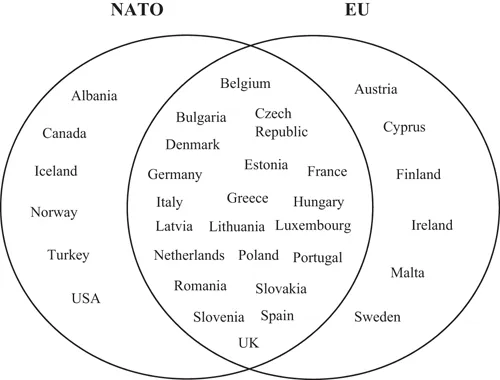
Therefore, despite the fact that the mechanisms for faster action do exist in both organizations, a member state is in a position to block any decision (Keukeleire and Delreux 2014: 103; Helwig et al. 2013: 10). This can impact on the ability to engage and the speed of interventions by both organizations; it can melt intervention down to the lowest common denominator and can also hamper EU-NATO collaboration. For example, in the case of the 2003 Iraq and 2012 Syrian wars, the EU was virtually ‘paralyzed by an internal split’ (Huber 2015: 122–123; Hill 2004: 152–153). NATO’s operation in Bosnia in 1995 required over two years to be launched and that in Kosovo in 1999, nearly a year and a half (Weighill and Gaub 2018: 37), as NATO struggled to get consensus.4 Domestic considerations, uneven military capabilities or diverging threat perceptions among EU and NATO member states have also caused problems when interventions were launched, for example by limiting the degree of force that could be employed (Auerswald and Saideman 2014; Marten 2004: 134; Keukeleire and Delreux 2014: 148–149). And finally, the asymmetrical membership in the EU and NATO, with most countries being ‘dual members’ and a few being ‘non-dual members’, left, on some occasions, one organization ‘hostage’ to the members of the other organization (Howorth 2014: 130; Aghniashvili 2016: 69). This has been a particularly sensitive problem given the bilateral dispute between Cyprus, an EU member, and Turkey, a NATO member – the so-called ‘Cyprus issue’ (Keukeleire and Delreux 2014: 176; Diesen 2013: 66).
Figure 1.1 EU and NATO memberships on the eve of the Libya conflict (adapted from Aghniashvili 2016: 89).
On the eve of the Libyan crisis in 2011, a tendency had emerged in the EU and NATO to operate following a de facto ‘coalition of the willing’ script. This was evidenced by the qualified majority vote authorizing the EU Rule of Law Mission in Kosovo (EULEX) in 2008 (Borrell 2021: 31) and by the voluntary nature of participation in all EU operations as well as in NATO’s training mission in Iraq in 2004 (Kay 2013: 107–108). Such formats of mobilization facilitated the launch of missions and operations, but left them more dependent on the fluctuating political will of the volunteering nations, thus strengthening, not reducing, member state primacy over the wider organization’s commitment. Paradoxically, such a trend could also facilitate or encourage autonomous action by the stronger (or more self-interested) member states (Keukeleire and Delreux 2014: 124, 148). This also tended to exacerbate inter-allied polemics on burden sharing. When only 16 of the then 26 NATO members agreed to participate in the Iraq training mission, the supreme Allied Commander in Europe, General James Jones, called that trend ‘disturbing’ and said that once NATO decides on a mission it is essential that ‘all Allies support it. … When 9, 10 or 11 countries in the Alliance will not send forces the burden falls on the other 14’ (Kay 2013: 108). Possibly the clearest example of the ‘coalition of the willing’ double-edged sword preceding Libya was offered by the Afghanistan war of 2001.
Although NATO had, on 12 September 2001, activated Art. 5 on mutual support for the first time in response to the 9/11 attacks (Buckley 2006), the US preferred to gather from NATO a few ‘well-chosen friends’ and some additional partners from the broader international community for Operation Enduring Freedom against the Taliban regime. This was motivated by the wish of the George W. Bush administration to act quickly and with fewer operational constraints than in existing multilateral fora (Petersson 2015: 12; Marten 2004: 91, 121–122). In time about 60 countries joined, though many offered little more than symbolic support. Washington’s decision backfired when the situation in Afghanistan deteriorated in the aftermath of the supposed ‘end of hostilities’. What was imagined as a surgical intervention turned into a prolonged counterinsurgency campaign fought in parallel with counterterrorism operations and nation-building efforts (Vestenskov and Wille-Jørgensen 2014: 130). The US-led coalition revealed significant coordination and command and control (C&C) issues when tested by greater difficulties than expected (Auerswald and Saideman 2014: 227).
At the end of 2001 the US turned to NATO. The Alliance took command of the International Security As...
Table of contents
Cover
Half-Title
Series
Title
Copyright
Dedication
Contents
List of figures
List of tables
Acknowledgments
List of abbreviations
Introduction
PART I Responsibility to protect
PART II Responsibility to rebuild
Conclusions and heading forward
Bibliography
Index
Trusted by 375,005 students
Access to over 1.5 million titles for a fair monthly price.
Study more efficiently using our study tools.
Frequently asked questions
Yes, you can cancel anytime from the Subscription tab in your account settings on the Perlego website. Your subscription will stay active until the end of your current billing period. Learn how to cancel your subscription
No, books cannot be downloaded as external files, such as PDFs, for use outside of Perlego. However, you can download books within the Perlego app for offline reading on mobile or tablet. Learn how to download books offline
Perlego offers two plans: Essential and Complete
Essential is ideal for learners and professionals who enjoy exploring a wide range of subjects. Access the Essential Library with 800,000+ trusted titles and best-sellers across business, personal growth, and the humanities. Includes unlimited reading time and Standard Read Aloud voice.
Complete: Perfect for advanced learners and researchers needing full, unrestricted access. Unlock 1.5M+ books across hundreds of subjects, including academic and specialized titles. The Complete Plan also includes advanced features like Premium Read Aloud and Research Assistant.
Both plans are available with monthly, semester, or annual billing cycles.
We are an online textbook subscription service, where you can get access to an entire online library for less than the price of a single book per month. With over 1.5 million books across 990+ topics, we’ve got you covered! Learn about our mission
Look out for the read-aloud symbol on your next book to see if you can listen to it. The read-aloud tool reads text aloud for you, highlighting the text as it is being read. You can pause it, speed it up and slow it down. Learn more about Read Aloud
Yes! You can use the Perlego app on both iOS and Android devices to read anytime, anywhere — even offline. Perfect for commutes or when you’re on the go. Please note we cannot support devices running on iOS 13 and Android 7 or earlier. Learn more about using the app
Yes, you can access The EU, NATO and the Libya Conflict by Stefano Marcuzzi in PDF and/or ePUB format, as well as other popular books in Politique et relations internationales & Politique africaine. We have over 1.5 million books available in our catalogue for you to explore.