Sound Authorities shows how experiences of music and sound played a crucial role in nineteenth-century scientific inquiry in Britain.
In Sound Authorities, Edward J. Gillin focuses on hearing and aurality in Victorian Britain, claiming that the development of the natural sciences in this era cannot be understood without attending to the study of sound and music.
During this time, scientific practitioners attempted to fashion themselves as authorities on sonorous phenomena, coming into conflict with traditional musical elites as well as religious bodies. Gillin pays attention to sound in both musical and nonmusical contexts, specifically the cacophony of British industrialization. Sound Authorities begins with the place of acoustics in early nineteenth-century London, examining scientific exhibitions, lectures, spectacles, workshops, laboratories, and showrooms. He goes on to explore how mathematicians mobilized sound in their understanding of natural laws and their vision of a harmonious ordered universe. In closing, Gillin delves into the era's religious and metaphysical debates over the place of music (and humanity) in nature, the relationship between music and the divine, and the tensions between spiritualist understandings of sound and scientific ones.
eBook - ePub
Sound Authorities
Scientific and Musical Knowledge in Nineteenth-Century Britain
- English
- ePUB (mobile friendly)
- Available on iOS & Android
eBook - ePub
About this book
Information
Subtopic
Modern British HistoryPart I
Experiments and Mathematics
The Making of Sound as a Scientific Object
• Chapter 1 •
The Laboratory of Harmony
The Transformation of Sound within British Science, 1815–46
There is no truer truth obtainable by man than comes of music.
Robert Browning, Parleying with Charles Avison
During the 1820s and 1830s, British natural philosophers transformed sound’s place in the natural sciences, refashioning the sonorous into a scientific object. Traditionally confined to the opera, concert halls, theaters, churches, streets, and taverns, harmonious sounds were now increasingly scrutinized within the laboratory and lecture theater. At once, this blurred distinctions between musical amusement and scientific instruction. London’s fashionable West End was at the center of this transformation, where sonorous displays, especially those of a musical nature combined with philosophical inquiry, provided mystifying and wondrous entertainment.1 Among the Westminster theaters and showrooms, scientific displays were popular and competed with rival sources of leisure. A new musical instrument or acoustic illusion could cause a sensation, and promoters of these performances were eager to show the philosophical implications of their work: such sonorous exhibitions helped to bring new scientific understandings to specialist and nonspecialist audiences. No one understood the value of these sonic resources better than the instrument-maker Charles Wheatstone (1802–75). During the 1820s, his mechanical creations astonished and bemused London audiences at his shop on Pall Mall. Yet by 1828 Wheatstone had changed the nature of this work. In collaboration with Michael Faraday (1791–1867), Wheatstone worked between 1828 and 1832 to turn his acoustic research into something much more philosophically significant. Together, Faraday and Wheatstone transformed London’s sonorous spectacles into lectures at the Royal Institution. Employing exotic instruments, new acoustic sensations, and wonderful applications for sound, they mobilized musical resources to help popularize science. In doing so, they challenged distinctions between experiment and entertainment, transcended boundaries between scientific and popular audiences, and raised questions over the social order between natural philosophers, musicians, and instrument makers. By tracing the story of musical performances from parties and theaters into scientific lecture rooms, laboratories, and scientific journals, this chapter explores how music provided a powerful cultural resource for scientific practitioners to mobilize. In analyzing the transition of what were, originally, forms of musical entertainment, into philosophical subjects, it becomes apparent how vague the boundaries were between the popular and the scientific. Often, the audiences of West End shops and showrooms were eager for scientific spectacles and mysterious natural phenomena, while those of the fashionable scientific venues did not just want scientific discourse, but to be entertained. For both, music provided valuable resources, both marketable and educational. Likewise, the journals reporting on these exhibitions included specialist and broadly cultural publications, from The Times and Literary Gazette to the more scientifically focused Mechanic’s Magazine and Philosophical Magazine.
Melissa Dickson has argued that while the construction of new acoustical knowledge depended on sight, this could be combined with sonorous experiences: to be convinced, audiences were encouraged both to see and hear sound.2 This chapter looks at the role of sound, specifically music, in popularizing and substantiating new philosophical claims and scientific authorities. Rather than treating science simply as a sort of knowledge, this chapter also considers it as a competing form of entertainment. Wheatstone and Faraday mobilized fashionable musical resources in what was a highly competitive entertainment market, as the Royal Institution had to compete with a broad range of alternative amusements, including operas and theaters.3 Between 1828 and 1832, this elite scientific venue was the site of a transformation in the nature of sound within British science. Yet this was not just a reorganization of how sonorous phenomena were presented. Through publications in the Royal Society’s Philosophical Transactions, university lectures, and the experimental investigation of heat, electricity, light, and magnetism, the ear took on new significance as an organ of scientific analysis. It featured prominently in Faraday and Wheatstone’s work and, increasingly, within the natural sciences across Britain. While popular accounts of acoustic experiments appealed to a general readership, these same inquiries could be refashioned for elite philosophical journals to recast sound as a scientific object. Sound exposed the vague boundaries between contrasting readerships and authorities: efforts to make the subject either popular or empirical revealed the nuances between amateur experimentalists, learned natural philosophers, instrument makers, and gentlemanly specialists. These were, of course, very fluid terms, with individuals like Faraday and Wheatstone respected both in specialist scientific networks and with polite metropolitan audiences.
This chapter explores Wheatstone’s efforts to disseminate acoustic knowledge, especially that of vibrating plate experiments, as something that was valuable for the study of nature more broadly. In Britain’s post-1815 experimental culture, Chladni’s acoustic plates provided a rich example of how specialist and nonspecialist audiences alike could engage with new scientific ideas from the Continent. Above all, it was sound’s experiential quality which made it so epistemologically valuable. It was not enough to read about sonorous phenomena on the pages of scientific treatises, no matter how accessibly written: they had to be experienced in show rooms and lecture theaters to be fully appreciated. This meant that sound was especially adept at transcending the boundaries between popular and elite science, between gentlemanly amateurs and specialist experimentalists, and between amusement and philosophical instruction. It did not require experimental or mathematical training to experience or conduct sonorous investigations. This character also made hearing valuable to the production of new knowledge: it was through both the eye and ear that nature could be known. Wheatstone and Faraday emphasized the connections between the study of sound and other phenomena, principally light and electromagnetism, conscripting their experiences of acoustics into later works on electricity and telegraphy. From metals to electricity and heat, acoustic knowledge and practices informed radical new approaches to natural philosophy, effecting a revolution in experimental techniques in which hearing was often as important as seeing.
Musical Marvels and Philosophical Exhibitions
Writing in 1832, the Edinburgh experimentalist David Brewster (1781–1868) reflected that sound was in the midst of a transformation. Historically, he observed, the manipulation of sonorous phenomena had been a powerful means of social control. The “science of Acoustics furnished the ancient sorcerers with some of their best deceptions,” with the imitation of thunder in temples indicating the presence of a “supernatural agent” and “the vocal statue of Memnon, which began at the break of day to accost the rising sun” being a similar sonic deception. Sound’s ability to conjure up spiritual feeling provided ancient governments with “influence over the human mind.”4 This metaphysical character of the sonorous had endured, with music’s ethereal quality a valuable resource for religious authorities, not least within Christian traditions. Chanting and melody were central to medieval worship, including the singing of Psalms and music for mass. In 1832 such performances were still prominent within the Roman Catholic Church, while instrumental music, especially with church organs, and hymns had flourished in the Protestant Church of England during the eighteenth century. Be it for ancient sorcerers or nineteenth-century clergymen, Brewster demonstrated how sonorous phenomena had provided audiences throughout history with apparently metaphysical experiences.
Brewster was familiar with sound’s religious implications. Although most famous for his invention of the kaleidoscope in 1817 and his commitment to the Newtonian conception of light as projected corpuscles, rather than undulating waves, Brewster had intended to become a minister in the Presbyterian Church of Scotland. After attending the University of Edinburgh between 1794 and 1800, he was forced to abandon his religious aspirations due to a chronic fear of public speaking.5 Yet at the heart of Brewster’s science was a Calvinistic conviction that to experiment was to reveal the truth of God’s creation. An understanding of the material world which was grounded in sensual experiences, including those sonorous, exposed the divine power of its author. Brewster, however, was aware that the place of sound in natural philosophy was undergoing a rapid transformation: it was becoming a scientific object.
Sound had long been a subject of philosophical inquiry but, as Brewster asserted, sonorous knowledge was permeating the boundaries between scientific discourse and popular entertainment. Natural philosophers were using acoustic marvels to captivate broad audiences and impart new knowledge of nature. No example of this was of greater celebrity than the French inventor M. Charles’s “Invisible Girl.”6 As early as 1807, spectators had been amazed by the voice of a small girl, able to answer questions, sing beautifully, converse in several languages, and make observations on members of the audience, emanating from a series of four trumpets and a ball, suspended by ribbons from a frame made of railings and posts (fig. 1.1). The faint sound of the girl appeared to come out of the trumpets which were suspended in midair, leaving audiences “in utter amazement.” Brewster explained that this illusion went beyond all other acoustic marvels because, unlike the talking heads of ancient times, the sound-producing ball and trumpets “communicated with nothing through which sound could be conveyed.” Yet this was a simple deception. In two of the horizontal railings opposite the trumpet mouths there was an aperture joined to a pipe connected to a vertical post which then ran down through the floor and into a room next door, where the “invisible lady sat” (fig. 1.2). From there she could speak and listen through the trumpet. Sound, then, was capable of arousing superstition within even the most rational of minds.7
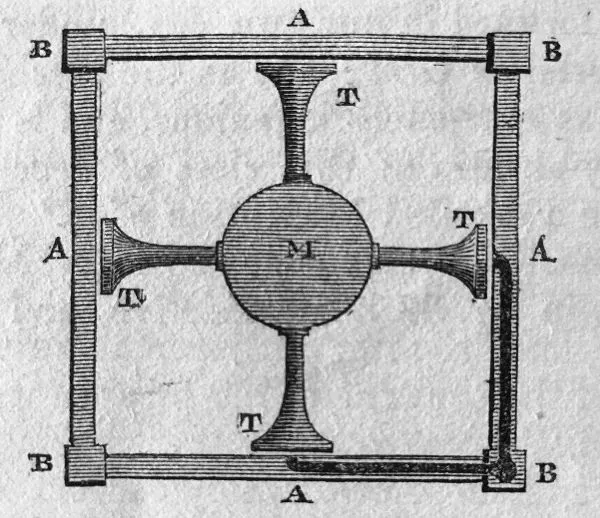
Figure 1.1 The arrangement of four trumpets to project the voice of the “Invisible Girl.” In the bottom right corner, a hidden tube was positioned through which sound was conveyed to and from a woman hidden in the next room. Brewster, Letters on Natural Magic, 162. Image by permission of Edinburgh University Library Centre for Special Collections, 2019.
Yet of all sounds, Brewster argued that it was those harmonic which produced the most entrancing influence over listeners. He explained that increasing knowledge over how a string vibrated to create harmonics, the production of concordant sounds by vibrating columns of air, and the vibration of solid bodies, were all contributing to acoustic effects of increasing wonder. The precise mechanisms of these processes were, Brewster maintained, known only to philosophers; as an example, he invoked Ernst Chladni’s (1756–1827) production of nodal lines with sand distributed over vibrating glass plates to demonstrate the oscillations of solid bodies (fig. 1.3). As Brewster concluded, “Among the discoveries of modern science there are few more remarkable than those which relate to the production of harmonic sounds. We are all familiar with the effects of musical instruments, from the deep-toned voice of the organ to the wiry shrill of the Jew’s harp. We sit entranced under their magical influence.”8
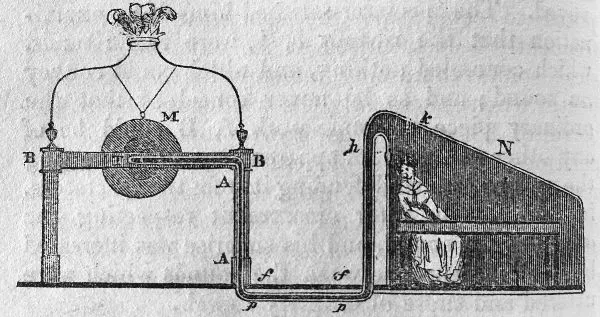
Figure 1.2 Brewster’s illustration of the “Invisible Girl,” showing the route that sound took between a hidden woman and the apparatus that mysteriously projected the voice of a small girl. Brewster, Letters on Natural Magic, 164. Image by permission of Edinburgh University Library Centre for Special Collections, 2019.
In 1820s London, the place of sound within scientific and popular culture had indeed changed. Brewster invoked two acoustic marvels which had, during the previous decade, aroused sensation. The first of these...
Table of contents
- Cover
- Title Page
- Copyright Page
- Dedication
- Contents
- List of Figures and Tables
- Introduction Sounds and Sweet Airs
- part i Experiments and Mathematics
- part ii Contesting Knowledge
- part iii Materialism and Morality
- Acknowledgments
- Notes
- Select Bibliography
- Index
Trusted by 375,005 students
Access to over 1.5 million titles for a fair monthly price.
Study more efficiently using our study tools.
Frequently asked questions
Yes, you can cancel anytime from the Subscription tab in your account settings on the Perlego website. Your subscription will stay active until the end of your current billing period. Learn how to cancel your subscription
No, books cannot be downloaded as external files, such as PDFs, for use outside of Perlego. However, you can download books within the Perlego app for offline reading on mobile or tablet. Learn how to download books offline
Perlego offers two plans: Essential and Complete
- Essential is ideal for learners and professionals who enjoy exploring a wide range of subjects. Access the Essential Library with 800,000+ trusted titles and best-sellers across business, personal growth, and the humanities. Includes unlimited reading time and Standard Read Aloud voice.
- Complete: Perfect for advanced learners and researchers needing full, unrestricted access. Unlock 1.5M+ books across hundreds of subjects, including academic and specialized titles. The Complete Plan also includes advanced features like Premium Read Aloud and Research Assistant.
We are an online textbook subscription service, where you can get access to an entire online library for less than the price of a single book per month. With over 1.5 million books across 990+ topics, we’ve got you covered! Learn about our mission
Look out for the read-aloud symbol on your next book to see if you can listen to it. The read-aloud tool reads text aloud for you, highlighting the text as it is being read. You can pause it, speed it up and slow it down. Learn more about Read Aloud
Yes! You can use the Perlego app on both iOS and Android devices to read anytime, anywhere — even offline. Perfect for commutes or when you’re on the go.
Please note we cannot support devices running on iOS 13 and Android 7 or earlier. Learn more about using the app
Please note we cannot support devices running on iOS 13 and Android 7 or earlier. Learn more about using the app
Yes, you can access Sound Authorities by Edward J. Gillin in PDF and/or ePUB format, as well as other popular books in Media & Performing Arts & Modern British History. We have over 1.5 million books available in our catalogue for you to explore.