Following conflicting desires for an Aztec crown, this book explores the possibilities of repatriation.
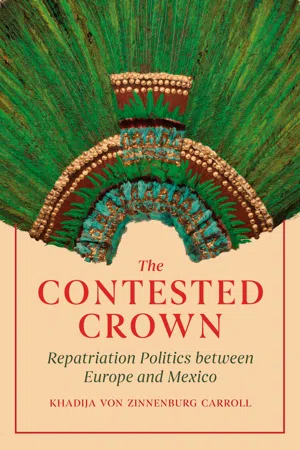
In The Contested Crown, Khadija von Zinnenburg Carroll meditates on the case of a spectacular feather headdress believed to have belonged to Montezuma, emperor of the Aztecs. This crown has long been the center of political and cultural power struggles, and it is one of the most contested museum claims between Europe and the Americas. Taken to Europe during the conquest of Mexico, it was placed at Ambras Castle, the Habsburg residence of the author's ancestors, and is now in Vienna's Welt Museum. Mexico has long requested to have it back, but the Welt Museum uses science to insist it is too fragile to travel.
Both the biography of a cultural object and a history of collecting and colonizing, this book offers an artist's perspective on the creative potentials of repatriation. Carroll compares Holocaust and colonial ethical claims, and she considers relationships between indigenous people, international law and the museums that amass global treasures, the significance of copies, and how conservation science shapes collections. Illustrated with diagrams and rare archival material, this book brings together global history, European history, and material culture around this fascinating object and the debates about repatriation.
eBook - ePub
The Contested Crown
Repatriation Politics between Europe and Mexico
- English
- ePUB (mobile friendly)
- Available on iOS & Android
eBook - ePub
About this book
Information
1
Writing as Listening

Figure 1.1 The Restitution of Complexity, 2020. Performance by Khadija von Zinnenburg Carroll and Nikolaus Gansterer.
I decided to write the story of El Penacho as a way of liberating myself from various modes of academic writing that do not seem adequate to heal the colonial wound. I will reflect on decolonizing whiteness and the perpetrator position through my own family history. Much of this book is based on conversations, providing space for reflection by accessing alternative perspectives. Ariella Aïsha Azoulay puts it this way: “I do not refuse . . . to assume the implications of this [Israeli in her case] perpetrator’s position that I inherited and out of and against which this book has been written.”1
I include those raw moments when, all of a sudden, I realize I am not just writing a set of facts. An unconscious set of desires drives what I am doing. For, despite skepticism, World War II demonstrated that passions could be harnessed in the service of fascism and propaganda, and modernity did not produce a less irrational society. It is therefore not possible to access the truth (whatever that might be) solely through facts. The repression of angry and “irrational” desires will only magnify them when they return, more violent than before. Frantz Fanon presents this social pathology in his texts On Violence in The Wretched of the Earth:
Demanding yet denying the human condition makes for an explosive contradiction. And explode it does, as you and I know. And we live in an age of conflagration: it only needs the rising birth rate to worsen the food shortage, it only needs the newly born to fear living a little more than dying, and for the torrent of violence to sweep away all the barriers. In Algeria and Angola, Europeans are massacred on sight.2
The contemporary relevance of this 1961 text is extraordinary and signals why understanding the role anger plays in political dissidence is so important. Yet anger is just one of the emotions, affects, feelings, or desires—the terms vary—that Western political thought, from the Stoics to Kant and Rawls, has treated as disruptive and suspicious. Since they influence the choices we make, the passions are necessarily caught up in political judgments and scientific research questions. They play a crucial role in providing the emotional basis of individual and social identities, and thus in forming the collective political communities in which we are all caught up. Passionate convictions are the basis of movements and ideologies that drive political change. The repatriation complex would be impoverished if we could not take into account how the violence and anger, expressed by Fanon and other decolonial voices, are responses to colonial upheaval; ask what the roles of love and empathy play in the formation of solidarity expressed among those who campaign and protest for the return of El Penacho or among the Concheros dancers; and examine the role of fear in white perpetrator repression. Recognition of such dynamics has driven the so-called “affective turn” in academia which, rather than seeing the passions only as a source of chaos, recognizes the way in which they inform the public and the so-called rational.3
My aim is to explore the responses of the perpetrators of colonial violence to positions of inherited white privilege by examining my own history but avoiding narcissism. Acknowledging and understanding my own position is necessary to the process of decolonization. For, as Indigenous scholars rightly stress, the onus is not on Indigenous people to accompany the process that white subjects must undertake—it is the white person’s responsibility to decolonize themselves. As greater transparency is sought regarding white privilege, the process of self-reflexivity, along with the realignment of responsibilities and reckoning with guilt, is something only the individual can do, even if in the context of a collective or social process.
What can change in a process of decolonization when a point of view shifts from white subjectivity to Indigenous ontologies? Shifting the arrogance that Walter Mignolo and Rolando Vázquez have written about to a “humbling ignorance” is one step on the way.4 A touch of guilt that gives way to a sense of responsibility may be another. Where trust has been eroded, honesty is necessary. Thus self-reflexivity offers a mode through which to move forward, although it must be employed without self-absorption, indulgence, or the instrumental quality that passing acknowledgments have. If decolonization of whiteness is reduced to merely an opening acknowledgment—“I am a white male”—it is misused, like a poem in a politician’s speech. Placed at the beginning or end of a text, such a statement replaces action. The self-reflexive and poetic might also be misunderstood as foreclosing empirical research and the important questions about who articulates what, and on behalf of whom. However, when the poetic is used as it is in Pacific history, it is precisely the language of identification, passion, and creative association that can move the discourse on decolonization forward. Poetry in oral histories, performance, and ceremony—like storytelling and narrative—offer ways of decolonizing knowledge because they do not invite the same analysis of meaning found in other cultures. Instead, oral histories, poetry, and stories are material for dialogue across cultures.
The Restitution of Complexity, from which the chapter frontispieces for this book are taken, is a performance that harnesses these elements.5 This is a short extract of the script, which preceded this book:
I am Quetzalcóatl the feathered serpent. Ghostly. Earthly. Heavenly. I was a priest banished from the ancient city of Tula. When I went out to sea it was expected I would return. I am Quetzalcóatl the banished priest from Tula who disappeared out to sea one day. And one day returned. I am Quetzalcóatl the feathered serpent god who is both of the sky and of the earth, to whom the Aztecs pray above all. I am the god of priests, I am Quetzalcóatl. But I am also Cortez. I am the banished priest god returning on a boat, blanched. And I am also Moctezuma who gives his hand to Cortez because I am the returned god, the prophesy of the end of empire. I am Quetzalcóatl, two sides, two eyes, both Moctezuma and Cortez. The black mirror. I am Quetzalcóatl, the feathered serpent. In the black mirror. Quetzal, Quetzalcóatl. Quetzal, Quetzalcóatl.
In the live performance these voices bubble and strut around the stage in an experiment in embodiment of the silenced. After the performance I thought I would let this book unfold in a similar way. Sometimes it is me speaking and often it is in conversation with someone else. Always I am the scribe (though I lapse in my ventriloquism, as the translator is always also interpreter). But the scribe does not try to interpret everything, know or represent everything she is told. This is like dramaturgy of many actors at different times on different stages. All the jumps and contradictions, repetitions and changes in register are left intentionally to signal the rupture between these voices. Some are complicit in the violence, others don’t agree, and everything dances on, deadly.
Recognizing that the onus is on white writers and readers to undertake a process of self-reflexive decolonization of their own imagination, how did I approach this ethical process? In the research for this book, I began to delve into my Austrian family history. There, to my initial horror, I found many more colonial encounters in the sixteenth century than in the family history of my parents who had emigrated to Australia after World War II. Among my ancestors, Philippine Welser Freiherrin von Zinnenburg, who moved to Austria from Bavaria after her illicit love affair with Prince Ferdinand, was the first Zinnenburg given the name and title of baroness to elevate her from the merchant class to the aristocracy. The cultural historian Gunther Bakay speculates that Ferdinand invented the name Zinnenburg as a play on Minneburg, which was the Zinnen (fortification) to which minnesänger (minstrels) would devote love songs about storming the castle with their desire. Minneburg would be too overt to take as a name, but Zinnenburg had just the right playful association, through its pronunciation, with a castle from which the loved one could look down to the suitor singing below. The name was also taken at the time Ferdinand gave Philippine the Ambras Castle as a gift.6
Traveling from Augsburg, Philippine arrived at the Ambras Castle in the Alps via Bohemia, where she had secretly married Ferdinand and was soon followed by a vast collection of marvelous objects from around the world. This empire of artifacts drawn from the New and Old World was assembled, interpreted, and played with in the sixteenth century, while Philippine and Ferdinand’s reign lasted.
Philippine’s family, the Welsers, led the world trade in spices, investing in the Portuguese circumnavigation of Africa in 1500 to evade the Venetian tax on trade with India and the Orient. In 1517 Philippine’s uncle Bartholomäus took leadership of the dynasty and shifted its focus from trade to credit and finance. Most significantly, his assets included investment in Emperor Charles V, who had succeeded his uncle Maximilian in 1519. Charles would not have become kaiser if he had not bribed the German Kurfürsten (princes entitled to take part in the election of the Holy Roman emperor) with funds from the Welser and Fugger families. The kaiser was therefore indebted to Bartholomäus Welser, and in 1528 he agreed to an asiento (a contract issued by the Spanish crown for the monopoly on a trade route or product) that made Bartholomäus the governor of Venezuela and gave the Welsers exclusive access to the country for four years. Charles V was not only the kaiser of Germany but also of Spain and thus of the Spanish colonies, opening up almost worldwide potential trade to the Welsers. In an asiento, the source of income and its particular type is also guaranteed. For four years, the Welsers could trade slaves from Guinea and the Venezuelan mainland. Bartholomäus procured 4,000 African slaves for the sugar plantations in the Antilles. Records show that 1,005 Indigenous slaves were exported from Venezuela, and it is estimated that a further 4,000 were sold to settlers, although this was illegal according to a king’s law passed in 1528.
The Welsers established mines in Venezuela and imported African slaves to work in them, although with limited success. Attempts in 1536 to harvest pearls failed, although later, from 1541 to 1543, pearls with a value of 150,000 pesos were harvested, and by the end of the sixteenth century, the annual profit from the trade reached 500,000 ducats (roughly $75 million USD today). Other exports included sugar, guaja wood, and canafista. The Arabs had initially traded sugar as a medicine, which had created the appetite for it on a global market. Guaja wood was prescribed to combat syphilis, which was plaguing Europe. Canafista, Rohr Cassia fistula, which in Latin America was mixed with saffron and cinnamon in a warm pea paste, was marketed in Europe as a failsafe laxative.
The Welsers’ exploits in Venezuela represent an underexposed episode in German colonial history. Some sixty texts have been published, currently only in Spanish and German, which paint a grim picture of gold-greedy German conquistadors who invested their time and fortune in searching for El Dorado. The Welsers traded throughout Venezuela with the Spanish settlers (whom they ruthlessly taxed as governors), hunting down those Indigenous people who had survived Spanish settler colonization and exploiting them as slaves to carry supplies on their entradas (expeditions) into the interior. This carried on until 1546, by which time the settlers had become bankrupt and could not pay their taxes. El Dorado had not been found and on return from the last entrada, the Welsers secretly abducted a group of Indigenous women and a leader of their party was murdered in revenge.
Transnationalism and Global Art History
Being an Austrian-Australian offers plenty of sources from which to choose guilt; including the vast dispossession of Aboriginal people from their land and central European accumulations of wealth from the colonies. Removing oneself from colonized lands seemed one obvious way to redress the settler situation, although it does not reverse history and its unjust privileges. Actively (rather than theoretically) changing practice, in my case of art history, was the next step.
I have been asked whether my life history is what led me to study global art history. The topic of my research would certainly suggest so, but I suspect this might be true, even if in indirect ways, of most researchers in the humanities. For in all family memories and collections there are personal histories that open out into the wider world. Therefore, I am experimenting with the idea that telling my story as honestly as possible, can be a way of approaching the emotionally charged subject of repatriation.
What are the implications of that approach for the subdiscipline of global art history that has emerged in past years? In my practice, it joins the ranks of poststructuralist movements and draws postcolonial theory into “decolonial doing,” as Philipp Schorch has called it.7 The reason it is promoted by universities, for example, the Chair of Global Art History post I hold at Birmingham University in the UK, is because of its resonance with the economics of globalization and its subsequent market-driven trends. The university system responds as a business venture, a position which makes scholars like the Czech art historian Marie Rakušanová and me skeptical. Global art history and its recent twin, transnationalism, should be treated as critically as globalization, capitalism, and neoliberal markets themselves. On one hand, the current transnational turn is one away from national art histories toward an acknowledgment of the mobility and multiplicity of influences on artists in the modern world. Mobility of goods and people are certainly characteristic of the accelerated circulation of capital, also theorized in terms of globalization. However, the drivers of these movements, or rather the beneficiaries of them, are a small percentage that force movement on the larger mass of working poor.
While the acceleration of global movements is associated with the contemporary world, there were transnational networks around different parts of the globe in the sixteenth century and even earlier, as shown in examples such as the Makassar trading Trepang with Aboriginal people on north coast of Australia; the colonizing of the Philippines by Mexico; or the migration of techniques such as batik through Asia to Africa.8 These historical relationships remain evident in cultural forms, institutional partnerships, and funding structures, for instance through international artist residency programs. The settler colonies maintain these global networks, which are evident in their art histories. The settler colonial position engendered the early study of transnational art works, which exist separately from national art works, outside of national boundaries or with dual or multiple identities. Global art history has emerged as a cure for the radicalized marginalization of particular communities, which remain difficult to access even when put on display. Transnationalism brings not only a shift in the canon of works viewed by art history but also, and more importantly, in the stance assumed by the historian. It is not entirely possible to take a perspective different from one’s own, but it is possible to be aware of other situations and to thereby perceive space beyond and toward those positions that have not yet been articulated. It is this expansion of the canon that a global art history seeks.
The chronopolitics that each postcolonial subject resides in are made up of a double movement in which the contemporary moment comes into focus and yet the ways in which we move are guided by specters from another time. These chronopolitical guidelines are both spatial and conceptual. We are forced to navigate imperial structures. Within those structures are found the organizing principles that demand chronology, that value older more stable colonial forms over ephemeral protests against them. In order to propose an alternative to traditional art history, global art history must be a platform for different perspectives other than a dominant epistemic regime that replaces the modernist linear chromosphere with a homogenous canon. Euro-American high culture does not resonate with the deterritorialized state of postcolonial histories, yet at the same time, the tendency to quickly narrow the range of artists included in a canon is also adopted by those advocating only certain minorities autochthony, or other positions of strategic essentialism. Opponents of indigeneity and autochthony; such as Quentin Gausset, Justin Kenrick, and Robert Gibb, show that these concepts can be cynically exploited to gain undue privileges and to exclude others from benefiting from th...
Table of contents
- Cover
- Title Page
- Copyright Page
- Dedication
- Contents
- Introduction
- Chapter 1: Writing as Listening
- Chapter 2: El Penacho
- Chapter 3: The View from the Vitrine
- Chapter 4: The Real and the Replica
- Chapter 5: Collecting and Catastrophe
- Chapter 6: Monuments and Exile
- Chapter 7: Relational Ethics and the Future of Museums
- Acknowledgments
- Notes
- Bibliography
- Index
Trusted by 375,005 students
Access to over 1.5 million titles for a fair monthly price.
Study more efficiently using our study tools.
Frequently asked questions
Yes, you can cancel anytime from the Subscription tab in your account settings on the Perlego website. Your subscription will stay active until the end of your current billing period. Learn how to cancel your subscription
No, books cannot be downloaded as external files, such as PDFs, for use outside of Perlego. However, you can download books within the Perlego app for offline reading on mobile or tablet. Learn how to download books offline
Perlego offers two plans: Essential and Complete
- Essential is ideal for learners and professionals who enjoy exploring a wide range of subjects. Access the Essential Library with 800,000+ trusted titles and best-sellers across business, personal growth, and the humanities. Includes unlimited reading time and Standard Read Aloud voice.
- Complete: Perfect for advanced learners and researchers needing full, unrestricted access. Unlock 1.5M+ books across hundreds of subjects, including academic and specialized titles. The Complete Plan also includes advanced features like Premium Read Aloud and Research Assistant.
We are an online textbook subscription service, where you can get access to an entire online library for less than the price of a single book per month. With over 1.5 million books across 990+ topics, we’ve got you covered! Learn about our mission
Look out for the read-aloud symbol on your next book to see if you can listen to it. The read-aloud tool reads text aloud for you, highlighting the text as it is being read. You can pause it, speed it up and slow it down. Learn more about Read Aloud
Yes! You can use the Perlego app on both iOS and Android devices to read anytime, anywhere — even offline. Perfect for commutes or when you’re on the go.
Please note we cannot support devices running on iOS 13 and Android 7 or earlier. Learn more about using the app
Please note we cannot support devices running on iOS 13 and Android 7 or earlier. Learn more about using the app
Yes, you can access The Contested Crown by Khadija von Zinnenburg Carroll in PDF and/or ePUB format, as well as other popular books in History & Art General. We have over 1.5 million books available in our catalogue for you to explore.