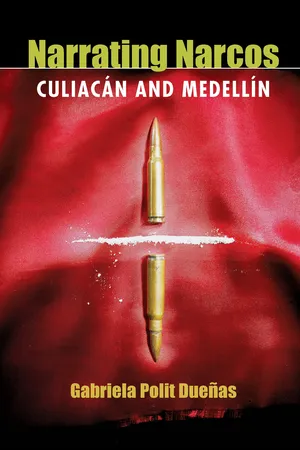
Narrating Narcos presents a probing examination of the prominent role of narcotics trafficking in contemporary Latin American cultural production. In her study, Gabriela Polit Due–as juxtaposes two infamous narco regions, Culiacan, Mexico, and Medellin, Colombia, to demonstrate the powerful forces of violence, corruption, and avarice and their influence over locally based cultural texts.
Polit Due–as provides a theoretical basis for her methods, citing the work of Walter Benjamin, Pierre Bourdieu, and other cultural analysts. She supplements this with extensive ethnographic fieldwork, interviewing artists and writers, their confidants, relatives, and others, and documents their responses to the portrayal of narco culture. Polit Due–as offers close readings of the characters, language, and milieu of popular works of literature and the visual arts and relates their ethical and thematic undercurrents to real life experiences. In both regions, there are few individuals who have not been personally affected by the narcotics trade. Each region has witnessed corrupt state, police, and paramilitary actors in league with drug capos. Both have a legacy of murder.
Polit Due–as documents how narco culture developed at different times historically in the two regions. In Mexico, drugs have been cultivated and trafficked for over a century, while in Colombia the cocaine trade is a relatively recent development. In Culiacan, characters in narco narratives are often modeled after the serrano (highlander), a romanticized historic figure and sometime thief who nobly defied a corrupt state and its laws. In Medellin, the oft-portrayed sicario (assassin) is a recent creation, an individual recruited by drug lords from poverty stricken shantytowns who would have little economic opportunity otherwise. As Polit Due–as shows, each character occupies a different place in the psyche of the local populace.
Narrating Narcos offers a unique melding of archival and ground-level research combined with textual analysis. Here, the relationship of writer, subject, and audience becomes clearly evident, and our understanding of the cultural bonds of Latin American drug trafficking is greatly enhanced. As such, this book will be an important resource for students and scholars of Latin American literature, history, culture, and contemporary issues.
- 242 pages
- English
- PDF
- Available on iOS & Android
eBook - PDF
About this book
Information
Table of contents
- Cover
- Contents
- Acknowledgments
- Introduction
- 1. The Places
- 2. The Book in Three Culichi Novels
- 3. The Author, the Crime, the Idiot, and the Language of the Narcos
- 4. Dealing with Everyday Violence: The Journalist and the Painter
- 5. The Epics of Two Highlanders: Cástulo Bojórquez and Ramón Guerrero
- 6. The Problematic Emergence of Sicarios in Colombia
- 7. Love and Letters in the Times of Narcos
- 8. Gender and Genre in Héctor Abad Faciolince’s Angosta
- 9. Playing with Stereotypes
- Epilogue
- Notes
- Works Cited
- Index
- Back Cover
Trusted by 375,005 students
Access to over 1.5 million titles for a fair monthly price.
Study more efficiently using our study tools.
Frequently asked questions
Yes, you can cancel anytime from the Subscription tab in your account settings on the Perlego website. Your subscription will stay active until the end of your current billing period. Learn how to cancel your subscription
No, books cannot be downloaded as external files, such as PDFs, for use outside of Perlego. However, you can download books within the Perlego app for offline reading on mobile or tablet. Learn how to download books offline
Perlego offers two plans: Essential and Complete
- Essential is ideal for learners and professionals who enjoy exploring a wide range of subjects. Access the Essential Library with 800,000+ trusted titles and best-sellers across business, personal growth, and the humanities. Includes unlimited reading time and Standard Read Aloud voice.
- Complete: Perfect for advanced learners and researchers needing full, unrestricted access. Unlock 1.5M+ books across hundreds of subjects, including academic and specialized titles. The Complete Plan also includes advanced features like Premium Read Aloud and Research Assistant.
We are an online textbook subscription service, where you can get access to an entire online library for less than the price of a single book per month. With over 1.5 million books across 990+ topics, we’ve got you covered! Learn about our mission
Look out for the read-aloud symbol on your next book to see if you can listen to it. The read-aloud tool reads text aloud for you, highlighting the text as it is being read. You can pause it, speed it up and slow it down. Learn more about Read Aloud
Yes! You can use the Perlego app on both iOS and Android devices to read anytime, anywhere — even offline. Perfect for commutes or when you’re on the go.
Please note we cannot support devices running on iOS 13 and Android 7 or earlier. Learn more about using the app
Please note we cannot support devices running on iOS 13 and Android 7 or earlier. Learn more about using the app
Yes, you can access Narrating Narcos by Gabriela Polit Dueñas in PDF and/or ePUB format, as well as other popular books in Literature & Latin American & Caribbean Literary Criticism. We have over 1.5 million books available in our catalogue for you to explore.