- 266 pages
- English
- ePUB (mobile friendly)
- Available on iOS & Android
eBook - ePub
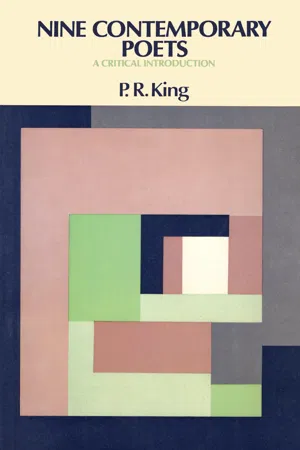
Nine Contemporary Poets
About this book
First Published in 1979. This volume includes simple and systematic introduction to the more important post-war English poets. Including reviews of the poetry of Larkin, Tomlinson, Gunn, Hughes, Plath, Heaney and more. This work will appeal to A-level students, undergraduates, members of adult education classes and general readers enjoying modern literature.
Information
1 Without illusion The poetry of Philip Larkin
DOI: 10.4324/9781315024639-1
Poetry and sanity
Philip Larkin enjoys a high reputation among contemporary poets. As long ago as 1965 one critic talked of him as ‘the best poet England now has’1 and ten years later this opinion was reaffirmed by Alan Brownjohn when he claimed that ‘Larkin has produced the most technically brilliant and resonantly beautiful, profoundly disturbing yet appealing and approachable, body of verse of any English poet in the last twenty-five years’.2
Larkin’s first volume of poetry appeared as long ago as 1945. The North Ship (revised in 1966) was quickly followed by two novels, Jill (1946) and A Girl in Winter (1947). The remaining volumes have been collections of poetry and have appeared at widely separated intervals: The Less Deceived (1955), The Whit-sun Weddings (1964) and High Windows (1974). Larkin has also edited The Oxford Book of Twentieth-Century English Verse (1973) and a collection of his own essays on jazz, All What Jazz? (1970). His total number of published poems does not exceed much more than 100 (of which nearly 30 are regarded by him as juvenilia). He has said he feels lucky if he writes more than one or two poems a year. This reflects the fact that Larkin has never been a full-time writer; but it also shows a high degree of self-criticism.
This somewhat slender output is a result of the scrupulous awareness of a man who refuses to be taken in by inflated notions of either art or life. Larkin is keenly aware of all aspects of the pretentious. In his introduction to Jill he accounts for this by the fact that he grew up just before and during the Second World War. He writes: ‘at an age when self-importance would have been normal, events cut us ruthlessly down to size’. Ever since then his poetry has been very much concerned with the ways in which man’s dreams, hopes, ideals and pretensions are relentlessly diminished by the reality of life.
This refusal to overestimate the value of things extends to his resolute avoidance of literary self-aggrandizement and to the attitude he displays towards the writing of poetry. He believes that a poet must write only about that which he feels deeply. Inflated feelings or rhetoric are to be avoided; for Larkin, poetry is a way of being honest. It is the record of the poet’s recovery of his authentic response to experience, and his muse is the muse of memory. He has written of poetry as an act of preservation, a way of defeating time:
I write poems to preserve things I have seen/thought/felt (if I may so indicate a composite and complex experience) both for myself and for others, though I feel that my prime responsibility is to the experience itself, which I am trying to keep from oblivion for its own sake. Why I should do this I have no idea, but I think the impulse to preserve lies at the bottom of all art.3
It is characteristic of Larkin that he should claim no part of that tradition of the poet as visionary or seer.
His demand for fidelity to experience is supported by his insistence that poetry should both communicate and give pleasure to the reader. Indeed, it is only by truth to experience that the poet is enabled to communicate. It is his belief that many modern artists have ignored this need to communicate and give pleasure that leads to his castigating of the ‘modernist’ movement in the arts. Larkin seems to have in mind the abstract movement in twentieth-century painting, some of the more esoteric poetry of this century and non-traditional jazz music. He sees in it only a deliberate attempt to obfuscate and bewilder, to mystify and outrage. He feels that the result of this has been increasingly to reduce the audience for the arts to a disastrously narrow group of academics and professionals. Larkin believes that poetry must regain a wider audience and that, ‘at bottom poetry, like all art, is inextricably bound up with giving pleasure, and if a poet loses his pleasure-seeking audience he has lost the only audience worth having.’4
It would be a mistake to dismiss this attitude as a form of simple literary conservatism. Larkin is not so much expressing an anti-intellectualism as attacking a particular form of artistic snobbery.
With this insistence that good poetry results from honesty to feeling and the desire to communicate, it is hardly surprising to discover that Larkin found his poetic identity after a close reading of the poetry of Thomas Hardy. Hardy antedates the modernist movement and his poetry blends traditional forms (which are nevertheless kept flexible enough for him to express his unique perspective) with very personal pressures of feeling. Larkin speaks of Hardy having given him ‘a sense of relief that I didn’t have to try and jack myself up to a concept of poetry that lay outside my own life’.5 Hardy taught him that a modern poet could write about the life around him in the language of the society around him. He encouraged him to use his poetry to examine the reality of his own life - an encouragement that led him to the view that ‘poetry is an affair of sanity, of seeing things as they are’.6 As a result Larkin abandoned the highly romantic style of The North Ship, which had been heavily influenced by the poetry of Yeats, and set out to write from the tensions that underlay his own everyday experiences. Hardy also supported his employment of traditional forms and techniques, which Larkin has gone on to use with subtlety and variety.
These attitudes to poetry are similar to those held by The Movement poets of the mid-1950s with whom Larkin was associated for a time. The Movement was a loosely connected group including Kingsley Amis, John Wain, Robert Conquest, John Holloway, D. J. Enright, Elizabeth Jennings, Donald Davie and Thom Gunn. Subsequently these poets developed their work in very different directions, but at the time that they were all contributing to the anthology New Lines (1956) they shared some similar opinions concerning the kind of poetry that ought to be written. They rejected both the politically committed poetry of the 1930s (of the young Auden, Spender and Day Lewis) and the neo-romantic surrealism of the poetry of the 1940s. To a generation that had grown up under the shadow of war it seemed that there had been altogether too much rhetoric and not enough rationality. They looked for poetry which expressed the ordered, rational self, that had ‘a suspicion of large rhetorical gestures, a belief that the intellect and moral judgement must play a decisive part in the shaping of a poem’,7 and which made use of traditional forms, a conversational idiom and adopted a strongly ironical tone of voice.
With the passage of time The Movement may be seen as of much less literary importance than previously, its chief claim to fame being as a nursery for the early growth of a number of talented poets. But it would be a mistake to see Larkin as one of these. Although he had sympathy with many of the attitudes to poetry represented by The Movement, his work is generally more robust and wider-ranging than most of the poetry of New Lines. Certainly he has links with The Movement, as Peschmann has pointed out:
What particularly links Larkin with The Movement in The Less Deceived is its fundamental honesty to experience: a clear-eyed, unillusioned view of contemporary living and its problems, and a refusal to sentimentalize them; the whole couched, for the most part, in a language instantly recognizable as the colloquial idiom of our day, free from pedantry, grandiloquence, or the recherché phrase.8
Larkin’s relationship with The Movement was casual, not causal. His view of the poet’s task owes more to his discovery of Hardy and antedates the formation of The Movement.
From the three major volumes of poetry Larkin has so far published there has emerged a consistency of poetic identity. It is the identity of a detached yet careful observer of the behaviour of himself and others. In many poems he seems to turn away from the society of others and to take up a solitary stance implying a purer vantage point from which to survey life in his ‘humorous, self-deprecatory and observant’9 way. The adoption of this role and a frequently ironic tone should not mislead the reader into assuming he is unmoved by his feelings and response to what he observes. The detachedness appears to be the necessary concomitant of his view of the artist’s role. He observes and remains apart as a result of his commitment to an art which is to record and preserve life rather than to enact or transcend life. He sees this commitment as demanding above all an honesty about his own nature and, if this requires him to be on the outside looking in, it must be accepted. This is made plain in ‘Reasons for Attendance’, where art is seen as his way of remaining true both to himself and to what he observes. The person in the poem is looking through a lighted window to watch people dancing inside. He realizes he prefers to remain outside and he asks himself why this should be so:
Why be out there?
But then, why be in there? Sex, yes, but what
Is sex? Surely, to think the lion’s share
Of happiness is found by couples - sheer
Inaccuracy, as far as I’m concerned.
What calls me is that lifted, rough-tongued bell
(Art, if you like) whose individual sound
Insists I too am individual….
Therefore I stay outside,
Believing this; and they maul to and fro,
Believing that; and both are satisfied,
If no one has misjudged himself. Or lied.
Although the dedication to his art is insisted upon, the final two words make it clear there is no room for self-congratulation. Larkin is aware that even this commitment of his may finally be as much an illusion and self-deception as those he exposes elsewhere in so many of his poems. Larkin seems anxious not to be taken in even by his own commitments.
The voice of this poetic identity has many tones and a variety of diction and idiom. It can be sharp and satirical (‘Vers de Société’), quiet and almost plaintive (‘Broadcast’), conversational and meditative (‘Church Going’), even lyrical and mysterious (‘Coming’) and occasionally resentful and bitter (‘Send No Money’). In all these tones and moods the same tension is at work: the conflict between our dreams, hopes and expectations, and the various ways in which reality serves to make them collapse. Larkin records the various ways in which man pulls the wool over his own eyes in being tempted to believe that he can achieve a paradise of money, or fame, or sex, or close relationships with others. He explores the way we ‘pick up bad habits of expectancy’ which is only to be destroyed eventually by that ‘solving oblivion’ which runs just under everything we do. He is concerned to expose our illusions and evasions so that we may stand naked but honest, ‘less deceived’ by ourselves before the reality of life and death.
It is this underlying concern which provides the constancy of the relatively small number of themes in Larkin’s poetry: the passage of time, memory and the past, the illusory visions of man (especially the failure of the promise of love) and old age and death. But this continuity of theme should not blind the reader to the variety of tone, form and intention in the poems. The central poetic identity remains constant but does not become dull. Larkin’s poetry may not develop in the sense of going through any sudden alterations of theme or style, but it rather has continued to deepen and refine his chosen concerns. He has said, ‘I don’t think I want to change; just to become better at what I am.’10 This has led some critics to be suspicious of his achievement, as if development in its meaning of change was the sine qua non of greatness in poetry. Since he found his mature style in The Less Deceived Larkin has not sought this kind of development and therefore it is not necessary to pursue a chronological approach in introducing his poetry. The remaining part of this chapter will consider a number of individual poems in the light of Larkin’s main themes, characteristic voices and variety of tones.
Time’s fool
At the heart of Larkin’s poetry lies a constant awareness of the passing of time and a belief that man is always in thrall to time. Time strips us of illusions and is the bearer of realities which we would prefer to avoid. In ‘Reference Back’ he writes,
Truly, though our element is time,
We are not suited to the long perspectives
Open at each instant of our lives.
They link us to our losses.
Time is a chain that binds us to our earlier hopes and dreams which, as we grow older, we realize will never become reality. This sense of loss, of hopes blasted and ideals destroyed, pervades the poetry. In many of the poems Larkin looks over his shoulder at his own past, or indirectly considers that past by observing the youth around him, and rubs his nose in the fact that memory is cruel enough to remind us that the adult life we now experience as mundane and drab is that very same life that in our childhood and youth we invested with all possible excitement and meaning. There is a double cruelty in time: it both reminds us of what we might have had, and turns what we do have into a sense of disappointment. The ‘long perspectives’
…show us what we have as it once was,
Blindingly undiminished, just as though
By acting differently we could have kept it so.
Although others might claim man can assert his will to prevent such diminishing of his hopes, the persona in many of these poems rules that out. He adopts a deterministic view of life whereby ‘something hidden from us’ destroys all attempts we m...
Table of contents
- Cover Page
- Half Title Page
- Title Page
- Copyright Page
- Contents Page
- Preface Page
- Acknowledgements Page
- 1 Without illusion: The poetry of Philip Larkin
- 2 Seeing and believing: The poetry of Charles Tomlinson
- 3 ‘A courier after identity’: The poetry of Thom Gunn
- 4 Elemental energy: The poetry of Ted Hughes
- 5 ‘Dying is an art’: The poetry of Sylvia Plath
- 6 ‘I step through origins’: The poetry of Seamus Heaney
- 7 Three new poets: Douglas Dunn, Tom Paulin, Paul Mills
- Notes
- Selected reading
- Index to poets and poems cited in the text
Trusted by 375,005 students
Access to over 1.5 million titles for a fair monthly price.
Study more efficiently using our study tools.
Frequently asked questions
Yes, you can cancel anytime from the Subscription tab in your account settings on the Perlego website. Your subscription will stay active until the end of your current billing period. Learn how to cancel your subscription
No, books cannot be downloaded as external files, such as PDFs, for use outside of Perlego. However, you can download books within the Perlego app for offline reading on mobile or tablet. Learn how to download books offline
Perlego offers two plans: Essential and Complete
- Essential is ideal for learners and professionals who enjoy exploring a wide range of subjects. Access the Essential Library with 800,000+ trusted titles and best-sellers across business, personal growth, and the humanities. Includes unlimited reading time and Standard Read Aloud voice.
- Complete: Perfect for advanced learners and researchers needing full, unrestricted access. Unlock 1.5M+ books across hundreds of subjects, including academic and specialized titles. The Complete Plan also includes advanced features like Premium Read Aloud and Research Assistant.
We are an online textbook subscription service, where you can get access to an entire online library for less than the price of a single book per month. With over 1.5 million books across 990+ topics, we’ve got you covered! Learn about our mission
Look out for the read-aloud symbol on your next book to see if you can listen to it. The read-aloud tool reads text aloud for you, highlighting the text as it is being read. You can pause it, speed it up and slow it down. Learn more about Read Aloud
Yes! You can use the Perlego app on both iOS and Android devices to read anytime, anywhere — even offline. Perfect for commutes or when you’re on the go.
Please note we cannot support devices running on iOS 13 and Android 7 or earlier. Learn more about using the app
Please note we cannot support devices running on iOS 13 and Android 7 or earlier. Learn more about using the app
Yes, you can access Nine Contemporary Poets by P.R. King in PDF and/or ePUB format, as well as other popular books in Letteratura & Critica letteraria inglese. We have over 1.5 million books available in our catalogue for you to explore.