Outdoor Lighting for Pedestrians shows how outdoor lighting is important for pedestrians' safety, personal security, and comfort, with major impacts on street, path, and park aesthetics and neighborhood sense of place. Providing clear, basic technical background (accessible to non-engineers), the book focuses especially on planning and policy concerns. It covers the fundamentals of lighting technology; benefits, costs, and possible adverse impacts of lighting enhancements; traditional and innovative approaches; planning and policy documents and practices; aesthetics and placemaking; and technology trends in lighting design. This book is aimed primarily at practicing transportation planners and engineers, generalist urban planners, safety advocates and researchers, and university students. However, lighting designers and other professionals will also find it useful. It considers how lighting can be coordinated with other potential improvements to enhance the pedestrian environment for better walkability.
- 200 pages
- English
- ePUB (mobile friendly)
- Available on iOS & Android
eBook - ePub
About this book
Information
Chapter 1Introduction
DOI: 10.4324/9781003149750-1
1.1 Why Is This Book Needed?
Lighting is increasingly recognized as a critical factor in the quality or “walkability” of the after-dark pedestrian environment. Pedestrian safety, personal security, and comfort are essential benefits of effective lighting. However, special lighting features and artistic lighting can also improve the aesthetics and unique identity of neighborhoods, tourist zones, and other areas. Lighting enhancements for pedestrians can boost the local economy. Good lighting helps many take advantage of evening and nighttime activities and exercise while enjoying the special after-dark atmosphere.
Lighting also can impose significant costs and potential adverse impacts, although there are measures to mitigate these impacts. Street lighting is a major contributor to municipal energy usage and budgets. Possible health impacts of artificial lighting, especially some light-emitting diodes (LEDs), have attracted the attention of multiple organizations. Unwanted light raises concerns by astronomers about sky glow, by residents and farmers about light “trespassing” on their properties, and by travelers about glare. Luminaires (light fixtures) and poles themselves can raise aesthetic issues and contribute to the hazards of fixed objects adjacent to the roadway.
A general reference is needed for the transportation planner/engineer and others who are not lighting specialists. Lighting technical references are typically aimed at the lighting designer or engineer (often with a background in lighting or architectural engineering, electrical engineering, traffic engineering, or a similar field). Lighting is often overlooked in policy considerations of pedestrian safety and walkability measures, in part because municipal responsibility for street lighting may be in a separate local agency with limited communication with other departments. Lighting needs of pedestrians need to be considered prominently along with those for drivers.
Lighting for pedestrians is an increasingly critical topic because of growing attention to pedestrian safety, dramatic changes in lighting technology, and new interest from professional and activist groups.
This book bridges that gap. It presents technical fundamentals in a manner understandable to those with no technical background in lighting. The Guide also includes extensive material on policy issues and case studies to provide a comprehensive, single reference on the most important information on this topic for transportation planners and engineers, safety researchers and advocates, and urban planners and designers, as well as lighting specialists.
This Guide comes at an important juncture with a multitude of challenging issues and new directions in lighting. The most important factors include:
- Increased attention to pedestrian safety and the pedestrian environment
- New technologies that provide greater control over lighting effects and impacts
- The involvement of a broad range of stakeholders in lighting issues
1.1.1 Pedestrian Safety and the Pedestrian Environment
Pedestrian safety is a major and growing public health concern. U.S. pedestrian fatalities from motor vehicles hit a 29-year high in 2019, at over 6,500.1 Fatalities continued to rise during 2020, and with the drop in traffic volumes with the COVID-19 pandemic, the fatality rate per vehicle mile traveled increased 21 percent from 2019.2 Increased speeding on less congested roads was a likely contributor. Pedestrian fatalities make up 17 percent of national traffic deaths. Nighttime pedestrian deaths increased 67 percent between 2009 and 2018, compared to only 16 percent during daytime. Globally, pedestrians and cyclists comprise 26 percent of traffic fatalities.3 Pedestrians are 1.5 times more likely than passenger vehicle occupants to be killed in a car crash on each trip.4 An additional 137,000 estimated pedestrians were treated in hospitals for nonfatal crash-related injuries in 2017.5
About three-quarters of pedestrian fatalities in the U.S. occur after dark. Research using 11 years of U.S. Department of Transportation Fatality Analysis Reporting Systems (FARS) data on the distribution of fatal crashes estimated the safety risk to pedestrians to be at least four times higher in darkness than in light.6
Lighting improvements can help allay concerns over pedestrian safety and personal security that discourage walking. The Governors Highway Safety Association supported street lighting improvements as a key safety measure (in addition to roadway engineering and enforcement measures, plus decreases in alcohol/drug impairment among drivers and pedestrians).7 Safety and security concerns can lead to a loss of the significant health and environmental benefits provided by walking or jogging. Walking is “the closest thing we have to a wonder drug,” in the words of Dr. Thomas Frieden, former director of the U.S. Centers for Disease Control and Prevention.8 Besides recognized health benefits of reduced risk for heart disease, diabetes, high blood pressure, and cancer, Harvard Medical School researchers identified several other less-known benefits, like easing joint pain.9
Walking is an essential way for residents and visitors to experience cities. As the writer Rebecca Solnit phrased it, “Walkers are ‘practitioners of the city,’ for the city is made to be walked.”10
Walkability (including the quality of pedestrian facilities and close proximity of key services) is important to support a high quality of life and attract diverse residents to new homes and travelers to tourist destinations. Homes in walkable neighborhoods command higher prices.11 One point higher on Walk Score can add nearly one percent to a property’s sale price. A survey by real estate firm Redfin found that 56 percent of millennial home buyers, those in their 20s and 30s, said “walkable communities” were a key factor when they looked to buy a home. Good lighting contributes to walkability.
1.1.2 New Technologies
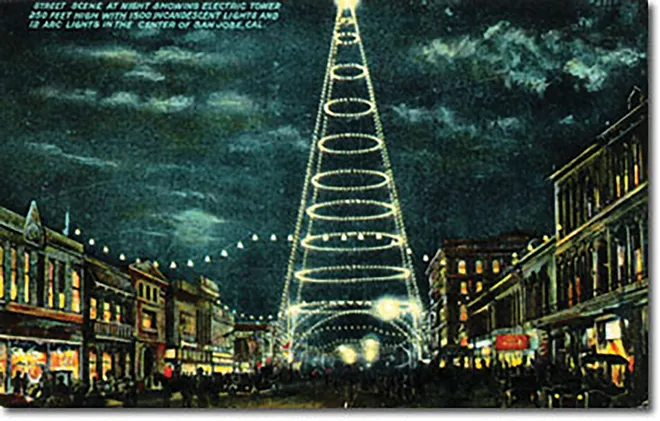
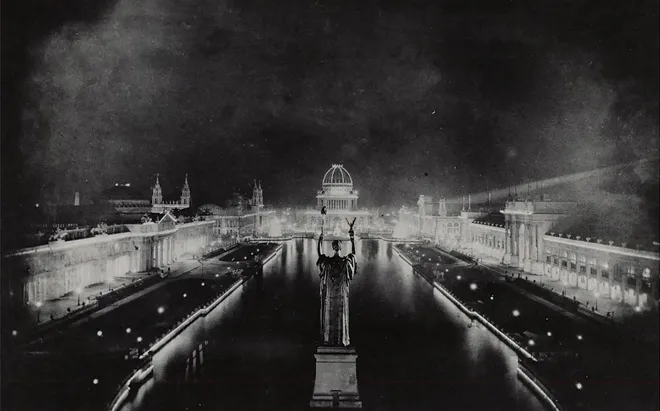
The potential for enhanced lighting dramatically improving the nighttime urban environment was recognized over a century ago at the dawn of the electric age. In 1881, San Jose, California, erected a 237-foot-tall light tower intended to illuminate the entire downtown area.12 (See Figure 1.1.) The tower failed to sufficiently light the streets, but it led to complaints from farmers about interference with hens laying eggs. (Moonlight towers, originally erected in 1895, remain in Austin, Texas, and are on the National Register of Historic Places.13) Around the 1870s and1880s, electric street lights were installed in parts of New York, London, and Paris. The 1893 World Columbian Exposition’s “White City” illuminated a miniature city in Chicago “as if the earth and sky were transformed by the immeasurable wands of colossal magicians” (in the colorful words of a contemporary account).14 (See Figure 1.2.)
Over the decades since, as electric lighting became commonplace, choices expanded dramatically. There is now an extensive range of pedestrian-serving lighting, from common pole-mounted roadway lights and pedestrian-scale lights to bollards, building-mounted, and ground-level lighting.
LED lighting and “smart lighting” are leading a revolutionary expansion in the ways outdoor lighting can be controlled and used more effectively.15 “Smart city” sensors to monitor traffic and other activities are often being deployed as part of smart lighting. This has also expanded the interest by researchers in the cost, environmental, and health impacts of these innovations.
1.1.3 Attention from a Broad Range of Stakeholders
Lighting improvements often have the support of safety advocates, businesses, and civic improvement groups. However, lighting technology has also drawn criticism from a broad range of organizations over possible adverse impacts.
The American Medical Association (AMA) in 2016 expressed concern about the possible adverse impacts of “intense blue-rich” LED street lighting, potentially creating a road hazard.16 The AMA critique listed possible adverse effects of “brighter nighttime lighting” including reduced sleep quantity and quality, daytime sleepiness, impaired daytime functioning, and obesity. Analyses by lighting engineers, discussed in later chapters, have countered these concerns, suggesting that such impacts of well-designed street lighting are minimal and less than that from personal or home electronic devices and indoor lighting.
Obtrusive lighting (sky glow, light trespass, and glare) is a concern for a number of groups and for state legislators. For example, the International Dark-Sky Association, a non-profit organization, “works to help stop light pollution and protect the night skies for present and future generations.”17
At least 18 states have laws addressing obtrusive lighting.18 The most common legislation requires on public grounds or right-of-way the installation of shielded light fixtures. Other laws require the use of low-glare or l...
Table of contents
- Cover
- Half Title
- Title Page
- Copyright Page
- Dedication
- Table of Contents
- List of Figures
- List of Tables
- Contributor Biographies
- Preface
- Acknowledgments
- 1 Introduction
- 2 Lighting 101: Technical Fundamentals
- 3 Benefits of Improving Lighting
- 4 Costs and Potential Adverse Impacts of Lighting
- 5 Basic Options in Lighting Equipment
- 6 Innovative Technologies
- 7 Policies and Planning for Enhanced Lighting
- 8 Integrating Pedestrian Lighting into Transportation Design, Operations, and Maintenance
- 9 Placemaking and Aesthetics
- 10 The Future of Lighting for Pedestrians
- Index
Trusted by 375,005 students
Access to over 1.5 million titles for a fair monthly price.
Study more efficiently using our study tools.
Frequently asked questions
Yes, you can cancel anytime from the Subscription tab in your account settings on the Perlego website. Your subscription will stay active until the end of your current billing period. Learn how to cancel your subscription
No, books cannot be downloaded as external files, such as PDFs, for use outside of Perlego. However, you can download books within the Perlego app for offline reading on mobile or tablet. Learn how to download books offline
Perlego offers two plans: Essential and Complete
- Essential is ideal for learners and professionals who enjoy exploring a wide range of subjects. Access the Essential Library with 800,000+ trusted titles and best-sellers across business, personal growth, and the humanities. Includes unlimited reading time and Standard Read Aloud voice.
- Complete: Perfect for advanced learners and researchers needing full, unrestricted access. Unlock 1.5M+ books across hundreds of subjects, including academic and specialized titles. The Complete Plan also includes advanced features like Premium Read Aloud and Research Assistant.
We are an online textbook subscription service, where you can get access to an entire online library for less than the price of a single book per month. With over 1.5 million books across 990+ topics, we’ve got you covered! Learn about our mission
Look out for the read-aloud symbol on your next book to see if you can listen to it. The read-aloud tool reads text aloud for you, highlighting the text as it is being read. You can pause it, speed it up and slow it down. Learn more about Read Aloud
Yes! You can use the Perlego app on both iOS and Android devices to read anytime, anywhere — even offline. Perfect for commutes or when you’re on the go.
Please note we cannot support devices running on iOS 13 and Android 7 or earlier. Learn more about using the app
Please note we cannot support devices running on iOS 13 and Android 7 or earlier. Learn more about using the app
Yes, you can access Outdoor Lighting for Pedestrians by Frank Markowitz in PDF and/or ePUB format, as well as other popular books in Architecture & Architecture General. We have over 1.5 million books available in our catalogue for you to explore.