eBook - ePub
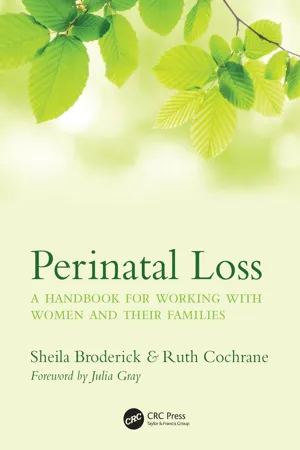
Perinatal Loss
A Handbook for Working with Women and Their Families
- 166 pages
- English
- ePUB (mobile friendly)
- Available on iOS & Android
eBook - ePub
About this book
The death of a baby is one of the most painful experiences anyone can imagine. This practical, compassionate text guides professionals in providing the best possible care through the physical and emotional pain of a pregnancy loss from early miscarriage to neonatal death, enabling patients and their families to grieve. Written by two professionals with extensive experience in the field, the book inspires confidence for those confronted with this challenging task. It focuses on common issues that inhibit good care and addresses the traditionally difficult topics. Healthcare staff assisting patients during this time often require support of their own and this is also addressed with constructive, inspirational approaches and ideas for professional training. Perinatal Loss: a handbook for working with women and their families offers insights, information and support for managing pregnancy loss for all professionals and students including nurses, sonographers, midwives, doctors (including obstetricians and general practitioners), chaplains and morticians. 'This is an important and warmly welcomed book which thoroughly endorses the key aims of Sands (Stillbirth & Neonatal Death Society). In particular, it demonstrates a forceful commitment to improving care for bereaved families whilst acknowledging the difficult task that staff undertake when caring for them. This handbook encompasses all aspects of perinatal loss, giving due care and attention to the many different circumstances and exploring the thoughts and feelings which are experienced when a baby dies at any gestation.' From the Foreword by Julia Gray
Information
CHAPTER 1

Introduction
The aim of this book is to shed some light on the issues for all those involved in caring for patients who experience a pregnancy loss. The end of a pregnancy, at whatever gestation, can be both physically frightening and emotionally painful and being looked after by professionals who care can make an otherwise unbearable experience bearable. More than anything, we want those looking after a mother and father whose baby dies to have a sense of pride and honour in relation to the care they provide.
The experience of a couple whose baby dies and who feel cared for by staff is hugely different from that of a couple who have a similar loss but do not feel cared for. The first will say that the staff ‘did everything they could’ and were wonderful and caring, and that they almost had a positive experience in the midst of their grief. The second will have noticed every little thing that was not done correctly or every phrase said to them that was insensitive, and may even attribute the death of their baby to the lack of care they received. This can happen prior to the death of the baby: for example, a woman who was worried about her baby but was refused a scan without adequate explanation may think that if she had been given a scan any problems would have been identified and acted upon. It can also happen at the time of giving birth: a woman may remember a delay in being taken to theatre for a trial of instrumental delivery and think that without the delay the baby may have survived. In the course of our work with bereaved couples, we have often been told ‘if only we had been cared for differently, perhaps our baby would have lived’. Occasionally, this will actually be true, but when it is not, it is very hard for couples to believe that this is the case. Lack of fundamental care can make parents suspicious of the motives of all caregivers and they will distrust feedback that can, to them, sound like a cover-up.
To highlight some of these issues, we have given examples throughout the book of both good and bad care. We hope that by discussing patients’ bad experiences, you will learn from these and therefore be more confident when dealing with bereaved parents in the future.
There is a collective myth, at least in this society, that getting pregnant, staying pregnant, giving birth to a live baby and having a baby that survives is simple, despite clear evidence that this is not the case. There is an assumption that it is easy and within people’s control. A woman who uses an ovulation predictor kit and gets pregnant soon afterwards will attribute her pregnancy to using the kit and feel that she had control over her conception, whereas our experience tells us that she was simply fortunate to get pregnant that month. Women who use predictor kits and never get pregnant can attest to this. It is partly this myth that women are up against when they experience a pregnancy loss. If a woman believes that her pregnancy will be normal and result in a healthy baby, she is protecting herself from the notion that something will go wrong. Women also think that things can go wrong with other people’s pregnancies but not their own. They believe that all will be well once they are pregnant and that their baby will be born alive and will thrive. Why else would women who are only 12 weeks pregnant start decorating the nursery and buying baby clothes? We, the caregivers, need to understand this myth so that we can recognise the myriad reactions women and their families have in response to a pregnancy loss. For example, women who have experienced a baby dying will mention that they feel like outsiders and that other people have what they have not. It will seem to them that babies and pregnant women are everywhere. They are often very aware of how children are being treated and if they are not being treated well this exacerbates their feeling of ‘Why me?’ and their sense of unfairness. They are no longer able to buy into the collective myth that all will be well.
We work in a diverse multicultural borough in London and are aware of the varied ways that people from different cultures cope with pregnancy loss. However, we have deliberately not made significant reference to these differences in our book, as we are wary of making distinctions that do not account for individuals within any particular culture. We want people to be treated as individuals and not grouped together by what is defined as their ‘culture’. Not all members of a perceived culture will react in the same way. For example, we once heard it said ‘African women do not want to see or hold their babies’ only to have this contradicted by an African midwife whose own baby had died. Cultural norms are collective; thus, to apply blanket beliefs to individuals is likely to do as much harm as being completely ignorant of them. Furthermore, until relatively recently, it was the cultural norm in Britain that newly bereaved mothers be separated from their dead babies immediately. It was thought that it was better for and kinder to women and their families to relieve them of the burden of seeing, holding or taking any responsibility for their babies. Nowadays, we see the error of this reasoning and know how in the past it harmed women, who then spent a lifetime wondering what happened to their son or daughter.
Our book covers both the practical and emotional aspects of caring for bereaved parents and their families. The focus is principally on the mother, but we have tried to acknowledge the significance of the loss for her partner and her extended family where it is appropriate.
There are some over-arching principles that cover all aspects of pregnancy loss that we discuss below.
COMMUNICATION
Good communication is at the heart of this work and is one of the ways in which people know they are cared for. Communication is a two-way process: it includes the way someone is spoken to – what is said or not said – as well as what is understood. It is complex and there needs to be an appreciation of the patient’s position before it can be said to be occurring. Patients come to hospital with many assumptions about the role of the doctor, nurse or midwife. Most patients will expect to be looked after. They can be in awe of you and expect you to be an expert. They can be worried about taking up too much of your time and scared of being thought wrong or stupid. They may attempt to communicate but give up because they are not being heard. These concerns are unlikely to be voiced, but they will manifest themselves in the way that the patient behaves: some will be aggressive and others will be passive. Aggressive patients are difficult to deal with, but it is important to see beyond their aggression, as they are likely to be worried and will use anger or hostility to hide this. Passive patients will not cause any trouble and it may be easy not to notice their concerns, but it is vital that you do.
Communication requires time. This can be difficult, but it behoves you to ensure that both the patient and yourself have enough time to enable it to happen. It may mean risking annoying colleagues by concentrating on one patient and leaving them to deal with the others. Fear of getting it wrong can interfere with the ability to communicate or making the time and effort required to stay with a distressed mother. There will be practical tasks that are the same for each pregnancy loss and the emotional response may be similar, but how both the tasks and the communication are undertaken will vary according to the patient you are dealing with each time.
PATIENT-CENTRED CARE
‘Patient-centred care’ means putting patients at the heart of their treatment. It means taking your cues from the patient and using active listening skills. Active listening skills are part of good communication. Worries need to be taken seriously and then if they are found to be groundless, so much the better, and you will have a patient who feels respected and acknowledged. Women report that they have sensed that something was wrong with their baby and been worried, only to be told by a doctor or midwife not to worry. It is important to know that if they had any choice about not worrying, then they would not worry. To say to someone ‘don’t worry’ is at best dismissive; at worst, if their worries prove to be correct, the patient will be left feeling hurt, frustrated and powerless. She will say ‘if only they had listened’ and think that it might have made a difference if they had done so.
No matter how many pregnancy-loss cases you have managed, you need to know that each and every loss is individual to the patient involved. The end of a pregnancy may be the patient’s first experience of a difficulty in pregnancy or she may have previously had a loss or losses. You need to take your cues from her as to how she wants to be treated. You may need to tell her what her options are, give her support whilst she decides which of these to choose and help her by making any necessary arrangements. It may be that patients make choices that surprise or unsettle you. An example of this would be a woman choosing to continue a pregnancy when the baby has been diagnosed with a lethal congenital abnormality. You need to be able to listen and be supportive, rather than voice any confusion or disapproval. Neither should you tell the woman what you would do in the same circumstances. It is her pregnancy and her decision, and you must show her that you support her, whatever she decides.
Another example of taking your cue from the patient is when you are referring to the baby’s sex. Some couples will not want to know the sex of their stillborn baby, which may be a defence mechanism – if they do not know whether their baby was a boy or a girl, they cannot get too close, or so they believe. For others, knowing the baby’s sex is intrinsic to their grieving process. They can refer to losing their daughter or their son and using these words helps them to start to make sense of their loss.
TRY NOT TO MAKE ASSUMPTIONS
Both patients and staff will make assumptions about pregnancy loss. Patients make assumptions about why the pregnancy went wrong in an effort to make sense of their loss, and staff make assumptions because it feels better to discuss a reason for the death than to admit that you do not know why it happened. Both of these reactions are strategies for managing the situation, but it can be very hard to unravel any misunderstandings if the original assumption was incorrect. Therefore, we would say that unfortunately there are no rules to follow other than never to make assumptions. If there were rules, then it would make the profound task of looking after a woman when her baby dies that much simpler.
The majority of people will want to know why this tragedy has happened to them. They will search for answers: they may scour the Internet and will review what they did or did not do that might have caused the loss; they will remember the glass of wine they drank or the heavy box they lifted. You may be tempted to respond to their questions, but do not guess if you do not know the answer; it is distressing to the patient to be told something that they later find out to be incorrect.
You may want to tell people what you think has happened because they ask you. You may find yourself saying things like ‘you’ll need a stitch next time’ or ‘the cord was wrapped around the baby’s neck’, but you need to resist answering any questions until such time as any cause of death has been established.
USE OF APPROPRIATE LANGUAGE
In writing this book, we have realised that the issue of the use of appropriate language comes up in several different ways. There is our use of language in this book, which we will discuss further in a moment; there is patients’ use of language and how that can differ from the way that staff speak; there is the risk of causing upset or offence to patients if we use language insensitively.
Even though this is primarily a book for staff rather than patients, we have made a deliberate effort to use language in a personal rather than clinical way. Doctors in particular may distance themselves from their patients’ agony by talking about what is going on in a detached and impersonal manner. As a contrast, we have used words that patients rather than doctors would use and tried to avoid euphemisms or any words that hide or belittle the truth. So, for example, we say ‘their baby’ rather than ‘the baby’, and try to say ‘death’ rather than ‘loss’. We have also used ‘he’ or ‘she’ rather than ‘it’ when referring to babies, swapping between sexes throughout each chapter.
Patients’ use of language is often very different from that of medical staff. We should do our best to use the same words as the patients. As an example, we have used the word ‘baby’ throughout the book, except when talking about the first trimester, when we have used the word ‘fetus’. We have done this deliberately because it refl ects the way that some women will use the word ‘fetus’ early on, until the pregnancy is more established. Some will not say ‘baby’ for fear of becoming attached to a pregnancy that they might lose, or they may feel that it is not a baby until a certain gestation. Others will say ‘baby’ from the beginning, which can be unnerving for some staff, especially in the context of a pregnancy going wrong in the first few weeks. We do not make a distinction between the relative importance of the two words ‘baby’ and ‘fetus’, and when working with a woman we would use the word ‘baby’ from the start if this is what she uses.
We have referred to couples sometimes as being a mother and her partner and sometimes as a mother and father. We are aware that same-sex couples and women without a partner, either by choice or not, have pregnancy losses, but we have not made these distinctions in the book for ease of writing.
RECOGNISING THE CHALLENGES
It is very important that, in the face of something awful happening, you do not become paralysed. We need to be aware of our own attitudes towards pregnancy loss, which aspects of a baby dying we find easier or harder to deal with and why that is. We need to strive to get it right, but it is important to be aware that it may not be possible to get it right for every patient every time. This is because each patient, her partner and her family are unique and will react to what has happened in their own individual ways. One example of this is in telling someone that you are scanning that they have suffered an intrauterine death. You may try to be kind by being indirect – ‘I can see the chambers of the heart here, and as you can see they are not moving, and I’m afraid this means that your baby’s heart is not beating, and so …’ – but some patients would prefer you to come straight out with it: ‘I am sorry to say that your baby has died’. Others would construe this as being too blunt. You may find that you are criticised whatever you do; you have to learn that this is part of the complexity of a baby dying and not blame the patient for her reaction to the dreadful news of her baby’s death.
We tend to live in a culture of blame: it is common to see advertisements that encourage insurance claims when accidents have happened. We believe there is a huge difference between blaming individuals and people taking responsibility for their mistakes. Mistakes are opportunities for learning and in the health profession there are sometimes near misses and sometimes dire consequences of mistakes. We want to emphasise that the hospital in which the two of us work is no different from any other in this regard: despite the best care, some pregnancies go wrong and usually no one is to blame. However, it is crucial that the organisation and individuals within it take responsibility for any mistakes that surround the death of a baby, including errors that might have contributed to the baby dying. Patients find it much easier to handle dreadful blunders if, from the outset, there is no attempt to cover them up. We would add that it is vital that the patient’s experience of what happened forms a key part of any investigation, as their experience can differ greatly from that of the others involved. From the outset, the investigating team should not take an adversarial approach. This does not mean that patients are exclusively correct; rather, it means that their experiences need to be appreciated, as you cannot disagree with or dispute someone else’s experience. In an atmosphere where blame is not the first resort, staff will feel safe enough to talk about their experience and be able to explain their decision-making.
Finally, in most cases in which a pregnancy loss is beyond anyone’s control, you need to know that whilst you cannot change anything or put it right, you can do something very meaningful. Do what you can to make the patient’s experience the best it can be and get help to do the things that you cannot. This maxim is a broad one, as it can mean asking a senior colleague to help manage an unfamiliar case or acknowledging that another member of the team may be better placed than you to help the patient. You cannot always get it right, but you can learn to live with this fact if your intentions towards the patient are good and you do your best to be kind and professional. We realise how hard this can be and that is why we have written this book.
CHAPTER 2
Types of losses
INTRODUCTION
This chapter discusses the different types of pregnancy loss and illustrates some of the emotional impact that these losses can have for women and their families.
USE OF LANGUAGE: WHY DEFINITIONS CAN BE PROBLEMATIC
We think it is worth starting this chapter with a discussion of the use of language in relation to pregnancy loss. Language is very important in this context because the use of insensitive language can be unexpectedly hurtful. For example, we are aware that as we write, members of the Miscarriage Association are trying to find different terminology for the evacuation of retained products of conception (ERPC), as women have told them that it is confusing and distressing to have the end of their pregnancy described this way.
Strictly speaking, in medical terminology, the word ‘miscarriage’ means ‘the loss of a pregnancy before 24 completed weeks’. Most miscarriages occur in the first trimester, so for most women ‘miscarriage’ means the loss of a pregnancy in the first 3 months. The Oxford English Dictionary defines miscarriage as ‘the spontaneous or unplanned expulsion of a fetus from the womb before it is able to survive independently’.1 This is slightly different from...
Table of contents
- Cover
- Title Page
- Copyright Page
- Table of Contents
- Foreword
- About the authors
- Abbreviations
- 1 Introduction
- 2 Types of losses
- 3 Bad and sad news
- 4 Initial reactions to grief
- 5 Patient–centred care
- 6 Support for staff
- 7 Labour and delivery
- 8 When something goes wrong in labour
- 9 What to do with the baby
- 10 Tests, post–mortems and paperwork
- 11 Funeral arrangements, including burial and cremation
- 12 Support for parents after the death and the longer lasting effects of grief
- 13 The next pregnancy
- 14 Training
- Index
Trusted by 375,005 students
Access to over 1.5 million titles for a fair monthly price.
Study more efficiently using our study tools.
Frequently asked questions
Yes, you can cancel anytime from the Subscription tab in your account settings on the Perlego website. Your subscription will stay active until the end of your current billing period. Learn how to cancel your subscription
No, books cannot be downloaded as external files, such as PDFs, for use outside of Perlego. However, you can download books within the Perlego app for offline reading on mobile or tablet. Learn how to download books offline
Perlego offers two plans: Essential and Complete
- Essential is ideal for learners and professionals who enjoy exploring a wide range of subjects. Access the Essential Library with 800,000+ trusted titles and best-sellers across business, personal growth, and the humanities. Includes unlimited reading time and Standard Read Aloud voice.
- Complete: Perfect for advanced learners and researchers needing full, unrestricted access. Unlock 1.5M+ books across hundreds of subjects, including academic and specialized titles. The Complete Plan also includes advanced features like Premium Read Aloud and Research Assistant.
We are an online textbook subscription service, where you can get access to an entire online library for less than the price of a single book per month. With over 1.5 million books across 990+ topics, we’ve got you covered! Learn about our mission
Look out for the read-aloud symbol on your next book to see if you can listen to it. The read-aloud tool reads text aloud for you, highlighting the text as it is being read. You can pause it, speed it up and slow it down. Learn more about Read Aloud
Yes! You can use the Perlego app on both iOS and Android devices to read anytime, anywhere — even offline. Perfect for commutes or when you’re on the go.
Please note we cannot support devices running on iOS 13 and Android 7 or earlier. Learn more about using the app
Please note we cannot support devices running on iOS 13 and Android 7 or earlier. Learn more about using the app
Yes, you can access Perinatal Loss by Sheila Broderick,Ruth Cochrane in PDF and/or ePUB format, as well as other popular books in Medicine & Gynecology, Obstetrics & Midwifery. We have over 1.5 million books available in our catalogue for you to explore.