The Cairo Genizah is considered one of the world's greatest Hebrew manuscript treasures. Yet the story of how over a quarter of a million fragments hidden in Egypt were discovered and distributed around the world, before becoming collectively known as "The Cairo Genizah," is far more convoluted and compelling than previously told. The full story involves an international cast of scholars, librarians, archaeologists, excavators, collectors, dealers and agents, operating from the mid-nineteenth to the early twentieth century, and all acting with varying motivations and intentions in a race for the spoils.
Basing her research on a wealth of archival materials, Jefferson reconstructs how these protagonists used their various networks to create key alliances, or to blaze lone trails, each one on a quest to recover ancient manuscripts. Following in their footsteps, she takes the reader on a journey down into ancient caves and tombs, under medieval rubbish mounds, into hidden attic rooms, vaults, basements and wells, along labyrinthine souks, and behind the doors of private clubs and cloistered colleges. Along the way, the reader will also learn about the importance of establishing manuscript provenance and authenticity, and the impact to our understanding of the past when either factor is in doubt.
eBook - ePub
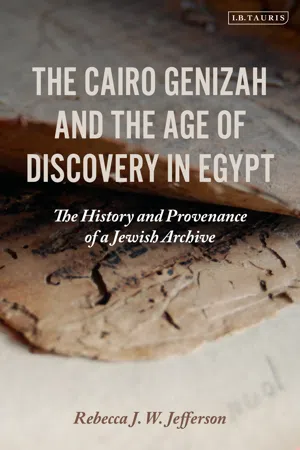
The Cairo Genizah and the Age of Discovery in Egypt
The History and Provenance of a Jewish Archive
- 288 pages
- English
- ePUB (mobile friendly)
- Available on iOS & Android
eBook - ePub
The Cairo Genizah and the Age of Discovery in Egypt
The History and Provenance of a Jewish Archive
About this book
Information
1
Hiding places for Hebrew manuscripts
It could have been a Howard Carter moment. A concealed receptacle filled with wonderful manuscripts, accessed via the rooftop of Old Cairo’s Ben Ezra Synagogue, was ripe for discovery by the time Jacob Saphir climbed up there in June 1864. But after toiling for two days to clear the debris from recent repairs blocking its entrance, Saphir finally gave up. The 42-year-old Jerusalemite envoy found little to inspire him among the fragmentary papers he managed to seize from under the dirt and dust. Nevertheless, he left the scene wondering what else lay beneath.1
In the year of Saphir’s near-discovery, an era of momentous change was underway in Egypt with the appointment of the country’s new leader, Ismāʿīl Pasha. Soon after he assumed leadership, Ismāʿīl began to capitalize on the ever-increasing demand for Egyptian cotton to realize his vision of Europeanizing his country. In 1862, severe shortages of cotton, resulting from the American Civil War, had prompted desperate Manchester industrialists to urge Egyptian leaders to expand their cotton production. Ismāʿīl heeded the cry, and by 1864 Egypt’s imports of steam engines, machinery and coal had almost doubled, with around 40 per cent of the total cultivated land of Lower Egypt placed under cotton.2 Europeans flooded in to take advantage of the new economic opportunities. Among them a sizeable number of Greek and Jewish immigrants who brought with them business and banking knowledge.3 As the number of foreign inhabitants in the cities and towns of the Delta cotton-growing region expanded, houses needed building and public utilities had to be improved. Along with this sudden economic growth, Ismāʿīl initiated his grand plan to make the city of Cairo a showpiece of Egyptian progress by founding the Ministry of Public Works. Supplies of gas and municipal water were established in the following year and, by 1867, inspired by the displays of urban planning at the Universal Exposition in Paris, Ismāʿīl commissioned Pierre Grand, a Parisian civil engineer, to devise similar plans for Cairo. An Egyptian engineer, Ali Pasha Mubarak, was appointed as the first minister of Public Works and entrusted to carry out these plans. Under Mubarak’s leadership, Cairo’s suburbs, previously separate and distinct entities, were unified with Cairo and assigned to four administrative districts (aqsam): Bulaq, Shubra, Wayli and Old Cairo. Each district was assigned a head engineer to map the streets and alleys, a necessary first step in helping Pierre Grand realize his definitive map of Cairo in 1874.4
The name ‘Old Cairo’ – based on the Arabic Misr al-Qadima or Misr al-Atiqa – was used by European travellers to refer to the fortress town of Babylon and the surrounding land, which was once the site of the first capital of Muslim Egypt (Misr). Babylon of Egypt was an ancient town situated on the east bank of the Nile. The Fortress of Babylon was built by the Roman emperor Diocletian on the site of a harbour and canal constructed by the emperor Trajan to connect the land to the Nile and Red Sea. During the Byzantine period, the area was inhabited by Coptic Christians and, possibly, a smaller population of Jews (although contemporaneous documentation regarding the latter is scant).5 By the fifth century, Babylon expanded and encompassed a large area, with over forty churches, governed by a Coptic bishopric.
When the Arab general Amr ibn al-As captured Babylon in 641 CE, the fortress was renamed Qasr al-Sham. Babylon became part of the new town created at the site of the general’s military encampment on the outskirts: al-Fustat from the Greek fossaton (camp). In time, al-Fustat became the new Islamic government’s administrative capital, and as it expanded and achieved greater importance the whole territory was referred to as Misr (the Arabic name for Egypt). ʿAmr extended protections to non-Muslims under an annual poll tax scheme, and land was granted back to the Copts enabling them to rebuild their churches.
After the Abbasid dynasty assumed the caliphate in the eighth century, a new capital, al-Askar, was established in the northeast, while the town within Qasr al-Sham remained mostly a Christian and Jewish enclave. A third capital city was founded by the Abbasids at al-Qata’i further north in the ninth century, and in the next century, the land was conquered by the Fatimid dynasty, which established its royal centre to the northeast at al-Qahira (meaning ‘the victorious’). These first capital cities were girded by a vast ancient necropolis, the Qarafa (City of the Dead), located along the foot of the Muqattam hills; its expansion matched the eventual migration from al-Fustat in the south up to al-Qahira in the north. Saladin, founder of the Ayyubid dynasty, brought about a temporary regeneration in al-Fustat, building his own fortified city, the imposing Citadel, to its northeast on a high area of land in the Muqattam hills. Under the successive Mamluk dynasty, however, al-Qahira grew exponentially while large parts of al-Fustat fell into ruin and only the Christian and Jewish enclave within Qasr al-Sham (the Fortress of Babylon) remained mostly intact. By the nineteenth century, visitors to the suburb of what they dubbed ‘Old Cairo’ would find only traces of the once flourishing medieval life in al-Fustat among the architectural remains, pottery kilns and rubbish mounds, and in the buildings still standing and inhabited within the Fortress.6 Little did they know that the written records of life under the medieval caliphate still existed and were hidden away in and around Cairo’s medieval synagogues, and in the caves and tombs of the ancient cemetery.
As nineteenth-century Cairo was being reimagined, revitalized and redrawn once again, old things were replaced with new, and new things became seemingly old. During the next two decades, the city’s medieval mosques, churches and synagogues, many of which had already undergone centuries of ongoing alteration and repair work, would be subject to more dramatic interventions. Under the leadership of the Ministry of Public Works, and later under the auspices of the Comité de Conservation des Monuments de l’Art Arabe, many of the city’s old mosques were stripped of their later Ottoman additions, acquired thanks to centuries of layer upon layer of local preservation work, or they were rebuilt entirely anew in a neo-Mamluk style.7 In the penultimate decade of the nineteenth century, several medieval buildings in Old Cairo, including the St. Barbara Church, the Hanging Church, the Church of St. George and the synagogue of Ezra the scribe, underwent major structural restoration projects. During this period, Cairo’s other synagogues went through similar architectural loss and revival. By the 1880s, the 800-year-old Maimonides (or Rambam Synagogue in the Jewish quarter was gone forever, replaced by a new structure which sat upon its ancient foundations. Synagogue rebuilding projects took place in Egypt’s other expanding cities, like the medieval Eliyahu Hanavi, Zaradel and Azouz synagogues in Alexandria. And in the growing town of al-Mahallah al-Kubra, at the heart of the Delta cotton trade, the community replaced their 600-year-old al-Amshati Synagogue with an 1880s replica.8
Such dramatic changes also contributed to the dislocation of interior artefacts from their historical location either into new settings or out into the markets or the hands of private collectors. Items that were genuinely old were sold alongside pieces that were restorations or modern pieces fashioned to look old. By the middle of the century, increasing numbers of town criers traversed the passageways of the souks and bazaars announcing the latest ‘interesting objects’ for sale to the rising numbers of Western tourists keen to appropriate ‘Oriental curiosities’.9
The ancient synagogue of Ezra the scribe (Ben Ezra) in Old Cairo was still in place when Jacob Saphir visited it six years earlier in 1858.10 The building dated to the eleventh century and stood on the site of at least one and possibly two former synagogues. Yet, restoration work to strengthen and whitewash the walls, the building caretakers told him, was being planned. When he returned to Cairo in 1863, after a long and arduous emissarial journey to raise funds among wealthy merchant families in India, an undertaking which took him on an unplanned route through Egypt, Yemen, Indonesia, India, Australia, New Zealand and back, he encountered a different city. He recorded the changes in his travelogue:
I found a new state of things here: the city as a whole had changed, with wide streets and fine new houses, especially in the Jewish areas. And the five large synagogues, which had been in the last stages of dilapidation . . ., were now demolished and new ones built in their place, large and tall, embellished with blocks of pure marble.11
Returning to Cairo again in 1864, he found evidence of the recent repairs on the roof of the Ben Ezra Synagogue: piles of roof rafters, boards, and other building debris obscuring a cache of manuscripts lying beneath and impeding his ability to discover anything of worth.
Saphir’s unexpected adventure in 1858 began with a tour of the various Jewish communities of Egypt. As an envoy of a Jerusalem-based Lithuanian community known as the perushim (separate ones), Saphir’s main purpose was to gather funds to restore the ancient Hurva Synagogue in Jerusalem. He was also a self-taught scholar, having made considerable efforts to advance on his early training in the rabbinic schools of the perushim. Influenced by their spiritual leader, the Vilna Gaon, who placed great emphasis on the philological study of Jewish religious texts, the perushim made notable efforts to integrate the secular sciences into their rabbinic studies. Saphir was therefore predisposed towards the ideas of a broader movement spreading across Central and Eastern Europe and into the Middle East through a Jewish ‘Republic of Letters’ known as the Haskalah (Jewish Enlightenment). The adherents of the Haskalah, the maskilim, regarded the Hebrew Bible as their main source and standard in reviving the Hebrew language. In the Bible, the maskilim saw the ‘pure’ Hebrew of their forebears, untainted by other languages. The maskilim promulgated their ideas through an active printing press, and particularly through the establishment of Hebrew-language periodicals. Intellectual enquiry into the history and nature of the Hebrew language was also increasing in the academies of higher learning; not only among the scholarly exponents of biblical criticism, but also within the nascent Wissenshaft des Judenthums (scientific study of Judaism) movement. Saphir, in spite of being a religiously observant rabbinic scholar with no formal academic training, was connected on the periphery to all these circles and ideas through his voracious reading and ongoing correspondence with other scholars.12
Saphir was particularly interested in the historical development of the Masorah: a Bible reading apparatus consisting of vowel signs, accents and extensive marginal notes. Since the Hebrew text is purely consonantal, which can lead to errors of pronunciation and interpretation, the Masorah was designed both to elucidate the Bible and to ensure its exact transmission. The authoritative version of the Hebrew Bible with its Masorah, called the Masoretic Text or the rabbinic Bible, was first printed in Venice in 1525 CE. The compiler of the Masoretic Text, Jacob ben Haim, had collated all the variant Masoretic notes he could find in the notable manuscript versions of the day, which themselves had been transmitted through the Middle Ages among the scholarly Jewish communities of Europe. Peering back further into the time before this period, the precise lines of transmission had become lost. Little was known of the work of those who invented the Masoretic system, apart from a few notable names, such as Moses Ben Naphtali and Aaron ben Asher, both of whom were credited with producing model Bible codices upon which other subsequent editions were based.13
Today, thanks to manuscript discoveries made in the nineteenth century, it is known that the Masoretic Text first emerged out of several Masoretic schools situated in the Near East in the sixth century CE. Three distinct traditions of vowelizing and pronouncing the Hebrew consonantal text were invented during the early Masoretic period, which were named according to their place of origin: Babylonia, Palestine and Tiberias. Since Bible scrolls copied for ritual purposes were prohibited from having extraneous marks on them, any vowel signs, accents and notes added to guide the reading were only permitted on non-liturgical copies of the Bible. Thus, hand in hand with the development of these reading traditions arose the development of the Hebrew Bible in book form (codex).
By the ninth century CE, the Tiberias tradition had become authoritative, and its system of vocalization prevailed. Evidence that a Palestinian school of vocalization had once existed was still unknown in the nineteenth century; evidence of the old Babylonian system (which unbeknown to many was still being used by some remote Jewish communities) had only recently come to light. The Tiberian tradition (the only one known at that time) was represented by a dynasty of scholars from the Ben Asher family. Its scion, Aaron ben Asher, was considered the most authoritative Masorete of all time: the creator of the model codex upon which the great medieval Jewish philosopher, Moses Maimonides, based his celebrated code of Jewish religious law, the Mishneh Torah. Even so, some of the model codices exhibited variants that were produced by the rival Tiberian school of Ben Naphtali, although no codex representing the entire Ben Naphtali system has been found.14
That so much mystery surrounded the development of the Masoretic Text, let alone the history of the Bible text preceding it, is not surprising given the overall paucity of manuscript evidence available to Hebrew scholars in the early to mid-nineteenth century. At the time of Saphir’s emissarial trip, over ninety years before the momentous discoveries of the Dead Sea Scrolls in the caves of Qumran, ancient copies of the Hebrew Bible were unknown. A few years after the founding of the Palestine Exploration Fund in 1865, a correspondent in The Jewish Chronicle expressed hope that through their future explorations, ancient scrolls would one day come to light:
The most precious relic that could be discovered by the Exploration Society would be some truly ancient scroll of the law or prophets, such as, undoubtedly, existed in every synagogue. And if manuscripts from Pompeii and Herculaneum are in our days being brought to light, why should we despair of meeting with a similar treasure in one of these synagogues, which have so long been hidden in the bowels of the earth?15
In Saphir’s day, the oldest Bible scroll in existence was the Ezra Scroll in Bologna, Italy. According to the legends surrounding it, the scroll was gifted by some of the Jews of Provence to a Dominican Friar, Aimerico Giliani, in 1302. Aimerico took it to Bologna where it was stored in the Library of the Dominican convent of San Salvatore. The scroll’s attribution to the biblical prophet, Ezra the scribe, rendered it so precious that it was kept locked up in a shrine whose duplicate keys were carefully guarded by the Dominicans and the Municipality, and its fame drew leading European Hebraists and biblical scholars to visit it. In 1802, the scroll was confiscated by Napoleon during the suppression of the monasteries, and in 1815 it was returned to the Dominican Library in Bologna only to be confiscated again and deposited in the University Library in 1866. From that time until 2013, it disappeared from notice having been mistakenly relabelled as a seventeenth-century scroll of unknown provenance.16 When it was rediscovered in 2013, scholars were able to use radiocarbon dating and other tools of scroll analysis to date it more precisely to the twelfth or thirteenth century CE...
Table of contents
- Cover
- Half-Title
- Dedication
- Title
- Contents
- List of Figures
- Acknowledgements
- Prologue
- 1 Hiding places for Hebrew manuscripts
- 2 Seeking out the hiding places (1860s)
- 3 Discovering the manuscript treasures of Egypt (1870s)
- 4 Increasing demand for Hebrew manuscripts (early 1880s)
- 5 Collectors and dealers on the rise (late 1880s)
- 6 A hidden room laid open (1889–90)
- 7 Secret dispatches from Cairo (1890–2)
- 8 Lost provenance (1892–3)
- 9 From the genizah of an Egyptian synagogue (1894)
- 10 A subterranean hoard (1895–6)
- 11 The keys to Cairo (1896–7)
- 12 In the footsteps of Jewish pilgrims (1897)
- 13 No leaf left unturned (1897–8)
- 14 Finding every last fragment (1898–9)
- 15 An inexhaustible supply (1900s)
- Epilogue
- Appendix: Genizah collections
- Notes
- Bibliography
- Index
- Copyright
Trusted by 375,005 students
Access to over 1.5 million titles for a fair monthly price.
Study more efficiently using our study tools.
Frequently asked questions
Yes, you can cancel anytime from the Subscription tab in your account settings on the Perlego website. Your subscription will stay active until the end of your current billing period. Learn how to cancel your subscription
No, books cannot be downloaded as external files, such as PDFs, for use outside of Perlego. However, you can download books within the Perlego app for offline reading on mobile or tablet. Learn how to download books offline
Perlego offers two plans: Essential and Complete
- Essential is ideal for learners and professionals who enjoy exploring a wide range of subjects. Access the Essential Library with 800,000+ trusted titles and best-sellers across business, personal growth, and the humanities. Includes unlimited reading time and Standard Read Aloud voice.
- Complete: Perfect for advanced learners and researchers needing full, unrestricted access. Unlock 1.5M+ books across hundreds of subjects, including academic and specialized titles. The Complete Plan also includes advanced features like Premium Read Aloud and Research Assistant.
We are an online textbook subscription service, where you can get access to an entire online library for less than the price of a single book per month. With over 1.5 million books across 990+ topics, we’ve got you covered! Learn about our mission
Look out for the read-aloud symbol on your next book to see if you can listen to it. The read-aloud tool reads text aloud for you, highlighting the text as it is being read. You can pause it, speed it up and slow it down. Learn more about Read Aloud
Yes! You can use the Perlego app on both iOS and Android devices to read anytime, anywhere — even offline. Perfect for commutes or when you’re on the go.
Please note we cannot support devices running on iOS 13 and Android 7 or earlier. Learn more about using the app
Please note we cannot support devices running on iOS 13 and Android 7 or earlier. Learn more about using the app
Yes, you can access The Cairo Genizah and the Age of Discovery in Egypt by Rebecca J. W. Jefferson in PDF and/or ePUB format, as well as other popular books in History & Middle Eastern History. We have over 1.5 million books available in our catalogue for you to explore.