In this magisterial cultural history of the Palestinians, Nur Masalha illuminates the entire history of Palestinian learning with specific reference to writing, education, literary production and the intellectual revolutions in the country. The book introduces this long cultural heritage to demonstrate that Palestine was not just a 'holy land' for the four monotheistic religions – Islam, Christianity, Judaism and Samaritanism – rather, the country evolved to become a major international site of classical education and knowledge production in multiple languages including Sumerian, Proto-Canaanite, Greek, Syriac, Arabic, Hebrew and Latin. The cultural saturation of the country is found then, not solely in landmark mosques, churches and synagogues, but in scholarship, historic schools, colleges, famous international libraries and archival centres.
This unique book unites these renowned institutions, movements and multiple historical periods for the first time, presenting them as part of a cumulative and incremental intellectual advancement rather than disconnected periods of educational excellence. In doing so, this multifaceted intellectual history transforms the orientations of scholarly research on Palestine and propels current historical knowledge on education and literacy in Palestine to new heights.
eBook - ePub
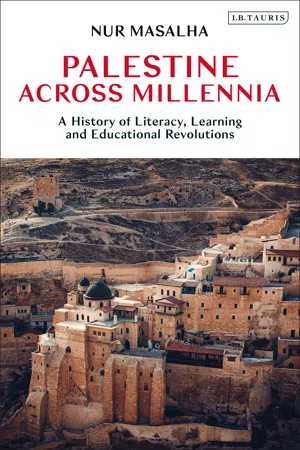
Palestine Across Millennia
A History of Literacy, Learning and Educational Revolutions
- 352 pages
- English
- ePUB (mobile friendly)
- Available on iOS & Android
eBook - ePub
About this book
Information
1 LITERACY AND FUNCTIONALITY: THE SCRIBAL SCHOOLS OF ANCIENT PALESTINE
Cuneiform Writing: Functional Literacy, Scribal Schools and Practical Skills
Early ancient pictorial writing began 5,000 years ago in the Fertile Crescent, with ancient Mesopotamia and Egypt at its centre – the region, which included Palestine, known as the ‘cradle of civilizations’, has been associated with settled farming and domesticated crops for the past 12,000 years. However, the early experiments in literacy and numeracy in combination with the first professional scribal schools emerged in the urban centres of Sumer at the beginning of the third millennium BC, with a considerable number of school textbooks dating from about 2500 BC (Kramer [1956] 1981: 3–4; Taha 2018). ‘The Sumerian school system was the direct outgrowth of the invention and development of the cuneiform system of writing’ (Goody 1993: 182). This stage of the cuneiform system of writing was characterized by ‘functional literacy’ of which most of the writing was done by professional scribes trained at professional scribal schools (Finkel and Taylor 2015: 24–32). The large urban centres and city-states of Sumer were the earliest known civilization of southern Mesopotamia, modern-day southern Iraq, and the Sumerian language remained as a sacerdotal language taught in scribal schools in Babylonia and Assyria. The Sumerian scholars were among the first mathematicians and astronomers, mapping the stars into sets of constellations, and the Sumerian scholars developed the first known codified legal and administrative systems, complete with government records. The first city-states of Sumer were roughly contemporaneous with similar city-states in what became known as Syria, Palestine and Lebanon. The Sumerian scribal school was the direct outgrowth of the invention and development of the cuneiform system of writing, Sumer’s most significant contribution to civilization (Kramer [1956] 1981: 3). The urban centres of ancient Palestine, like those of Mesopotamia and Egypt, provided some of the early sites of scribal schools and learning centres in the ancient ‘Near East’.1
While papyri collections and paper books and scroll manuscripts could easily be destroyed by fire, ancient clay tablets were baked hard, making them among the best-preserved documents from the ancient Near East. Clay tablets were ‘most commonly used in Palestine for literacy and writing purposes in the fifteenth and early fourteenth century’ BC (Albright 1942: 28). Archaeological and epigraphic evidence from Tell Balata, ancient Shikmu, near Nablus, and other important urban centres in Palestine2 (including Tell al-Hesi, Megiddo, Gezer and Jell al-Sultan/ancient Jericho, the latter being the most long-lived human settlement in the ancient Near East) dated to 1400 BC, together with Sumerian tablets from Iraq, show notes written on clay tablets – often found in royal palaces and aristocratic dwellings rather than in the dwellings of ordinary people (28) or the Palestinian peasantry – by teachers to students as well as large numbers of exercise tablets performed by pupils at early scribal schools in the country (28–31; Taha 2018).
Pre-modern royal and aristocratic families in many societies tended to educate their children at home, but the Sumerian professional scribal schools and the development of group literacy and scribal schooling in Palestine and the ancient Near East, in which education was dominated by the aristocracy, were much in evidence and widespread. Ancient youth instruction took several years and progressed from elementary to advanced levels. The Sumerian curricula concentrated on literacy and the law – copying, imitating and studying large collections of legal and literary texts and epics – and included the study of hundreds of cuneiform signs (cuneiform means simply ‘wedge-shaped’). The curricula included the memorization of literary texts and epic poems such as the Babylonian Epic of Gilgamesh, named after the king of the Sumerian city-state of Uruk. The story in this great work of literature, written in the Semitic Akkadian language during the late second millennium BC, tells of an ancient king, Gilgamesh, in search of immortality, which he fails to find. Elementary-level pupils had to learn the basic skills of preparing their pictographic clay tablets, memorize cuneiform documents and copy texts, whereas at more advanced levels the curriculum encouraged a degree of specialization: students practised copying text and literary sources and studied textbooks in arithmetic and practical skills as well as studying subjects such as law, music and dance. ‘Examinations were given in a variety of topics, calligraphy, grammar, translation, vocabulary, phonetics, epigraphy, as well as for special studies in accountancy’ (Goody 1993: 183). Just as with modern-day educational specialism, scribal schooling enabled graduate pupils/students to be employed as professional royal scribes and temple administrators or accountants as well as to take up positions in the civil-administrative, military, diplomatic service and commercial sectors (Kramer [1956] 1981: 3–5; Taha 2018).
Early archival and library collections were produced in clay-tablet form and kept at royal palaces or Houses of Tablets. Thirty libraries, or Houses of Tablets, dating to 1000 to 300 BC, have been uncovered in Mesopotamia, including fifteen libraries from the Neo-Assyrian cities of Assur, Kalhu, Dur Sarukin, Neniveh and Huzirina (Galli 2016: 111). The Library of Ashurbanipal, king of the Neo-Assyrian Empire from 668 BC to c. 627 BC, is a significant collection of over 30,000 clay-tablet cuneiform documents, which was kept at the royal palace at Nineveh, and is now held in the British Museum, London. However, later, from 800 to 300 BC, archival and library and manuscript collections in Palestine were produced on perishable writing materials such as papyrus, leather and ostraca rather than clay tablet, and only a few remains of these archives have been uncovered (111).
Cuneiform clay tablets and Sumerian literature were widely known in the ancient cultures of Palestine and Syria, and cultural borrowing and trade and diplomatic links between the three countries – Mesopotamia (and Babylonia), Syria and Palestine – were always strong. Copies of the Epic of Gilgamesh were found at Megiddo (Palestine), Emar (Ugarit, Syria) and Boghazkoy (Turkey) (Kovacs 1989: xxxiii; Mason 2003: 118; Tigay 2002: 119). At Megiddo (a powerful city-state in Palestine in the middle Bronze Age, with regional diplomatic connections), a piece of the text of Enkidu’s death, probably ‘a scribal practice tablet’ and part of classroom training from a scribal school in the city, was found (Kovacs 1989: xxxiii). The teaching of this Babylonian epic poem, written in Akkadian during the late second millennium BC (with versions found in Old Babylonian) in the scribal schools of Bronze Age Palestine, shows how the earliest surviving great works of literature (Tigay 2002: 42) were not only available in ancient Palestine but were also part of the wider shared literary cultures of the Fertile Crescent.
This shared culture and the history of literacy were advanced by scribal literacy and the knowledge of literary languages which became functionally and professionally important to international diplomacy. Knowledge of Akkadian (Sumerian) became vital when it became the language of international diplomacy of the Fertile Crescent in the fourteenth century BC. Akkadian is closely related to pre-classical old Arabic or proto-Arabic (also known as ‘Akkadian Arabic’) (Abulhab 2013: 144).
Evidence of Shared Experiences by Students and Teachers
Education and literacy are often studied normatively and institutionally, with little attention to the everyday (quotidian) and shared experiences of students and teachers. Also, most studies of education focus on socioeconomic structures, institutions and formal curricula, while the human factor and, crucially, the experiences of students, teachers and educational administrators remain hidden. However, autobiographies, memoirs and diaries often give us some insights into how classroom practices were experienced by teachers and students. The following composition of ‘day scribal school’ created by a Sumerian teacher and involving the ‘Tablet House’, written in the form of a dialogue and a diary of a pupil, gives us a glimpse into the classroom experiences. It begins with a direct question to the student:
• O son of the Tablet House, where did you go from the earliest days?
• I went to the Tablet House.
• What did you do in the Tablet House?
I recited my tablet, I ate my lunch, and then I prepare my new tablet, and set it up, write it, finished it, and in the afternoon, they assigned me housework.
I returned what I wrote.
When the Tablet House was dismissed, I returned home, entered the house, and found my father sitting there.
I told my father of my homework, then recited my tablet to him, and my father was delighted . . .
The next day I got up early, looked at my mother and said to her: Give me my lunch, my mother gave me two rolls and I went to school.
In the Tablet house, the guard said to me, Why are you late?
I felt scared, and my heart beat.
Then I appeared in front of my teacher and made a respectful curtsy.
(Kramer [1956] 1981: 10–11; Taha 2018)
The city-states of ancient Palestine were smaller than those of ancient Mesopotamia and scribal schools in Palestine, like Sumerian youth education, were relatively costly; group education was neither universal nor compulsory. Most of the students came from wealthy urban families and they were all male (Goody 1993: 183), not from families of ordinary people; the headteacher was called ‘school father’ (183) and teachers were generally paid, mostly out of tuition fees collected from the students (Kramer 1981: 5; Albright 1942: 28–31). An interesting tablet letter by a Tell Balata teacher to the prince of Shikmu in Palestine, discovered by Dutch archaeologists Ernest Sellin and Franz Bohl in 1926, dated to the late Bronze Age (c. 1400 BC), states:
From three years ago until now thou has had me paid
Is there no grain nor oil nor wine
What is my offence that thou hast not paid
The children who are with me
Continue to learn
Their father and mother
Every day alike
Am am i
[………………Interruption in the text]
Now
Whatever
At the disposal of my – unto me
And let him inform me
(quoted in Albright 1942: 28–31; Sellin 1926)
Hellenization and Syncretic Education in Late Antiquity in Palestine
From the late Bronze Age through the Iron Age (c. 1200‒600 BC) and antiquity, Palestine absorbed a range of outside influences as well as diverse cultural literary traditions, including Egyptian, Assyrian, Persian and Hellenistic; thus, schooling in urban Palestine often reflected these influences, together with evolving indigenous cultural and social influences and requirements.
The gradual linguistic Hellenization of literacy and education in Palestine did not mean that the cultures and peoples of the country changed entirely. It meant Palestine adopted and adapted aspects of Hellenization, which produced a combination of educational traditions; this phenomenon can be described as syncretic education. Syncretism was closely associated with the Hellenization of the urban elites, and cosmopolitanism started long before the conquest of Palestine by Alexander the Great in 332 BC. After Alexander’s death, Palestine came under the control of the Greek dynasties of the Ptolemys; these elites ruled from Egypt. Palestine later fell to the Seleucid kings of Asia and remained part of the Hellenized eastern Mediterranean region. With the acceleration of Hellenization, Koine Greek’s introduction into Palestine made it a dominant urban elite language that was spoken and written during the Hellenistic, Roman and Byzantine periods. Koine Greek had evolved from the spread of Greek following the conquests of Alexander the Great in the fourth century BC and had served as the lingua franca of much of the education and trade of the eastern Mediterranean region and the ancient ‘Near East’ in the course of the following centuries.
Greek and Jewish Secular Hellenistic Education: Josephus and Philo of Alexandria
There is a typical misconception that ‘secular education’ is a modern invention, while ‘religious education’ is deeply rooted in the ancient past. In fact, both religious and secular education (including the teaching of secular subjects, secular sciences and secular philosophies) are deeply rooted in ancient history and classical education. The extent of the secular Hellenization of education in Palestine’s urban centres and their urban elites, and the intellectual interaction of these urban elites with the ancient world-famous centres of learning and ‘academies’ of Athens and Alexandria in antiquity, were reflected in the life and works of Antiochus of Ascalon (130‒68/67 BC) as well as in the classical texts of elite Jewish historians and philosophers such as Josephus (AD 37–c. 100; Hebrew: Yosef ben Matityahu), born in Jerusalem to a priestly family, and Philo of Alexandria (c. 25 BC–AD c. 50; Hebrew: Yedidia HaCohen; ‘Philo Judaeus’), a Hellenistic Jewish philosopher and a contemporary of Jesus who lived in the Roman province of Egypt and became the most important representative of secular Hellenistic Judaism and the educated Hellenized Jewish elite of Roman Alexandria (Koskenniemi 2019). Philo used rational secular philosophy and philosophical allegory and symbolism – instead of literalist interpretations – to reconcile the Torah with Greek philosophy. This rational approach can also be found later in the Arabic and Islamic traditions of Aristotelian logic, philosophy (falsafa) and the works of the Arab-Jewish rational philosopher Moses Maimonides (Ibn Maimun [1138–1204]). Logos (Λόγος), a term used in classical philosophy and rhetoric, is derived from the Greek for ‘word’, ‘reason’, argument and ‘discourse’. Fluent in rational Greek philosophy rather than Aramaic or Hebrew and writing for mixed audiences (Jews and non-Jews), Philo’s rational Hellenistic learning practices and syncretic approach were important to the Christian School of Alexandria, the first Christian institution of higher learning, founded in the mid-second century AD in Alexandria, Egypt, and early Christian Hellenistic higher learning in Palestine and the development of the rational Christian doctrine of the Logos by Justin of Neapolis (Nablus) and Origen in Caesarea-Palaestina in the second and third centuries AD respectively, but Philo’s work had very little reception within Rabbinic Judaism (Hiller n.d.). But Philo was representative of the highly educated elite of the Alexandrian Jewish community and in AD 39–40 he headed the delegation of the Alexandrian Jewish community to the Roman Emperor Gaius following civil strife between the Alexandrian Jewish and Greek communities (Hiller n.d.).
While Philo’s syncretic work of blending Jewish and Platonic ideas was overall representative of the ‘Alexandrian School’ – a collective designation for the various currents of Greek literature, philosophy and sciences developed in Alexandria during the Ptolemaic and Roman period – Antiochus of Ascalon represented the rational classical Hellenistic Academy of Athens and the formal, structured Platonic New Academy. In contrast to Antiochus’ formal education, Josephus was apparently home tutored. Josephus’ classic works include The Jewish War (1981) and the Antiquities of the Jews (2004). In the latter, Josephus writes that in first-century AD Roman Palestine it was Greek historians and geographers – not the Romans – who first called the country Palestine (Josephus 2006: 19, 27; Masalha 2018: 11, 48). His works include material about individuals, groups, customs and place names in Palestine. Josephus almost never refers to Torah-authority Jewish scribes as ‘scribes’; instead he refers to them as sophists and elders. Similarly, Josephus refers to Jewish ‘sects’ (a loaded term) as philosophies or intellectual schools.
The Jewish contribution to the secular Hellenistic traditions of learning in ancient Palestine and to the multifaith, cultural heterogeneity and pluralist heritage of the ancient history of Palestine can hardly be overstated (Masalha 2018). The cultural heterogeneity of ancient Palestine, its hybrid education and its remarkable cultural and religious pluralism are evident in the privileged personal schooling of Hellenized Jewish elites in Palestine and the well-known Greek-language works of Josephus. Moreover, the general Hellenization of elite education in Palestine during the early Roman period was characterized by a great deal of cultural diversity and eclecticism as well as a combination of the local traditional education with the wider and more sophisticated secular Hellenistic Jewish education. In her study Jewish Literacy in Roman Palestine (2001), Catherine Hezser explores Jewish education and schools, Jewish religious interest in writing and books, the availability and costs of writing materials, the existence of archives and libraries, and the question of multilingualism. Hezser also argues that Jewish literacy in Palestine was around 3 per cent, largely located in urban centres, with writing being used almost exclusively by the social, economic, political and religious elites, and was influenced by Greek education and Greco-Roman writings. Born in Jerusalem in AD 37 and educated in his native city, Josephus was a Jewish priest of royal descent and Pharisaic (sect) persuasion. After the defeat of the anti-Roman Jewish revolt of AD 66–73, he became a Roman citizen and spent the second half of his life in Rome, where, still a Jew, he devoted himself largely to writing historical works on...
Table of contents
- Cover
- Halftitle Page
- Title Page
- Contents
- Acknowledgements
- Introduction
- 1 Literacy and Functionality: The Scribal Schools of Ancient Palestine
- 2 Cities of Learning: The Intellectual Revolutions of Byzantine Palestine (Third to Early Seventh Century)
- 3 Greek and Syriac into Arabic and the Palestinian Translation Movement under Islam: Monasteries of Learning, Mar Saba and Arabic Belles-Lettres (Eighth–Eleventh Century)
- 4 Latin Learning and the Crusader Kingdoms of Palestine: The Library of Nazareth
- 5 The Golden Age of the Islamic Law Colleges of Jerusalem: The Palestinian Madrasas under the Ayyubids and Mamluks (1187–1517)
- 6 Legal Pluralism and the Social World of Palestine in the Seventeenth Century: The Azhar College of Cairo and Palestinian Muslim Scholars
- 7 The ‘Azhar’ of Palestine: The Ahmadiyya Seminary of Acre (1782–1948)
- 8 Modernity, the Printing Press and Mass Literacy: The Educational Revolution of Late Ottoman Palestine and the Mandatory Period (1860s–1948)
- 9 Humanism and Arab Nahda Education: Khalil Sakakini and Reforming Palestinian Education
- 10 Learning from Below: The Kuttab Schools in Palestine (Muslim, Jewish and Christian)
- 11 Between Professionalism and Cultural Nationalism: Palestinian Education in Mandatory Palestine (1918–1948)
- Epilogue: The Libraries, Archival Collections and Sharia Courts’ Records of Modern Palestine
- Notes
- Bibliography
- Index
- Imprint
Trusted by 375,005 students
Access to over 1.5 million titles for a fair monthly price.
Study more efficiently using our study tools.
Frequently asked questions
Yes, you can cancel anytime from the Subscription tab in your account settings on the Perlego website. Your subscription will stay active until the end of your current billing period. Learn how to cancel your subscription
No, books cannot be downloaded as external files, such as PDFs, for use outside of Perlego. However, you can download books within the Perlego app for offline reading on mobile or tablet. Learn how to download books offline
Perlego offers two plans: Essential and Complete
- Essential is ideal for learners and professionals who enjoy exploring a wide range of subjects. Access the Essential Library with 800,000+ trusted titles and best-sellers across business, personal growth, and the humanities. Includes unlimited reading time and Standard Read Aloud voice.
- Complete: Perfect for advanced learners and researchers needing full, unrestricted access. Unlock 1.5M+ books across hundreds of subjects, including academic and specialized titles. The Complete Plan also includes advanced features like Premium Read Aloud and Research Assistant.
We are an online textbook subscription service, where you can get access to an entire online library for less than the price of a single book per month. With over 1.5 million books across 990+ topics, we’ve got you covered! Learn about our mission
Look out for the read-aloud symbol on your next book to see if you can listen to it. The read-aloud tool reads text aloud for you, highlighting the text as it is being read. You can pause it, speed it up and slow it down. Learn more about Read Aloud
Yes! You can use the Perlego app on both iOS and Android devices to read anytime, anywhere — even offline. Perfect for commutes or when you’re on the go.
Please note we cannot support devices running on iOS 13 and Android 7 or earlier. Learn more about using the app
Please note we cannot support devices running on iOS 13 and Android 7 or earlier. Learn more about using the app
Yes, you can access Palestine Across Millennia by Nur Masalha in PDF and/or ePUB format, as well as other popular books in History & Middle Eastern History. We have over 1.5 million books available in our catalogue for you to explore.