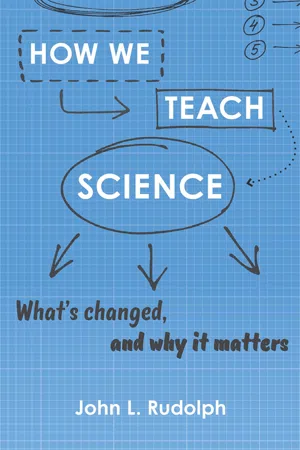
A former Wisconsin high school science teacher makes the case that how and why we teach science matters, especially now that its legitimacy is under attack.
Why teach science? The answer to that question will determine how it is taught. Yet despite the enduring belief in this country that science should be taught, there has been no enduring consensus about how or why.
This is especially true when it comes to teaching scientific process. Nearly all of the basic knowledge we have about the world is rock solid. The science we teach in high schools in particular—laws of motion, the structure of the atom, cell division, DNA replication, the universal speed limit of light—is accepted as the way nature works. Everyone also agrees that students and the public more generally should understand the methods used to gain this knowledge. But what exactly is the scientific method?
Ever since the late 1800s, scientists and science educators have grappled with that question. Through the years, they've advanced an assortment of strategies, ranging from "the laboratory method" to the "five-step method" to "science as inquiry" to no method at all. How We Teach Science reveals that each strategy was influenced by the intellectual, cultural, and political circumstances of the time. In some eras, learning about experimentation and scientific inquiry was seen to contribute to an individual's intellectual and moral improvement, while in others it was viewed as a way to minimize public interference in institutional science.
John Rudolph shows that how we think about and teach science will either sustain or thwart future innovation, and ultimately determine how science is perceived and received by the public.
- 321 pages
- English
- PDF
- Available on iOS & Android
eBook - PDF
About this book
Information
Topic
EducationSubtopic
History of EducationTable of contents
- Cover
- Title Page
- Copyright
- Dedication
- Contents
- Introduction
- 1. From Textbook to Laboratory
- 2. The Laboratory in Practice
- 3. Student Interest and the New Movement
- 4. The Scientific Method
- 5. Problems and Projects
- 6. The War on Method
- 7. Origins of Inquiry
- 8. Scientists in the Classroom
- 9. Project 2061 and the Nature of Science
- 10. Science in the Standards Era
- Conclusion
- Notes
- Acknowledgments
- Index
Trusted by 375,005 students
Access to over 1.5 million titles for a fair monthly price.
Study more efficiently using our study tools.
Frequently asked questions
Yes, you can cancel anytime from the Subscription tab in your account settings on the Perlego website. Your subscription will stay active until the end of your current billing period. Learn how to cancel your subscription
No, books cannot be downloaded as external files, such as PDFs, for use outside of Perlego. However, you can download books within the Perlego app for offline reading on mobile or tablet. Learn how to download books offline
Perlego offers two plans: Essential and Complete
- Essential is ideal for learners and professionals who enjoy exploring a wide range of subjects. Access the Essential Library with 800,000+ trusted titles and best-sellers across business, personal growth, and the humanities. Includes unlimited reading time and Standard Read Aloud voice.
- Complete: Perfect for advanced learners and researchers needing full, unrestricted access. Unlock 1.5M+ books across hundreds of subjects, including academic and specialized titles. The Complete Plan also includes advanced features like Premium Read Aloud and Research Assistant.
We are an online textbook subscription service, where you can get access to an entire online library for less than the price of a single book per month. With over 1.5 million books across 990+ topics, we’ve got you covered! Learn about our mission
Look out for the read-aloud symbol on your next book to see if you can listen to it. The read-aloud tool reads text aloud for you, highlighting the text as it is being read. You can pause it, speed it up and slow it down. Learn more about Read Aloud
Yes! You can use the Perlego app on both iOS and Android devices to read anytime, anywhere — even offline. Perfect for commutes or when you’re on the go.
Please note we cannot support devices running on iOS 13 and Android 7 or earlier. Learn more about using the app
Please note we cannot support devices running on iOS 13 and Android 7 or earlier. Learn more about using the app
Yes, you can access How We Teach Science by John L. Rudolph in PDF and/or ePUB format, as well as other popular books in Education & History of Education. We have over 1.5 million books available in our catalogue for you to explore.