In the early decades of the twentieth century, business leaders condemned civil liberties as masks for subversive activity, while labor sympathizers denounced the courts as shills for industrial interests. But by the Second World War, prominent figures in both camps celebrated the judiciary for protecting freedom of speech. In this strikingly original history, Laura Weinrib illustrates how a surprising coalition of lawyers and activists made judicial enforcement of the Bill of Rights a defining feature of American democracy.
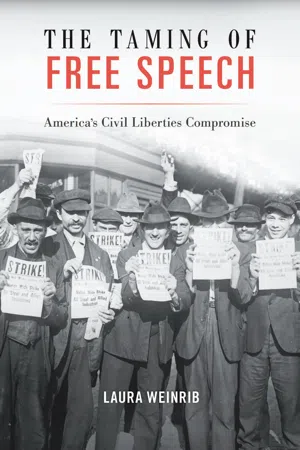
The Taming of Free Speech traces our understanding of civil liberties to conflict between 1910 and 1940 over workers' right to strike. As self-proclaimed partisans in the class war, the founders of the American Civil Liberties Union promoted a bold vision of free speech that encompassed unrestricted picketing and boycotts. Over time, however, they subdued their rhetoric to attract adherents and prevail in court. At the height of the New Deal, many liberals opposed the ACLU's litigation strategy, fearing it would legitimize a judiciary they deemed too friendly to corporations and too hostile to the administrative state. Conversely, conservatives eager to insulate industry from government regulation pivoted to embrace civil liberties, despite their radical roots. The resulting transformation in constitutional jurisprudence—often understood as a triumph for the Left—was in fact a calculated bargain.
America's civil liberties compromise saved the courts from New Deal attack and secured free speech for labor radicals and businesses alike. Ever since, competing groups have clashed in the arena of ideas, shielded by the First Amendment.
- 472 pages
- English
- PDF
- Available on iOS & Android
eBook - PDF
About this book
Information
Topic
DirittoSubtopic
Storia nordamericanaTable of contents
- Cover
- Title
- Copyright
- Dedication
- Contents
- Introduction
- Chapter 1. Freedom of Speech in Class War Time
- Chapter 2. The Citadel of Civil Liberty
- Chapter 3. The Right of Agitation
- Chapter 4. Dissent
- Chapter 5. The New Battleground
- Chapter 6. Old Left, New Rights
- Chapter 7. The Civil Liberties Consensus
- Chapter 8. Free Speech or Fair Labor
- Epilogue
- Abbreviations
- Notes
- Acknowledgments
- Index
Trusted by 375,005 students
Access to over 1.5 million titles for a fair monthly price.
Study more efficiently using our study tools.
Frequently asked questions
Yes, you can cancel anytime from the Subscription tab in your account settings on the Perlego website. Your subscription will stay active until the end of your current billing period. Learn how to cancel your subscription
No, books cannot be downloaded as external files, such as PDFs, for use outside of Perlego. However, you can download books within the Perlego app for offline reading on mobile or tablet. Learn how to download books offline
Perlego offers two plans: Essential and Complete
- Essential is ideal for learners and professionals who enjoy exploring a wide range of subjects. Access the Essential Library with 800,000+ trusted titles and best-sellers across business, personal growth, and the humanities. Includes unlimited reading time and Standard Read Aloud voice.
- Complete: Perfect for advanced learners and researchers needing full, unrestricted access. Unlock 1.5M+ books across hundreds of subjects, including academic and specialized titles. The Complete Plan also includes advanced features like Premium Read Aloud and Research Assistant.
We are an online textbook subscription service, where you can get access to an entire online library for less than the price of a single book per month. With over 1.5 million books across 990+ topics, we’ve got you covered! Learn about our mission
Look out for the read-aloud symbol on your next book to see if you can listen to it. The read-aloud tool reads text aloud for you, highlighting the text as it is being read. You can pause it, speed it up and slow it down. Learn more about Read Aloud
Yes! You can use the Perlego app on both iOS and Android devices to read anytime, anywhere — even offline. Perfect for commutes or when you’re on the go.
Please note we cannot support devices running on iOS 13 and Android 7 or earlier. Learn more about using the app
Please note we cannot support devices running on iOS 13 and Android 7 or earlier. Learn more about using the app
Yes, you can access The Taming of Free Speech by Laura Weinrib in PDF and/or ePUB format, as well as other popular books in Diritto & Storia nordamericana. We have over 1.5 million books available in our catalogue for you to explore.