Winner of the Helen and Howard Marraro Prize
A Times Literary Supplement Book of the Year
"Perhaps the greatest study ever written of Renaissance political thought."
—Jeffrey Collins, Times Literary Supplement
"Magisterial…Hankins shows that the humanists' obsession with character explains their surprising indifference to particular forms of government. If rulers lacked authentic virtue, they believed, it did not matter what institutions framed their power."
—Wall Street Journal
"Puts the politics back into humanism in an extraordinarily deep and far-reaching way…For generations to come, all who write about the political thought of Italian humanism will have to refer to it; its influence will be…nothing less than transformative."
—Noel Malcolm, American Affairs
"[A] masterpiece…It is only Hankins's tireless exploration of forgotten documents…and extraordinary endeavors of editing, translation, and exposition that allow us to reconstruct—almost for the first time in 550 years—[the humanists'] three compelling arguments for why a strong moral character and habits of truth are vital for governing well. Yet they are as relevant to contemporary democracy in Britain, and in the United States, as to Machiavelli."
—Rory Stewart, Times Literary Supplement
"The lessons for today are clear and profound."
—Robert D. Kaplan
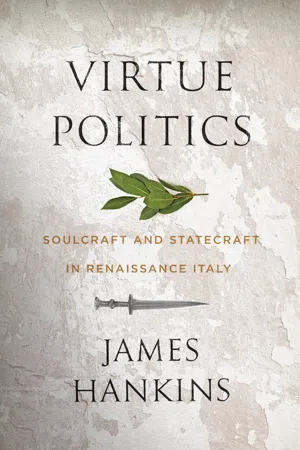
Convulsed by a civilizational crisis, the great thinkers of the Renaissance set out to reconceive the nature of society. Everywhere they saw problems. Corrupt and reckless tyrants sowing discord and ruling through fear; elites who prized wealth and status over the common good; religious leaders preoccupied with self-advancement while feuding armies waged endless wars. Their solution was at once simple and radical. "Men, not walls, make a city," as Thucydides so memorably said. They would rebuild the fabric of society by transforming the moral character of its citizens. Soulcraft, they believed, was a precondition of successful statecraft.
A landmark reappraisal of Renaissance political thought, Virtue Politics challenges the traditional narrative that looks to the Renaissance as the seedbed of modern republicanism and sees Machiavelli as its exemplary thinker. James Hankins reveals that what most concerned the humanists was not reforming institutions so much as shaping citizens. If character mattered more than laws, it would have to be nurtured through a new program of education they called the studia humanitatis: the precursor to our embattled humanities.
- 769 pages
- English
- PDF
- Available on iOS & Android
eBook - PDF
About this book
Information
Table of contents
- Cover
- Title Page
- Copyright
- Dedication
- Contents
- Preface
- 1. A Civilization in Crisis
- 2. Virtue Politics
- 3. What Was a Republic in the Renaissance?
- 4. Taming the Tyrant
- 5. The Triumph of Virtue: Petrarch’s Political Thought
- 6. Should a Good Man Participate in a Corrupt Government? Petrarch on the Solitary Life
- 7. Boccaccio on the Perils of Wealth and Status
- 8. Leonardo Bruni and the Virtuous Hegemon
- 9. War and Military Service in the Virtuous Republic
- 10. A Mirror for Statesmen: Leonardo Bruni’s History of the Florentine People
- 11. Biondo Flavio: What Made the Romans Great
- 12. Cyriac of Ancona on Democracy and Empire
- 13. Leon Battista Alberti on Corrupt Princes and Virtuous Oligarchs
- 14. George of Trebizond on Cosmopolitanism and Liberty
- 15. Francesco Filelfo and the Spartan Republic
- 16. Greek Constitutional Theory in the Quattrocento
- 17. Francesco Patrizi and Humanist Absolutism
- 18. Machiavelli: Reviving the Military Republic
- 19. Machiavelli: From Virtue to Virtù
- 20. Two Cures for Hyperpartisanship: Bruni versus Machiavelli
- 21. Conclusion: Ex Oriente Lux
- Appendixes
- Notes
- Bibliography
- Acknowledgments
- Index of Manuscripts and Archival Documents
- General Index
Trusted by 375,005 students
Access to over 1.5 million titles for a fair monthly price.
Study more efficiently using our study tools.
Frequently asked questions
Yes, you can cancel anytime from the Subscription tab in your account settings on the Perlego website. Your subscription will stay active until the end of your current billing period. Learn how to cancel your subscription
No, books cannot be downloaded as external files, such as PDFs, for use outside of Perlego. However, you can download books within the Perlego app for offline reading on mobile or tablet. Learn how to download books offline
Perlego offers two plans: Essential and Complete
- Essential is ideal for learners and professionals who enjoy exploring a wide range of subjects. Access the Essential Library with 800,000+ trusted titles and best-sellers across business, personal growth, and the humanities. Includes unlimited reading time and Standard Read Aloud voice.
- Complete: Perfect for advanced learners and researchers needing full, unrestricted access. Unlock 1.5M+ books across hundreds of subjects, including academic and specialized titles. The Complete Plan also includes advanced features like Premium Read Aloud and Research Assistant.
We are an online textbook subscription service, where you can get access to an entire online library for less than the price of a single book per month. With over 1.5 million books across 990+ topics, we’ve got you covered! Learn about our mission
Look out for the read-aloud symbol on your next book to see if you can listen to it. The read-aloud tool reads text aloud for you, highlighting the text as it is being read. You can pause it, speed it up and slow it down. Learn more about Read Aloud
Yes! You can use the Perlego app on both iOS and Android devices to read anytime, anywhere — even offline. Perfect for commutes or when you’re on the go.
Please note we cannot support devices running on iOS 13 and Android 7 or earlier. Learn more about using the app
Please note we cannot support devices running on iOS 13 and Android 7 or earlier. Learn more about using the app
Yes, you can access Virtue Politics by James Hankins in PDF and/or ePUB format, as well as other popular books in Politics & International Relations & European Renaissance History. We have over 1.5 million books available in our catalogue for you to explore.