Newgrange in Ireland is a world famous monument not only because of its vast scale and elaborate megalithic art, but also because of its renowned alignment to the sun on the winter solstice. Yet the origins of Newgrange remain somewhat mysterious. Across Ireland over two hundred similar passage tombs are found, some of which are considerably older than Newgrange. These less investigated monuments reveal that the origins of Newgrange may be hidden in plain sight. A progression in the scale and sophistication of construction of these passage tombs, developments in the styles of megalithic art, and an increase in the scale and craftsmanship of associated artefacts may be observed, which taken together indicate a lengthy process of development. In short, Robert Hensey uncovers an untold history at Newgrange; an island-wide story of incremental changes over hundreds of years, of a society in evolution, perhaps in extremis, who left behind such a rich, enigmatic and patterned legacy.
This book not only charts the earlier history of Newgrange, but addresses why it was constructed, what was its purpose. In the Boyne Valley, through Newgrange and related sites at Brúna Bóinne, we have evidence not only of extraordinary physical accomplishments, but of tremendous acts of imagination; a testament to rich and developed inner worlds. In this book, it is proposed that the concept of an otherworld which could be embodied by and accessed through passage tombs was a central motivator in passage tomb construction from its earliest beginnings. Newgrange is at the end of a long tradition of monuments dedicated to the religious needs of Neolithic communities, from small-scale monuments built by early farming groups; to potent otherworld centres of ritual training at the edge of society; eventually to temple-like monuments standing at the very heart of the religious and political sphere in Neolithic Ireland.
Challenging both orthodox archaeological opinions and popular conjecture, this will be an important book for anyone interested in Neolithic archaeology.
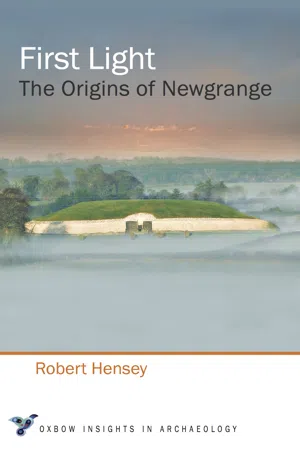
- 210 pages
- English
- ePUB (mobile friendly)
- Available on iOS & Android
eBook - ePub
About this book
Information
Subtopic
British HistoryIndex
HistoryCHAPTER ONE
The Earliest Irish Passage Tombs
Others made shore in different lands, seeds scattered on the winds. A small group rests beside the gathered boulders – before the stone raising. The lineage of the journey takers would be remembered, their spirits return over the sea.
Irish passage tombs, as noted already, display many differences to their continental counterparts. One of their most unusual features is that they tend to occur in groups. In the past, these were referred to as cemeteries; today usually as complexes. The best known are the Brú na Bóinne complex, where Newgrange is located and the Loughcrew complex in the east of Ireland. In the west, though somewhat less well known, are the Carrowmore and Carrowkeel complexes.
Brú na Bóinne is the setting for the enormous sites Newgrange, Knowth and Dowth, but also for a host of smaller passage tombs (Fig 1.1; Plate 1). The majority of monuments are situated on an islandlike area of land measuring approximately five square kilometres. A minimum number of thirty-seven passage tombs are extant, but it is likely the original number was once greater. Several unopened earthen mounds are likely passage tombs, and geophysical survey and other research suggests that remnants of up to forty-five passage tombs could be present.1 The scale and sophistication of the monuments at Brú na Bóinne and the enormous concentration of megalithic art are among the reasons the area was recognised as one of the most important prehistoric locations in Europe and in 1993 assigned UNESCO World Heritage Site status.
The passage tomb complex at Loughcrew is located approximately 40 km west of Newgrange. The complex contains fifteen definite passage tombs, but as many cairns are unopened the true total may be closer to thirty.2 The majority of the monuments are focused around three main hills. Though not possessing passage tombs of an equivalent scale to the largest examples in the Boyne complex, the complex contains many stunning sites. Cairn T, the focal monument on Carnbane East, is 35 m in diameter and set in a spectacular location, at the highest point in County Meath. It is known for its probable equinoctal solar orientation. One of the more notable features of Loughcrew is the quantities of megalithic art found there.

Figure 1.1. Brú na Bóinne passage tombs and related monuments (after Cooney 2000, fig. 2.3).
Carrowkeel is a dramatically situated megalithic complex, primarily in uplands. If unopened cairns and probable passage tombs are included in the total, up to twenty-five passage tomb tradition monuments may be located there.3 As at Brú na Bóinne, the majority of cairns would fit into an area of roughly five square kilometres. Carrowkeel townland and Keashcorran Mountain are the two main foci. There are also several associated sites on the lower ground however, including the stupendous Heapstown Cairn, one of the largest cairns in the country outside of Brú na Bóinne. The complex is sometimes referred to as ‘Carrowkeel-Keashcorran’ to highlight the two areas where the most monuments are grouped. In general, the monuments appear less accomplished than those at Loughcrew and Brú na Bóinne, in their current condition at least, and megalithic art is for the most part absent. Yet in terms of its landscape setting Carrowkeel is arguably the most dramatic of the four major complexes.
Carrowmore is of different character than the other three complexes. The passage tombs there are often referred to as dolmens because they are simpler in design and without surrounding cairns. They are usually accounted for by five or six stones, which form a small pear-shaped chamber covered by an unworked glacial erratic. The chambers are further defined through situation on a small artificial platform of soil and stone and a surrounding boulder circle. Most monuments do not have the large covering mounds which are a standard feature at Carrowkeel, Loughcrew and Brú na Bóinne. There are approximately thirty passage tombs at Carrowmore today, though the number may once have been as high as forty five. Older (inflated) estimates of a hundred tombs or more still persist even though there is no substantive evidence to support those claims.4 In the centre of the complex is a large focal monument with a cairn over 30 m in diameter, Listoghil (Carrowmore 51). The cairn contains a chamber of different appearance than the surrounding satellite sites. The capstone of this atypical passage tomb is decorated with the only examples of passage tomb art in the complex.5
Besides these four largest clusters, several other significant groupings are known. Twelve passage tombs are situated at Kilmonaster, Co. Donegal.6 A significant complex is found along the east coast at Bremore/Gormanstown in north Co. Dublin.7 Many smaller groupings, sometimes of just three of four monuments are known, for example, at Finner, Co. Donegal or Sheemore, Co. Leitrim. Other notable passage tombs areas include north-east Antrim and the Wicklow Mountains, though the monuments there tend to be dispersed rather than grouped as at the major complexes.
Passage tomb distribution reflects a preference for the northern half of the island, the majority of monuments located along a band extending from the Boyne River to Sligo Bay (see Fig. 1.2). However, examples have been identified as far south as Co. Cork. The number of existing monuments is not definitive. It can be difficult to be sure about a site’s classification if it is badly ruined. Moreover, many stone and earthen tumuli around the country are unexcavated and some probably contain passages tombs. Queen Maeve’s tomb and Heapstown, Co. Sligo, for instance, are technically categorised as cairns, even though it is almost certain they are passage tombs. If probable passage tombs are included in the total, then a realistic (and still conservative) number is approximately 260 monuments island-wide.8
Though passage tombs exist in various states of repair or disrepair, they display several fundamental design elements which allow us to categorise them, including a megalithic chamber, passage, and almost always a surrounding kerb or boulder circle. Often, the chamber is covered by a cairn and, less frequently, has a corbelled roof, as at Newgrange. Several sites possess passage tomb art, similar to that from Brú na Bóinne. It is these few features, together with the artefacts from within their chambers, which identify them as passage tombs. Yet, several monuments only had some of these architectural features – even when newly constructed – and some can look startlingly different from each other.
The arrow of time
When comparing sites within the passage tomb tradition it is perhaps the sheer variability in dimensions and effort of construction that is most arresting. Newgrange, for instance, is reputedly composed of 200,000 tonnes of material and is 85 m at its widest point. By contrast, Carrowmore 3 is only 13 m in diameter and has a chamber and circle composed of just thirty-four stones, many of which are small enough to be lifted by a single individual. As Irish passage tombs can vary so much in their scale and morphology, over time, scholars believed that a process of evolution or devolution in monument construction occurred, and that careful analysis would reveal that sequence of development.

Figure 1.2. Schematic map of main passage tomb locations in Ireland (map by Dag Hammar after Eogan 1986, fig. 41).
Yet, until the nineteenth century, the monuments in the east and west had not been considered connected. One of the first people to make the association was Eugene Conwell, a retired schools inspector, who recognised links between the passage tombs he had investigated at Loughcrew and those at Brú na Bóinne. Not only did he correctly conclude that these two complexes were part of the same tradition, he further proposed that they were part of a chain of monuments extending westwards: “I have little doubt that the cairns on the Loughcrew Hills are but a portion of a chain of such remains, terminated on the east by the great mounds of Knowth, New Grange, and Dowth; and that a fuller and more careful examination of the country will prove that chain to have extended westward to the Atlantic”, thus implying the inclusion of Carrowmore and Carrowkeel.9
Various surveys and maps of Carrowmore also played a significant role in bringing this most westerly cluster of passage tombs into focus, followed in 1887 by excavations at twenty-two monuments by Col. William Wood-Martin.10 The artefacts he found removed any doubt that the monuments were a near relation of those in the Loughcrew and Brú na Bóinne complexes. His discoveries consolidated the idea that Irish passage tombs are found from coast to coast. Then, in 1911, R. A. S. Macalister further filled-in the picture by carrying out excavations at the Carrowkeel passage tomb complex 22 km to the south of Carrowmore.11 This work revealed that the chambered cairns there were also of the same tradition as Newgrange. The discovery meant that similar quantities of passage tombs existed in the west of Ireland (Carrowmore and Carrowkeel) and the east (Loughcrew and Brú na Bóinne).
But the question of which came first, the developed monuments in the east, like Newgrange, or the more rudimentary examples in the west, still remained unanswered. Had there been a gradual evolution from west to east? Or were the sophisticated construction techniques from the east poorly replicated by less ambitious or less resourced groups in the west? Wood-Martin was one of the first to weigh in on the subject, confidently proposing that the large monuments in the Brú na Bóinne complex had developed from the simpler sites: “Between the lowly cists, composed of four or more flags and a covering stone, and the gigantic tumuli of Newgrange and Dowth, there is seemingly a great difference; but that these latter are but developments from the former; through such connecting links as varieties of cromleac-like monuments afford, there can be but little question”.12
Wood-Martin’s simple-to-complex sequential model was soon to be decisively overturned, however. A powerful new explanatory mechanism in archaeology, the cultural historical perspective which developed in the first half of the twentieth century, seemed a perfect tool to explain the sequence of passage tomb construction in Ireland. The large sophisticated tombs at Brú na Bóinne were evidence of the landing point of colonists whose culture and building traditions then moved westwards through a process of diffusion. Smaller passage tombs of less complex design, such as at Carrowmore, were thought to be late in the developmental sequence. As they were geographically removed from the centre of innovation, they were necessarily less sophisticated, and their construction techniques poorer.13 This also explained why the monuments lacked artwork. The difficulty with this model, however, was that there were so few radiocarbon dates from passage tombs outside of Brú na Bóinne that the east-west diffusion model was purely theoretical.
Cultural historical thinking was soon to receive a fatal blow, however. As radiocarbon dating became more common in the 1960s and 70s, cultural historical models began to collapse; indeed, in some instances the new dates supported a reversed chronological sequence. It appeared invasion and diffusion were not the only way change could happen in a society. In some cases, the appearance of new artefacts, burial traditions, or monuments could be the result of a process of internal evolution, a society passing through various stages from mobile hunter-gatherer groups to segmentary society to chiefdom. Alternatively, an indigenous group could, of their own volition, adopt an idea such as megalith building from elsewhere, thus opening up the possibility of independent centres of innovation.14 In Ireland, this new archaeology gained support through a pivotal series of excavations at the Carrowmore passage tombs. Work began there in 1977, just two years after the excavation and reconstruction at Newgrange was completed by Professor M. J. O’Kelly (1962–75). The Carrowmore excavations proved crucial not only to models of the chronology and sequence of Irish passage tomb construction but, as we will see, to understanding of the history of Newgrange.
Carrowmore re-visited
The excavations led by Göran Burenhult at the Carrowmore passage tombs from 1977–1982 and 1994–1998 had the stated aim of clarifying the construction, use, and date of the most westerly passage tomb complex in Ireland.15 Shortly into the first excavation campaign, several of the excavated charcoal samples returned surprisingly early dates. Some were so early that they led the excavation director to conclude the monuments’ construction must have taken place before the arrival of farming to Ireland.16 Was Carrowmore an independent centre of invention, perhaps the work of ‘complex’ hunter-gat...
Table of contents
- Cover
- Title Page
- Copyright
- Contents
- Preface
- Acknowledgements
- List of Illustrations
- Introduction
- Chapter 1: The Earliest Irish Passage Tombs
- Chapter 2: Constructing New Realities
- Chapter 3: Into the Earth
- Chapter 4: Waiting for the Sun
- Chapter 5: Where the River Meets the Sea
- Chapter 6: Going Public
- Chapter 7: A Secret History
- Chapter 8: Journey to Newgrange
- Colors Plates
- Conclusion: An Archaeology of the Otherworld
- Notes
- References
Trusted by 375,005 students
Access to over 1.5 million titles for a fair monthly price.
Study more efficiently using our study tools.
Frequently asked questions
Yes, you can cancel anytime from the Subscription tab in your account settings on the Perlego website. Your subscription will stay active until the end of your current billing period. Learn how to cancel your subscription
No, books cannot be downloaded as external files, such as PDFs, for use outside of Perlego. However, you can download books within the Perlego app for offline reading on mobile or tablet. Learn how to download books offline
Perlego offers two plans: Essential and Complete
- Essential is ideal for learners and professionals who enjoy exploring a wide range of subjects. Access the Essential Library with 800,000+ trusted titles and best-sellers across business, personal growth, and the humanities. Includes unlimited reading time and Standard Read Aloud voice.
- Complete: Perfect for advanced learners and researchers needing full, unrestricted access. Unlock 1.5M+ books across hundreds of subjects, including academic and specialized titles. The Complete Plan also includes advanced features like Premium Read Aloud and Research Assistant.
We are an online textbook subscription service, where you can get access to an entire online library for less than the price of a single book per month. With over 1.5 million books across 990+ topics, we’ve got you covered! Learn about our mission
Look out for the read-aloud symbol on your next book to see if you can listen to it. The read-aloud tool reads text aloud for you, highlighting the text as it is being read. You can pause it, speed it up and slow it down. Learn more about Read Aloud
Yes! You can use the Perlego app on both iOS and Android devices to read anytime, anywhere — even offline. Perfect for commutes or when you’re on the go.
Please note we cannot support devices running on iOS 13 and Android 7 or earlier. Learn more about using the app
Please note we cannot support devices running on iOS 13 and Android 7 or earlier. Learn more about using the app
Yes, you can access First Light by Robert Hensey in PDF and/or ePUB format, as well as other popular books in History & British History. We have over 1.5 million books available in our catalogue for you to explore.