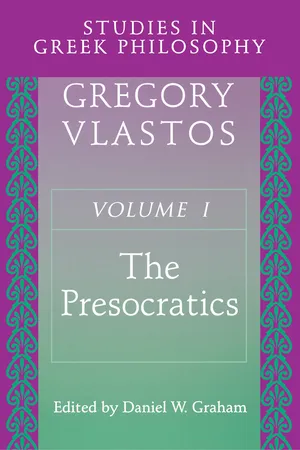
Gregory Vlastos (1907-1991) was one of the twentieth century's most influential scholars of ancient philosophy. Over a span of more than fifty years, he published essays and book reviews that established his place as a leading authority on early Greek philosophy. The two volumes that comprise Studies in Greek Philosophy include nearly forty contributions by this acknowledged master of the philosophical essay. Many of these pieces are now considered to be classics in the field. Perhaps more than any other modern scholar, Gregory Vlastos was responsible for raising standards of research, analysis, and exposition in classical philosophy to new levels of excellence. His essays have served as paradigms of scholarship for several generations. Available for the first time in a comprehensive collection, these contributions reveal the author's ability to combine the skills of a philosopher, philologist, and historian of ideas in addressing some of the most difficult problems of ancient philosophy. Volume I collects Vlastos's essays on Presocratic philosophy. Wide-ranging concept studies link Greek science, religion, and politics with philosophy. Individual studies illuminate the thought of major philosophers such as Heraclitus, Parmenides, Anaxagoras, and Democritus. A magisterial series of studies on Zeno of Elea reveals the author's power in source criticism and logical analysis. Volume II contains essays on the thought of Socrates, Plato, and later thinkers and essays dealing with ethical, social, and political issues as well as metaphysics, science, and the foundations of mathematics.
- 424 pages
- English
- ePUB (mobile friendly)
- Available on iOS & Android
eBook - ePub
About this book
Information
Publisher
Princeton University PressYear
2022Print ISBN
9780691019376
9780691033105
eBook ISBN
9780691241883
Topic
PhilosophySubtopic
Ancient & Classical PhilosophyPART ONE
CONCEPT STUDIES
1
THEOLOGY AND PHILOSOPHY IN EARLY GREEK THOUGHT
I
WHEN ONE reads the Presocratics with open mind and sensitive ear, one cannot help being struck by the religious note in much of what they say. Few words occur more frequently in their fragments than the term god.1 The style itself in certain contexts is charged with religious associations; the rhythm and sentence structure of certain utterances is unmistakably hymnodic.2 In Parmenides and Empedocles the whole doctrine of Being and Nature is put forth as a religious revelation. The major themes of all the physiologoi—the creation of the world, the necessity of its order, the origin of life, the nature of the soul, and even such things as the causes of winds, rain, lightning and thunder, rivers, meteorites, eclipses, earthquakes, plagues—were matters of vivid religious import to their contemporaries. Lightning, thunder, a storm, an earthquake were “signs from Zeus” (diosemiai) that could stop a meeting of the Law Courts or of the Assembly;3 religious feeling for an eclipse could overrule military intelligence to cause the greatest disaster ever suffered by Athenian arms.4 The philosophers who took the “natural” view of these things could not be indifferent to the religious bearing of their conclusions. To think of them [97] as mere naturalists, bracketing off their speculations from religious belief and feeling, would be to take a very anachronistic view of their thought.
Now it is just this view that was upheld quite belligerently by Burnet,5 whose Early Greek Philosophy has gone through four editions since its first publication in 1892 to become the most influential guide to the study of the origins of Greek thought in the English-speaking world. Burnet explained away the term god in the pre-Socratics as a “non-religious use of the word” (p. 14); and though perhaps he never thought through the meaning of this remarkable expression, the general point of his contention is clear enough. Like many a god and goddess in Hesiod, he argued, the “gods” of the philosophers are not “objects of worship” but “mere personifications” of natural phenomena. Now it is true that the physiologoi maintained in all their thinking a singular independence from the public cult. If this were all that Burnet had in mind, his contention would be not only true but, as I shall argue shortly, absolutely fundamental to the proper understanding of their religious ideas. But Burnet went far beyond this when he claimed that they themselves attached no religious import to those ideas which they proclaimed in open or tacit defiance of the prevailing faith. It is true, of course, that their primary object is to understand nature, not to reform religion. When they discuss religious concepts, they are generally content to leave religious practices alone. But even this statement has important exceptions, and though one of them fits Burnet’s thesis, the rest go dead against it.
In Empedocles it is the mystic, not the physiologos, who is exercised about the cult. His heart-wringing appeals for a religion undefiled by animal sacrifices and the eating of beans are inspired by the Orphic piety of his Purifications which admits of no rational connection with the scientific temper and doctrine of his work On Nature.6 But in Xenophanes we find something quite different. When he calls nature “God,”7 he is asserting no “mere” personification, but a doctrine which has urgent religious relevance, since it prompts him to attack the traditional beliefs as both irrational and irreverent.8 It is impious, he says in effect, to speak about the gods [98] as Homer and Hesiod do, implying that his doctrine sets general standards for pious utterance. Heraclitus goes much further when he blasts away not only at what people say about the gods, but at what they do in their most sacred rites.9 Such modes of worship offend not only his reason but his religious sense; they are not only “madness” (B5, B16) but sacrilegious madness, “unholy mysteries” (B14). There is a strong implication here that there can and ought to be a different form of worship which would qualify as “holy”; and this is confirmed by a passage in Iamblichus: “I distinguish two kinds of sacrifice: first, those of the completely purified, such as would happen rarely with a single individual, as Heraclitus says, or with a handful of men; secondly, the material. . . .”10 We need not take this as a willful preference for solitary worship. It is more likely an expression of Heraclitus’s despair of the capacity of the “many” to understand what he was talking about and to act accordingly. In any case, it is clear that the “divinity” of his World Order11 is seriously meant as a genuine religious object that could be worshiped by the enlightened.
Nor will Burnet’s appeal to Hesiod support his thesis. Certainly many divinities of the Theogony were not worshiped; but the same could be said of scores of figures in the traditional mythology which no one would term “non-religious.” A Greek might know of no local cult to Sun or Moon and might even think with Aristophanes12 that none existed throughout the whole of Greece, and still be outraged by a denial of their bona fide divinity.13 Certainly, too, many of Hesiod’s figures are personifications of natural or human phenomena; but to say they are “mere” personifications is to confuse the issue. What is there more typical of Greek religion than the personification of winds, springs, rivers, earth, season, graces, love, victory, justice, peace, etc., whose religious vitality is attested in the cult?14 It is not Hesiod’s verse that personifies everything from Lightning and Thunder to Sleep and Fear and Rumor, but the religious attitude of his people which feels the world as the theater of supernatural and superhuman forces. When Hesiod fills out the divine genealogies with innumerable [99] persons, some of whom doubtless never figured in earlier mythology, he is simply pursuing the logic of this animistic view of nature and life. They all belong to the same “race” as the gods of the cult; they all have some share, great or small, of that mysterious power which exalts divine beings above the rigid limits of natural necessity.15
And this is precisely what, on any theory, Heraclitus (for example) did not mean, when he called his World Unity “god.” What then did he mean? Burnet’s theory stops him from so much as asking the question and leaves him with a blind spot for that part of pre-Socratic thought which is its unique contribution to religion. Thus he can see no more in Xenophanes than a denial of “the existence of any gods in the proper sense”; the words “One god” mean “No god but the world” (p. 128). The result has the effect of a distortion. It turns the pre-Socratics into purely “scientific” thinkers, ignoring the fact that, for better or for worse, their “science” was far more (and less) than science, in our sense, has any business to be.16 Doubtless their concept of nature as a self-enclosed, self-regulative system is the intellectual foundation of science, and they who built it out of incredibly inadequate materials have every right to be considered pioneers of the scientific spirit. But neither can we forget on this account that those who discovered this concept of nature believed that they found in it not only the principles of physical explanation, but also the key to the right ordering of human life and the answer to the problem of destiny. They began with the faith that nature itself was animated17 by that Wisdom and Justice which the most enlightened conscience of their race had imputed to Zeus. So long as this faith lived, they could transfer to nature the reverence hitherto reserved for Zeus and could therefore call nature “god” without indulging in an empty figure of speech. [100]
II
There is a kind of poetic justice in the fact that Professor Jaeger’s Theology of the Early Greek Philosophers should have been delivered as the Gifford Lectures (1936) at St. Andrews, where Burnet had held for many years the chair in Greek. It is not polemical in tone, and there is no mention of Burnet except at incidental points where Jaeger agrees with him as often as not. But it is doubtless the strongest reply Burnet’s thesis has yet received,18 and it is all the more telling for keeping clear of the fanciful speculations that marred earlier statements of the antithesis.19 It works with the sound methodological principle that pre-Socratic philosophy is generally marked by close-knit coherence and should therefore be studied “as an indivisible organism, never considering the theological components apart from the physical or ontological” (p. 7). Coming as it does from one of the foremost living students of Greek thought, it cannot fail to command attention. It will remain for years to come one of th...
Table of contents
- Cover Page
- Title Page
- Copyright Page
- Dedication
- Contents
- Preface
- Acknowledgments
- Introduction
- Note On Textual Conventions
- List of Abbreviations
- Part One: Concept Studies
- Part Two: Heraclitus
- Part Three: The Eleatics
- Part Four: The Pluralists
- Index Locorum
- General Index
Trusted by 375,005 students
Access to over 1.5 million titles for a fair monthly price.
Study more efficiently using our study tools.
Frequently asked questions
Yes, you can cancel anytime from the Subscription tab in your account settings on the Perlego website. Your subscription will stay active until the end of your current billing period. Learn how to cancel your subscription
No, books cannot be downloaded as external files, such as PDFs, for use outside of Perlego. However, you can download books within the Perlego app for offline reading on mobile or tablet. Learn how to download books offline
Perlego offers two plans: Essential and Complete
- Essential is ideal for learners and professionals who enjoy exploring a wide range of subjects. Access the Essential Library with 800,000+ trusted titles and best-sellers across business, personal growth, and the humanities. Includes unlimited reading time and Standard Read Aloud voice.
- Complete: Perfect for advanced learners and researchers needing full, unrestricted access. Unlock 1.5M+ books across hundreds of subjects, including academic and specialized titles. The Complete Plan also includes advanced features like Premium Read Aloud and Research Assistant.
We are an online textbook subscription service, where you can get access to an entire online library for less than the price of a single book per month. With over 1.5 million books across 990+ topics, we’ve got you covered! Learn about our mission
Look out for the read-aloud symbol on your next book to see if you can listen to it. The read-aloud tool reads text aloud for you, highlighting the text as it is being read. You can pause it, speed it up and slow it down. Learn more about Read Aloud
Yes! You can use the Perlego app on both iOS and Android devices to read anytime, anywhere — even offline. Perfect for commutes or when you’re on the go.
Please note we cannot support devices running on iOS 13 and Android 7 or earlier. Learn more about using the app
Please note we cannot support devices running on iOS 13 and Android 7 or earlier. Learn more about using the app
Yes, you can access Studies in Greek Philosophy, Volume I by Gregory Vlastos, Daniel W. Graham in PDF and/or ePUB format, as well as other popular books in Philosophy & Ancient & Classical Philosophy. We have over 1.5 million books available in our catalogue for you to explore.