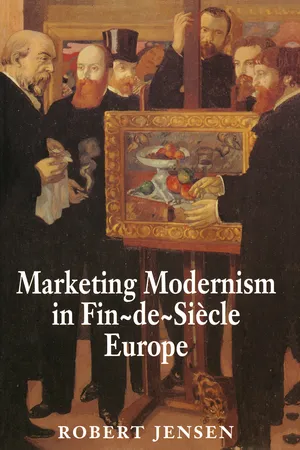
In this fundamental rethinking of the rise of modernism from its beginnings in the Impressionist movement, Robert Jensen reveals that market discourses were pervasive in the ideological defense of modernism from its very inception and that the avant-garde actually thrived on the commercial appeal of anti-commercialism at the turn of the century. The commercial success of modernism, he argues, depended greatly on possession of historical legitimacy. The very development of modern art was inseparable from the commercialism many of its proponents sought to transcend. Here Jensen explores the economic, aesthetic, institutional, and ideological factors that led to its dominance in the international art world by the early 1900s. He emphasizes the role of the emerging dealer/gallery market and of modernist art historiographies in evaluating modern art and legitimizing it through the formation of a canon of modernist masters.
In describing the canon-building of modern dealerships, Jensen considers the new "ideological dealer" and explores the commercial construction of artistic identity through such rhetorical concepts as temperament and "independent art" and through such institutional structures as the retrospective. His inquiries into the fate of the juste milieu, a group of dissidents who saw themselves as "true heirs" of Impressionism, and his look at a new form of art history emerging in Germany further expose a linear, dealer- oriented history of modernist art constructed by or through the modernists themselves.
- 376 pages
- English
- ePUB (mobile friendly)
- Available on iOS & Android
eBook - ePub
Marketing Modernism in Fin-de-Siècle Europe
About this book
Information
Publisher
Princeton University PressYear
2022Print ISBN
9780691029269
9780691033334
eBook ISBN
9780691241951
Topic
ArtSubtopic
History of Art■ CHAPTER ONE ■
“This painting sells”
THÉODORE DURET made his reputation as an art critic and journalist, but he lived an equally influential life as a collector, middleman, and speculator in contemporary French painting. In a famous defense of the Impressionists written in 1878, Duret argued their worth on the two principal grounds that first they had as supporters numerous prestigious writers, including Philippe Burty, Jules Castagnary, Ernest Chesneau, and Emile Zola, and that second, their success with the amateurs was a sign that their’s was the art of the future.1
Because it is necessary that the public who laughs so loudly over the Impressionists should be even more astonished!—this painting sells. It is true that it does not enrich the artists sufficiently enough to permit them to construct hôtels, but in the end, this painting sells.2
The buyers who in the past collected Delacroix, Corot, and Courbet “today form for themselves Impressionist collections[212]”. In 1884 Duret defended Manet in his introduction to the posthumous auction catalogue by again appealing directly to the amateur, the collector, who, unlike the public, was not blinded by fashion and asked only of a painting that “it be painted.” Duret proposed two kinds of artists, those who are “avec le temps” and those who create “formes nouvelles, des créations originales.”3 The “really original painters of modern France” he wrote, were “Delacroix, Rousseau, Corot, Millet, Courbet and, in the last position, Manet.” Great works of art, Duret insisted, are like the “heights of great mountains” which from close by cannot be perceived, but “from afar appear alone on the horizon.”
Duret’s equation of genius with market value inverted the two-centuries-old effort on the part of the European academies to preserve many of the features of traditional patronage in the face of a growing market economy. They attempted to ennoble and distance art from craft and to repress the commercial aspects of an artist’s enterprise. The challengers to the French Academy used market value to demonstrate how previously disenfranchised artists (and that could mean almost anyone who was not a member of the Academy) were vindicated by later prices, consequently demonstrating their right of place in the pantheon of great artists. Their version of the Academy’s detachment from the marketplace was the vilified genius.
What drove modernist artists and their supporters into such marketoriented arguments was not simply their ostracism from the traditional venues of the Academy, its schools and its chief exhibition site, the Salon. The famous persecutions of the Salon’s juries were but a symptom of a problem that transcended aesthetics or political causes: the institutional business of distinguishing oneself from the crowd. In France, as elsewhere in Europe, the state-supported Salon, with its prizes and its honors, had helped to create a proletariat of artists and a vast new audience for art. By mid-century it was widely felt that the Salon had become commercially debased, appealing to the tastes of the public rather than remaining true to the noble calling of art. With the decline of history painting, the appearance of the mass spectacle of the Salon, and the bitter disappointments of the refusés, it became increasingly clear that the academic system no longer worked, either from the perspective of producing major works of art or as a professional organization that could ensure the economic livelihood of all of its membership.4 Yet by virtue of the inherent inertia of institutions, the system continued to dominate French cultural life.
Thus arose the paradox that the opposition to the Salon would deride the commercialism of the annual public exhibitions, while attempting to appear, like the academicians, to act above the interests of money. The artists who belonged to the “avant-gardes” would never see themselves, or be seen by their supporters (at least until Dada), as producing commodities. For example, in 1893 a young Dutch symbolist painter, R. N. Roland-Holst, demonstrated this unconscious duplicity in a catalogue introduction for a retrospective exhibition of Vincent van Gogh held in a commercial gallery in Amsterdam. Roland-Holst deplored the commercialization of art— “The work of art has become merchandise as good as any other, merchandise for speculation”—but declared that “this exhibition is assembled for the few people who still believe that what is grasped immediately is really not always the best.”5 The suppression of commerce in the appreciation of “true” art meant that artists were faced quite simply with the social denial of their public right to make a living from their work. Thus to draw such subtle, tenuous distinctions between commercial and non-commercial exhibitions as Roland-Holst’s, modernist artists needed protection, they needed distance from the market, even as they came to rely exclusively on the market for their presence in the art world.
Compare Duret’s or Roland-Holst’s texts to the modernist treatment of one of their great pompier rivals, William Bouguereau, and it becomes evident just how deep, how long-lived, how paradoxical this modernist market rhetoric was. The first line of argument was that Bouguereau (and all others like him) was corrupted by the marketplace. The American art historian Frank Mather, in his Modern Painting (1926), accused Bouguereau of having self-consciously “multiplied vague, pink effigies of nymphs, occasionally draped them, when they become saints and madonnas, painted on the great scale that dominates an exhibition, and has had his reward. ... I am convinced that the nude of Bouguereau was prearranged to meet the ideals of a New York stockbroker of the black walnut generation.”6 Remarkably, Bouguereau, the greatest prince of the Salon, agreed.7 In an 1891 interview Bouguereau contrasted his pre-1863 work (i.e., before he had “arrived”) with what he had been doing ever since.
Here’s my Angel of Death. Opposite is my second painting, Dante's Hell. As you can see, they are different from the paintings I do these days. . . . If I continued to paint similar works, it is probable that, like these, I would still own them. What do you expect, you have to follow public taste, and the public only buys what it likes. That’s why, with time, I changed my way of painting. [100]
Casting himself as a victim of public taste, Bouguereau gave exemplary testimony to the belief, so widely held then as now, that artists must prostitute themselves, that the dedication to the “high” goals of art must be sacrificed for professional survival. As the painting market began to be perceived as revolving around the nouveau-riche collector, the critical habitus would hold in opposition the paradigm of the aristocratic patron, supposedly defined by his innate qualities as a connoisseur, and the crass— usually American, and also often portrayed as Jewish—businessman. Art critics increasingly saw the fundamental alteration—and lowering—of the art profession in their servitude to their new clientele. P. G. Hamerton, the British etcher, critic, and publisher of The Portfolio, reflected popular prejudices when he wrote in 1867 that
the power of money over art has never been stronger than it is now, and the manner of its operation, being very subtle and difficult to trace, increases the power by making it irresponsible. When a banker or speculator, some Rothschild or Pereire, goes to the annual exhibition of French Art in the Salon, and buys some picture there, he is not held responsible for the artistic qualities of the work, for which the artist alone is blamed or praised by the newspapers, as the case may be. And yet in a certain intelligible sense it is these bankers, and other rich men, who paint the pictures. They do not mix the colors and apply them with their own hands; nor do they even, except in the case of works directly commissioned by them, offer any suggestions as to the choice of subject and manner of execution; but still, since the great majority of pictures are painted to suit what are perfectly well known to be their tastes, it may be truly said that the artists aim rather at the realization of what the rich man likes than what they themselves care for. Enormous quantities of pictures are in this way painted every year expressly for the market, with care and trained skill, but no more artistic passion or enthusiasm than goes to the manufacture of any other elegant superfluities. And the evil of it is, that unless a picture is painted in this way, with the most careful attention to the points which happen just now to make a work salable, it is not likely to be sold at all.8
Hamerton expressed an enduring topos of a collector no longer guided by the educated taste of a connoisseur. The new men of business and industry were understood to be dependent upon public approbation to certify the quality of the art they purchased. Since the aristocratic domain of connoisseurship was unobtainable to them, they were said to pursue the most sensational and the most decorated artists of the Salon, and to prefer the most sentimental narratives and the most photographic styles of depiction possible. Bouguereau said what he was willing to do to satisfy such tastes.
It is in this context that Duret and other apologists for French modernism invoked the necessity for a refined aesthetic sense belonging to the connoisseur (a.k.a. the buyer) to distinguish authentic art from the debased tastes of the crowd (“these bankers”). Duret explained that painting demands “an adaptation of the eye and the habit of discovery, under the process of the métier, the intimate sentiments of the artist . . . (it) is one of the arts the least accessible to the crowd.”9 Just as Delacroix, Millet, Corot, and Manet were misunderstood by the least refined, so too were the Impressionists. The snob appeal of Duret’s remarks effectively combined the market elements of his text, the appreciations of the connoisseur, with the neglectedgenius topos. In other words, the neglect was not universal, it simply took the cultivated eye of the amateur to recognize the artist’s greatness. Duret had in mind cultivated connoisseurs like Baron Le Caze, who gave to the Louvre Watteau’s Gilles, which he had purchased many years before for 600 francs.10 If the discovery of the “temperament” behind a great work of art became a matter for “experts,” the invitation was there for those with money to come and buy and with their purchases achieve a new kind of cultural capital, that lay not in the objects, but in the associations, the fetish gloss, ownership conferred on the buyer—marking the passage from the “rich man” to the amateur.
In the modernist criticism and historiography that wrote Bouguereau and his fellow academicians out of the history of nineteenth-century art, the assumption was that Bouguereau was not merely corrupted by money but that the academic tradition as an entity was virtually corrupt by definition In 1894, the German art historian Richard Muther characterized Bouguereau as “a man destitute of artistic feeling but possessing a cultured taste [who] reveals ... in his feeble mawkishness, the fatal decline of the old schools of convention.”11 Muther caustically described Bouguereau’s religious painting as “an elegant lie, like the whole of the Second Empire.” Of course, in Bouguereau’s own self-appraisal, given at a time when such accusations were becoming publicly popular, the artist was anxious to disassociate the commercial element of his art from his academic training. But as Muther wrote off the academic tradition on the grounds that it was convention without art, so posterity would adopt Muther’s implicit formula—itself derived from the cliches of modernist French art criticism—that what is academic is commercial and what is commercial is academic.
The next step in modernist discourse was to claim that what is modern, or what is avant-garde, by virtue of its claims to authenticity as art, is inherently not commercial. In the modernist habitus an absolute split was maintained between the motives and circumstances of an artist like Bouguereau on the one hand and the Impressionists on the other. To look at post-1860s art again, outside the lens proffered by the Impressionists, their successors, and their apologists, the boundaries between authentic and unauthentic art, between the “real” artists and their commercial rivals, appear not only arbitrary, but fly in the face of the fact that the Impressionists were more market reliant than their Salon competitors. For many years scholars have acknowledged the commercial connections of the Impressionists; and indeed, even those most concerned with defending their importance vis-à-vis a discredited academic tradition have done much to describe the economic conditions of their practice. But what is still generally missing is a substantial interrogation of how their style(s), the way they organized their careers, the kinds of clients they came to possess, belonged to an across-the-board transformation of the relationship between artists and their audience, a transformation that involved an artist such as Bouguereau as equally as a Manet.
GETTING PUBLISHED: THE ACADEMY AND THE ENTREPRENEURIAL DEALER
As the number of practicing artists steadily expanded in the course of the nineteenth century, the social and aesthetic identities of artists were diluted. An artist-proletariat created an inevitable institutional revolt in the struggle over markets. Already by the middle of the nineteenth century the professional artist sought to define himself by more than the traditional desire to place the practice of art on the same level as that of the poet or philosopher. Their increasing dependence on a nameless, constantly evolving public for their livelihood forced artists, in much the same vein as their contemporaries in the fields of medicine or law, to assert their identities as a higher class of professional from that of the amateur artist, or the student, or the explicitly commercial artist. To be a member of a profession was to be “a producer of special services (who) sought to constitute and control a market for their expertise.”12 Artists sought to isolate themselves on the respective grounds of quality, difference, and the historical place of their work.
Until the last quarter of the century, however, the process of professionalism was dictated by the ruling academic system.13 France possessed the most centralized of all European art worlds, with almost all important art activities from pedagogy to exhibitions to auctions concentrated in Paris. The French government was also the most involved in the visual arts and had committed its patronage to a single artist association, the Académie des Beaux-Arts. Although not exclusively composed of members of the visual arts community, the Academy asserted its dominance over artistic matters through the Salon. The unmatched success of the Salon system in the previous century and a half resulted in the suppression of alternative exhibition opportunities for artists—as distinguished, for example, from Britain, where the Royal Academy was itself a commercial institution in competition with other commercial organizations for its publics. The French consequently possessed, on the one hand, the most influential system in the world for the display of works of art and the cultivation of a career as an artist, and relatively negligible alternative means by which, to use P. G. Hamerton’s term, works of art could be “published.”14
Designed to train, to confer legitimacy, to provide economic support, and to create business opportunities for its membership, the Academy’s unrivaled success in Paris by the end of the eighteenth century allowed the exercise of considerable influence over the subjects, the styles, and even the size of works of art shown at the Salon.15 With the cooperation of the State, the Academy and the Salon offered a regularized system of rewards, a clearly defined professional track through which an artist could progress. Through the combination of a pedagogical system centered on the École des Beaux-Arts and a regularized system of prizes, headed by the Prix de Rome, the Academy was able to assert its aesthetic standards at both the level of pedagogy and from the vantage of the Eco...
Table of contents
- Cover Page
- Title Page
- Copyright Page
- Contents
- Acknowledgments
- Introduction
- Chapter One: “This painting sells”
- Chapter Two: “The circle of dealers”
- Chapter Three: Rhetoric from the Battlefield: Innovation and Independence
- Chapter Four: The Retrospective
- Chapter Five: The Juste Milieu International
- Chapter Six: Secessionism
- Chapter Seven: The Rise of the Impressionist Weltanschauung
- Chapter Eight: Der Fall Meier-Graefe
- Postscript: 1905
- Appendix
- Notes
- Index
Trusted by 375,005 students
Access to over 1.5 million titles for a fair monthly price.
Study more efficiently using our study tools.
Frequently asked questions
Yes, you can cancel anytime from the Subscription tab in your account settings on the Perlego website. Your subscription will stay active until the end of your current billing period. Learn how to cancel your subscription
No, books cannot be downloaded as external files, such as PDFs, for use outside of Perlego. However, you can download books within the Perlego app for offline reading on mobile or tablet. Learn how to download books offline
We are an online textbook subscription service, where you can get access to an entire online library for less than the price of a single book per month. With over 1.5 million books across 990+ topics, we’ve got you covered! Learn about our mission
Look out for the read-aloud symbol on your next book to see if you can listen to it. The read-aloud tool reads text aloud for you, highlighting the text as it is being read. You can pause it, speed it up and slow it down. Learn more about Read Aloud
Yes! You can use the Perlego app on both iOS and Android devices to read anytime, anywhere — even offline. Perfect for commutes or when you’re on the go.
Please note we cannot support devices running on iOS 13 and Android 7 or earlier. Learn more about using the app
Please note we cannot support devices running on iOS 13 and Android 7 or earlier. Learn more about using the app
Yes, you can access Marketing Modernism in Fin-de-Siècle Europe by Robert Jensen in PDF and/or ePUB format, as well as other popular books in Art & History of Art. We have over 1.5 million books available in our catalogue for you to explore.