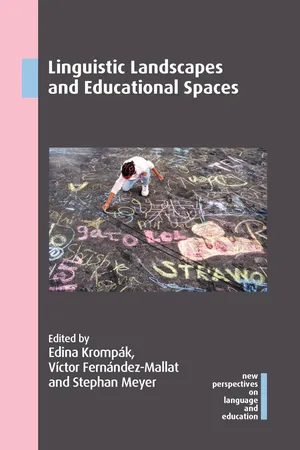
How do written and other signs shape our educational spaces and practices; and how, in turn, are these written and other signs shaped by the educational spaces and practices they inhabit? Building on enquiries into the linguistic landscapes of public spaces, this volume addresses these questions and thereby further advances the educational turn in linguistic and semiotic landscapes studies. Prompted by social changes associated with migration and superdiversity, as well as imperatives to promote pluri- and multilingualism, the studies collected here speak to the interest of researchers and practitioners in educational linguistics and educational sciences. They confirm the value of combining empirical analyses of linguistic and semiotic educationscapes with action research on mobilising linguistic landscapes as pedagogical resources to promote multilingual equality.
eBook - ePub
Linguistic Landscapes and Educational Spaces
- English
- ePUB (mobile friendly)
- Available on iOS & Android
eBook - ePub
Linguistic Landscapes and Educational Spaces
About this book
Information
1The Symbolic Value of Educationscapes – Expanding the Intersections Between Linguistic Landscape and Education
Edina Krompák, Víctor Fernández-Mallat and Stephan Meyer
Introducing the Educational Turn in Linguistic Landscape Studies
Traditionally, when thinking of languages in school, our mind’s eye would race directly to reading and writing. Given time, a whole landscape of classrooms and corridors may unfold, leading to assembly spaces, playgrounds and pitches; all of these peopled by pupils, teachers and principals doing their thing. We might even pause at signs on doors, designating spaces for staff or students to work and for boys and girls to congregate; at writing on the board commanding us to be silent or inviting us to speak; and at placards and posters on the walls in which pictures combine with various languages to inform, instruct or influence us. Absorbed into this maelstrom, we have become participant observers of the interconnections between the languages, signs, spaces and practices that constitute the linguistic and semiotic landscapes of an educational space.
This volume illustrates the potential of applying the central tenets and multiple methods of linguistic and semiotic landscape studies to the specific domain of education. A central theme of inquiry into linguistic and semiotic landscapes relates to the way the writing and signs we put on walls both shape and saturate the public spaces we create and how we behave in them; and how this writing and these signs, in turn, are shaped by our behaviours and the spaces they inhabit. Applying the educational turn to insights from linguistic and semiotic landscape studies, the findings collected here illuminate the ways in which linguistic and other signs shape our educational spaces and practices within those spaces, and vice versa. In doing so, they also advance our understanding of the relevance of these multiple relations to multilingualism and multilingual equality in education (for their account of multilingual inequality, see Gorter and Cenoz’s contribution to this volume).
Focusing on linguistic and semiotic educationscapes, the contributors to this volume describe, analyse and theorise the ways in which, in their everyday linguistic practices, stakeholders negotiate the meanings of languages, signs and spaces. In this context, linguistic and semiotic educationscapes may be defined as the mutually constitutive material and social spaces in which linguistic and symbolic resources are mobilised for educational purposes. Linguistic and semiotic educationscapes are thereby demarcated as a specific field within the broader domain of linguistic and semiotic landscape studies. Placing linguistic landscapes and educationscapes adjacent to semiotic landscapes and educationscapes reflects the continuities between these concepts while also acknowledging the differences between them. While linguistic resources include written text and oral practices, symbolic resources include these linguistic resources and extend beyond to symbolic systems such as music, mathematics and images. This adjacency also reflects the fact that, as visualisations of language, written linguistic signs necessarily have semiotic components such as colour, size and placement of the text. Accordingly, they belong to both the linguistic and semiotic educationscapes. However, the converse does not apply: Non-linguistic signs belong only to the semiotic educationscapes. While this distinction is valuable in some contexts, in others, it fades into the background. In linguistic landscape studies, even as the objects of inquiry expanded beyond linguistic signs to non-linguistic ones, the programmatic term ‘linguistic landscape’ has endured and is at times used interchangeably with the more general semiotic landscape. This usage may reflect the fact that in multimodal communication particularly, linguistic and semiotic signs are often inextricable. Opting for the historical and more focused term linguistic landscapes, the title of the present volume signals that the contributors treat language as their primary interest and/or point of departure. This focus on language notwithstanding, some of the studies collected here enrich our understanding of linguistic educationscapes by also venturing into the broader domain of the semiotic educationscapes into which they are interwoven.
The studies presented here are each in their own way entangled in the broader social, linguistic and educational issues of our times. Within contemporary critical theory, justice has been described as a complex, comprising recognition, distribution and parity of participation (Fraser & Honneth, 2003). Ongoing struggles for justice signal wide-ranging and persistent inequalities and exclusions related to difference and diversity (e.g. Adichie, 2014; Ngũgĩ wa Thiongʾo, 1986). Directly or indirectly, some of these struggles for justice play out in contestations over globalisation, migration and cosmopolitanism, or multiple and alternative modernities (Appadurai, 1996; Benhabib, 2008; Breckenridge et al., 2002; Vertovec, 2019). Others play out in greater preoccupation with identities of all kinds, and the implications of such preoccupations for the possibility of society to function at all (Alexander, 2007; Appiah, 2018; Benhabib, 2018). These struggles for justice and against social inequality also exist around language and education.
Linguistic justice is, likewise, a complex, involving issues such as language recognition (De Meulder et al., 2019; Wells, 2019), the distribution of material and symbolic resources related to language (Civico & Grin, 2020) and participation (Grotlüschen et al., 2020). In particular, mobility and immobility, as well as internationalism and nationalism, contribute to new multilingualisms – various constellations of local, migrant, national and indigenous languages in the same space. Justice through multilingualism raises various questions related to mono-, bi- and multilingual realities, from language policy to language rights, language hierarchies and language use (Piller, 2016; Skutnabb-Kangas et al., 2009). The diversity and linguistic inequalities among users of these languages confront institutions – from the education and administrative systems of the state to civil society organisations – with complex challenges. How to balance the benefits and disadvantages of mono-, bi- and multilingualism? Specifically, what language or languages to use and promote, and for what purposes, be that in state institutions, civil society and private interactions? And how can language education facilitate or hinder linguistic justice?
Educational policy, institutions and practices too are involved in struggles for justice comprising recognition, redistribution and participation (Huttunen, 2007; Keddie, 2012; Power, 2012). Some of the concrete contestations in which these struggles are played out concern decolonial curricula and knowledge (Jansen, 2019; Posholi, 2020), the digitisation of education (Schmidt & Tang, 2020) and language. Addressing linguistic diversity and inequality is central to social justice in language education (Piller, 2016). This stretches from the frontstage, such as the linguistic landscape of educational institutions, to the backstage (Goffman, 1956), which includes the hidden language policies of schools and classrooms, as well as administrators’, teachers’, students’ and even parents’ beliefs about multilingualism (Krompák, 2021). For example, while linguistic diversity in society is widely recognised, educational institutions still adhere to a monolingual habitus – monolingual education that collides with superdiverse societies (Gogolin, 1994) – or to monolingual mindsets (Clyne, 2005) that idealise lingua francae such as English (see Krompák, 2021). The extent to which these actors follow a monolingual habitus or mindset may influence their recognition of languages additional to the languages of instruction. This predisposition may also influence their reasoning and decisions regarding the visibility of various languages, the number of languages to be represented and the prominence they receive in the schoolscape.
Against this larger social, linguistic and educational backdrop, an early interest in linguistic schoolscapes has recently surged into an educational turn in linguistic landscape studies (for a survey of the development from linguistic landscape to schoolscape studies, see the section below). Researchers, practitioners and policymakers in linguistics and education may come to the present volume, like other publications on linguistic and semiotic educationscapes, with various questions and interests. For some, the volume will be of interest because of the ways in which it engages with the mentioned broader issues of justice, language and education through the specific lenses of linguistic and semiotic educationscapes. Some will be interested in the ways it seeks to fill lacunae in existing linguistic landscape studies. Others will find the volume pertinent because it brings into view educational aspects that enrich future linguistic landscape studies, as well as, conversely, sociolinguistic aspects and methodologies that will enrich educational studies on language learning and teaching. And yet others may be interested in the conversations it facilitates among different stakeholders such as educators, policymakers, students and their parents or how the various studies cross the divides that hamper both research and everyday practice.
The first intersection that the volume expands is that between educational practices on one hand and theoretical concepts and empirical research in linguistics on the other. It thereby contributes to educational linguistics, understood as ‘a problem-oriented discipline, focusing on the needs of practice and drawing from available theories and principles of many relevant fields including many of the subfields of linguistics’ (Spolsky, 1975: 347). Countering siloisation, the present volume integrates two approaches to linguistic landscape and education. Motivated by an interest in language vitality and multilingualism, early linguistic landscape studies have ventured into schools as one of the key institutions in the reproduction of the symbolic order (Foucault, 1971). Focusing on writing in various languages in school buildings (Brown, 2005, 2012), these early studies on linguistic schoolscapes extended the questions and methods of linguistic landscape s...
Table of contents
- Cover-Page
- Half-Title
- Series
- Title
- Copyright
- Contents
- Acknowledgements
- Contributors
- 1 The Symbolic Value of Educationscapes – Expanding the Intersections Between Linguistic Landscape and Education
- Part 1: Assessing the Linguistic and Semiotic Landscapes of Educational Spaces
- Part 2: Linguistic Landscape as a Pedagogical Resource
- Index
Trusted by 375,005 students
Access to over 1.5 million titles for a fair monthly price.
Study more efficiently using our study tools.
Frequently asked questions
Yes, you can cancel anytime from the Subscription tab in your account settings on the Perlego website. Your subscription will stay active until the end of your current billing period. Learn how to cancel your subscription
No, books cannot be downloaded as external files, such as PDFs, for use outside of Perlego. However, you can download books within the Perlego app for offline reading on mobile or tablet. Learn how to download books offline
Perlego offers two plans: Essential and Complete
- Essential is ideal for learners and professionals who enjoy exploring a wide range of subjects. Access the Essential Library with 800,000+ trusted titles and best-sellers across business, personal growth, and the humanities. Includes unlimited reading time and Standard Read Aloud voice.
- Complete: Perfect for advanced learners and researchers needing full, unrestricted access. Unlock 1.5M+ books across hundreds of subjects, including academic and specialized titles. The Complete Plan also includes advanced features like Premium Read Aloud and Research Assistant.
We are an online textbook subscription service, where you can get access to an entire online library for less than the price of a single book per month. With over 1.5 million books across 990+ topics, we’ve got you covered! Learn about our mission
Look out for the read-aloud symbol on your next book to see if you can listen to it. The read-aloud tool reads text aloud for you, highlighting the text as it is being read. You can pause it, speed it up and slow it down. Learn more about Read Aloud
Yes! You can use the Perlego app on both iOS and Android devices to read anytime, anywhere — even offline. Perfect for commutes or when you’re on the go.
Please note we cannot support devices running on iOS 13 and Android 7 or earlier. Learn more about using the app
Please note we cannot support devices running on iOS 13 and Android 7 or earlier. Learn more about using the app
Yes, you can access Linguistic Landscapes and Educational Spaces by Edina Krompák, Víctor Fernández-Mallat, Stephan Meyer, Edina Krompák,Víctor Fernández-Mallat,Stephan Meyer in PDF and/or ePUB format, as well as other popular books in Literature & Linguistics. We have over 1.5 million books available in our catalogue for you to explore.