A single species of fly, Drosophila melanogaster, has been the subject of scientific research for more than one hundred years. Why does this tiny insect merit such intense scrutiny?
Drosophila's importance as a research organism began with its short life cycle, ability to reproduce in large numbers, and easy-to-see mutant phenotypes. Over time, laboratory investigation revealed surprising similarities between flies and other animals at the level of genes, gene networks, cell interactions, physiology, immunity, and behavior. Like humans, flies learn and remember, fight microbial infection, and slow down as they age. Scientists use Drosophila to investigate complex biological activities in a simple but intact living system. Fly research provides answers to some of the most challenging questions in biology and biomedicine, including how cells transmit signals and form ordered structures, how we can interpret the wealth of human genome data now available, and how we can develop effective treatments for cancer, diabetes, and neurodegenerative diseases.
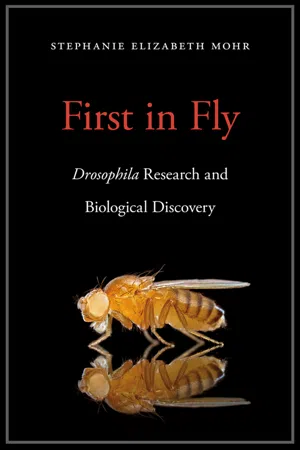
Written by a leader in the Drosophila research community, First in Fly celebrates key insights uncovered by investigators using this model organism. Stephanie Elizabeth Mohr draws on these "first in fly" findings to introduce fundamental biological concepts gained over the last century and explore how research in the common fruit fly has expanded our understanding of human health and disease.
- 273 pages
- English
- PDF
- Available on iOS & Android
eBook - PDF
About this book
Information
Table of contents
- Cover
- Title Page
- Copyright
- Dedication
- Contents
- Preface
- Introduction
- Chapter 1. Maps
- Chapter 2. Change
- Chapter 3. Communication
- Chapter 4. Size
- Chapter 5. Direction
- Chapter 6. Difference
- Chapter 7. Defenses
- Chapter 8. Behavior
- Chapter 9. Coordination
- Chapter 10. Continuity
- Epilogue
- Appendix A. How to Make a Flytrap
- Appendix B. Comparable Organs in Humans and Flies
- Appendix C. Selected Genetic Screens Performed in Drosophila
- Recommended Reading
- Abbreviations
- References
- Acknowledgments
- Index
Trusted by 375,005 students
Access to over 1.5 million titles for a fair monthly price.
Study more efficiently using our study tools.
Frequently asked questions
Yes, you can cancel anytime from the Subscription tab in your account settings on the Perlego website. Your subscription will stay active until the end of your current billing period. Learn how to cancel your subscription
No, books cannot be downloaded as external files, such as PDFs, for use outside of Perlego. However, you can download books within the Perlego app for offline reading on mobile or tablet. Learn how to download books offline
Perlego offers two plans: Essential and Complete
- Essential is ideal for learners and professionals who enjoy exploring a wide range of subjects. Access the Essential Library with 800,000+ trusted titles and best-sellers across business, personal growth, and the humanities. Includes unlimited reading time and Standard Read Aloud voice.
- Complete: Perfect for advanced learners and researchers needing full, unrestricted access. Unlock 1.5M+ books across hundreds of subjects, including academic and specialized titles. The Complete Plan also includes advanced features like Premium Read Aloud and Research Assistant.
We are an online textbook subscription service, where you can get access to an entire online library for less than the price of a single book per month. With over 1.5 million books across 990+ topics, we’ve got you covered! Learn about our mission
Look out for the read-aloud symbol on your next book to see if you can listen to it. The read-aloud tool reads text aloud for you, highlighting the text as it is being read. You can pause it, speed it up and slow it down. Learn more about Read Aloud
Yes! You can use the Perlego app on both iOS and Android devices to read anytime, anywhere — even offline. Perfect for commutes or when you’re on the go.
Please note we cannot support devices running on iOS 13 and Android 7 or earlier. Learn more about using the app
Please note we cannot support devices running on iOS 13 and Android 7 or earlier. Learn more about using the app
Yes, you can access First in Fly by Stephanie Elizabeth Mohr in PDF and/or ePUB format, as well as other popular books in Biological Sciences & Biology. We have over 1.5 million books available in our catalogue for you to explore.