How did the Reformation, which initially promoted decidedly illiberal positions, end up laying the groundwork for Western liberalism?
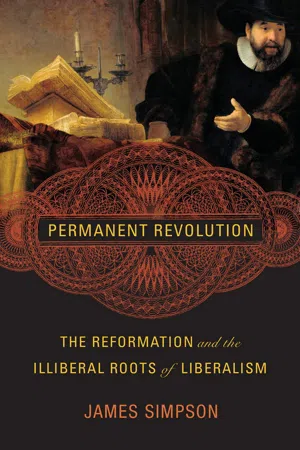
The English Reformation began as an evangelical movement driven by an unyielding belief in predestination, intolerance, stringent literalism, political quietism, and destructive iconoclasm. Yet by 1688, this illiberal early modern upheaval would deliver the foundations of liberalism: free will, liberty of conscience, religious toleration, readerly freedom, constitutionalism, and aesthetic liberty. How did a movement with such illiberal beginnings lay the groundwork for the Enlightenment? James Simpson provocatively rewrites the history of liberalism and uncovers its unexpected debt to evangelical religion.
Sixteenth-century Protestantism ushered in a culture of permanent revolution, ceaselessly repudiating its own prior forms. Its rejection of tradition was divisive, violent, and unsustainable. The proto-liberalism of the later seventeenth century emerged as a cultural package designed to stabilize the social chaos brought about by this evangelical revolution. A brilliant assault on many of our deepest assumptions, Permanent Revolution argues that far from being driven by a new strain of secular philosophy, the British Enlightenment is a story of transformation and reversal of the Protestant tradition from within. The gains of liberalism were the unintended results of the violent early Reformation.
Today those gains are increasingly under threat, in part because liberals do not understand their own history. They fail to grasp that liberalism is less the secular opponent of religious fundamentalism than its dissident younger sibling, uncertain how to confront its older evangelical competitor.
- 465 pages
- English
- PDF
- Available on iOS & Android
eBook - PDF
About this book
Information
Table of contents
- Cover
- Title Page
- Copyright
- Dedication
- Contents
- Preface
- Regnal Dates
- Introduction
- Part 1. Religion as Revolution
- Part 2. Working Modernity’s Despair
- Part 3. Sincerity and Hypocrisy
- Part 4. Breaking Idols
- Part 5. Theater, Magic, Sacrament
- Part 6. Managing Scripture
- Part 7. Liberty and Liberties
- Conclusion
- Note on Texts and Citations
- Abbreviations
- Notes
- Index
Trusted by 375,005 students
Access to over 1.5 million titles for a fair monthly price.
Study more efficiently using our study tools.
Frequently asked questions
Yes, you can cancel anytime from the Subscription tab in your account settings on the Perlego website. Your subscription will stay active until the end of your current billing period. Learn how to cancel your subscription
No, books cannot be downloaded as external files, such as PDFs, for use outside of Perlego. However, you can download books within the Perlego app for offline reading on mobile or tablet. Learn how to download books offline
Perlego offers two plans: Essential and Complete
- Essential is ideal for learners and professionals who enjoy exploring a wide range of subjects. Access the Essential Library with 800,000+ trusted titles and best-sellers across business, personal growth, and the humanities. Includes unlimited reading time and Standard Read Aloud voice.
- Complete: Perfect for advanced learners and researchers needing full, unrestricted access. Unlock 1.5M+ books across hundreds of subjects, including academic and specialized titles. The Complete Plan also includes advanced features like Premium Read Aloud and Research Assistant.
We are an online textbook subscription service, where you can get access to an entire online library for less than the price of a single book per month. With over 1.5 million books across 990+ topics, we’ve got you covered! Learn about our mission
Look out for the read-aloud symbol on your next book to see if you can listen to it. The read-aloud tool reads text aloud for you, highlighting the text as it is being read. You can pause it, speed it up and slow it down. Learn more about Read Aloud
Yes! You can use the Perlego app on both iOS and Android devices to read anytime, anywhere — even offline. Perfect for commutes or when you’re on the go.
Please note we cannot support devices running on iOS 13 and Android 7 or earlier. Learn more about using the app
Please note we cannot support devices running on iOS 13 and Android 7 or earlier. Learn more about using the app
Yes, you can access Permanent Revolution by James Simpson in PDF and/or ePUB format, as well as other popular books in Literature & British History. We have over 1.5 million books available in our catalogue for you to explore.