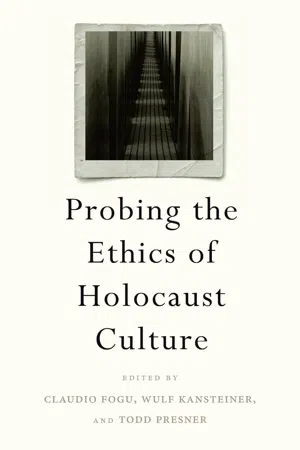
Depictions of the Holocaust in history, literature, and film became a focus of intense academic debate in the 1980s and 1990s. Today, with the passing of the eyewitness generation and the rise of comparative genocide studies, the Holocaust's privileged place not only in scholarly discourse but across Western society has been called into question.
Probing the Ethics of Holocaust Culture is a searching reappraisal of the debates and controversies that have shaped Holocaust studies over a quarter century. This landmark volume brings international scholars of the founding generation of Holocaust studies into conversation with a new generation of historians, artists, and writers who have challenged the limits of representation through their scholarly and cultural practices. Focusing on the public memorial cultures, testimonial narratives, and artifacts of cultural memory and history generated by Holocaust remembrance, the volume examines how Holocaust culture has become institutionalized, globalized, and variously contested. Organized around three interlocking themes—the stakes of narrative, the remediation of the archive, and the politics of exceptionality—the essays in this volume explore the complex ethics surrounding the discourses, artifacts, and institutions of Holocaust remembrance.
From contrasting viewpoints and, in particular, from the multiple perspectives of genocide studies, the authors question if and why the Holocaust should remain the ultimate test case for ethics and a unique reference point for how we understand genocide and crimes against humanity.
eBook - PDF
Probing the Ethics of Holocaust Culture
- 528 pages
- English
- PDF
- Available on iOS & Android
eBook - PDF
Probing the Ethics of Holocaust Culture
About this book
Information
Table of contents
- Cover
- Title
- Copyright
- Contents
- Introduction: The Field of Holocaust Studies and the Emergence of Global Holocaust Culture
- Part I: The Stakes of Narrative
- Part II: Remediations of The Archive
- Part III: The Politics of Exceptionality
- Epilogue: Interview with Saul Friedländer
- Notes
- Acknowledgments
- Illustration Credits
- Contributors
- Index
Trusted by 375,005 students
Access to over 1.5 million titles for a fair monthly price.
Study more efficiently using our study tools.
Frequently asked questions
Yes, you can cancel anytime from the Subscription tab in your account settings on the Perlego website. Your subscription will stay active until the end of your current billing period. Learn how to cancel your subscription
No, books cannot be downloaded as external files, such as PDFs, for use outside of Perlego. However, you can download books within the Perlego app for offline reading on mobile or tablet. Learn how to download books offline
Perlego offers two plans: Essential and Complete
- Essential is ideal for learners and professionals who enjoy exploring a wide range of subjects. Access the Essential Library with 800,000+ trusted titles and best-sellers across business, personal growth, and the humanities. Includes unlimited reading time and Standard Read Aloud voice.
- Complete: Perfect for advanced learners and researchers needing full, unrestricted access. Unlock 1.5M+ books across hundreds of subjects, including academic and specialized titles. The Complete Plan also includes advanced features like Premium Read Aloud and Research Assistant.
We are an online textbook subscription service, where you can get access to an entire online library for less than the price of a single book per month. With over 1.5 million books across 990+ topics, we’ve got you covered! Learn about our mission
Look out for the read-aloud symbol on your next book to see if you can listen to it. The read-aloud tool reads text aloud for you, highlighting the text as it is being read. You can pause it, speed it up and slow it down. Learn more about Read Aloud
Yes! You can use the Perlego app on both iOS and Android devices to read anytime, anywhere — even offline. Perfect for commutes or when you’re on the go.
Please note we cannot support devices running on iOS 13 and Android 7 or earlier. Learn more about using the app
Please note we cannot support devices running on iOS 13 and Android 7 or earlier. Learn more about using the app
Yes, you can access Probing the Ethics of Holocaust Culture by Claudio Fogu, Wulf Kansteiner, Todd Presner, Claudio Fogu,Wulf Kansteiner,Todd Presner in PDF and/or ePUB format, as well as other popular books in History & European History. We have over 1.5 million books available in our catalogue for you to explore.