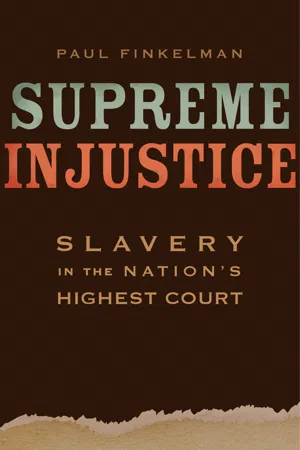
The three most important Supreme Court Justices before the Civil War—Chief Justices John Marshall and Roger B. Taney and Associate Justice Joseph Story—upheld the institution of slavery in ruling after ruling. These opinions cast a shadow over the Court and the legacies of these men, but historians have rarely delved deeply into the personal and political ideas and motivations they held. In Supreme Injustice, the distinguished legal historian Paul Finkelman establishes an authoritative account of each justice's proslavery position, the reasoning behind his opposition to black freedom, and the incentives created by circumstances in his private life.
Finkelman uses census data and other sources to reveal that Justice Marshall aggressively bought and sold slaves throughout his lifetime—a fact that biographers have ignored. Justice Story never owned slaves and condemned slavery while riding circuit, and yet on the high court he remained silent on slave trade cases and ruled against blacks who sued for freedom. Although Justice Taney freed many of his own slaves, he zealously and consistently opposed black freedom, arguing in Dred Scott that free blacks had no Constitutional rights and that slave owners could move slaves into the Western territories. Finkelman situates this infamous holding within a solid record of support for slavery and hostility to free blacks.
Supreme Injustice boldly documents the entanglements that alienated three major justices from America's founding ideals and embedded racism ever deeper in American civic life.
- 301 pages
- English
- PDF
- Available on iOS & Android
eBook - PDF
About this book
Information
Table of contents
- Cover
- Title Page
- Copyright
- Dedication
- Contents
- Introduction
- 1. The Antebellum Constitution and Slavery
- 2. John Marshall: Slave Owner and Jurist
- 3. John Marshall and the African Slave Trade
- 4. Joseph Story: New England Icon in the Service of Slavery
- 5. Roger B. Taney: Slavery’s Great Chief Justice
- Coda
- Notes
- Acknowledgments
- Index of Cases Cited
- Index
Trusted by 375,005 students
Access to over 1.5 million titles for a fair monthly price.
Study more efficiently using our study tools.
Frequently asked questions
Yes, you can cancel anytime from the Subscription tab in your account settings on the Perlego website. Your subscription will stay active until the end of your current billing period. Learn how to cancel your subscription
No, books cannot be downloaded as external files, such as PDFs, for use outside of Perlego. However, you can download books within the Perlego app for offline reading on mobile or tablet. Learn how to download books offline
Perlego offers two plans: Essential and Complete
- Essential is ideal for learners and professionals who enjoy exploring a wide range of subjects. Access the Essential Library with 800,000+ trusted titles and best-sellers across business, personal growth, and the humanities. Includes unlimited reading time and Standard Read Aloud voice.
- Complete: Perfect for advanced learners and researchers needing full, unrestricted access. Unlock 1.5M+ books across hundreds of subjects, including academic and specialized titles. The Complete Plan also includes advanced features like Premium Read Aloud and Research Assistant.
We are an online textbook subscription service, where you can get access to an entire online library for less than the price of a single book per month. With over 1.5 million books across 990+ topics, we’ve got you covered! Learn about our mission
Look out for the read-aloud symbol on your next book to see if you can listen to it. The read-aloud tool reads text aloud for you, highlighting the text as it is being read. You can pause it, speed it up and slow it down. Learn more about Read Aloud
Yes! You can use the Perlego app on both iOS and Android devices to read anytime, anywhere — even offline. Perfect for commutes or when you’re on the go.
Please note we cannot support devices running on iOS 13 and Android 7 or earlier. Learn more about using the app
Please note we cannot support devices running on iOS 13 and Android 7 or earlier. Learn more about using the app
Yes, you can access Supreme Injustice by Paul Finkelman in PDF and/or ePUB format, as well as other popular books in Law & Law Biographies. We have over 1.5 million books available in our catalogue for you to explore.