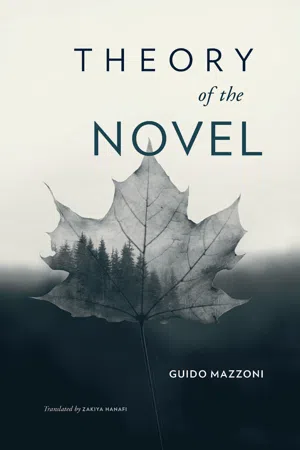
The novel is the most important form of Western art. It aims to represent the totality of life; it is the flagship that literature sends out against the systematic thought of science and philosophy. Indebted to Lukács and Bakhtin, to Auerbach and Ian Watt, Guido Mazzoni's Theory of the Novel breaks new ground, building a historical understanding of how the novel became the modern book of life: one of the best representations of our experience of the world.
The genre arose during a long metamorphosis of narrative forms that took place between 1550 and 1800. By the nineteenth century it had come to encompass a corpus of texts distinguished by their freedom from traditional formal boundaries and by the particularity of their narratives. Mazzoni explains that modern novels consist of stories told in any way whatsoever, by narrators who exist—like us—as contingent beings within time and space. They therefore present an interpretation, not a copy, of the world.
Novels grant new importance to the stories of ordinary men and women and allow readers to step into other lives and other versions of truth. As Theory of the Novel makes clear, this art form narrates an epoch and a society in which individual experiences do not converge but proliferate, in which the common world has fragmented into a plurality of small, local worlds, each absolute in its particularity.
- 403 pages
- English
- PDF
- Available on iOS & Android
eBook - PDF
Theory of the Novel
About this book
Information
Table of contents
- Cover
- Title
- Copyright
- Contents
- Translator’s Note
- Introduction: Truth and Literature
- Chapter One: A Theory of Narrative
- Chapter Two: The Origin of the Novel
- Chapter Three: The Novel and the Literature of the Ancien Régime
- Chapter Four: The Book of Particular Life
- Chapter Five: The Birth of the Modern Novel
- Chapter Six: The Nineteenth-Century Paradigm
- Chapter Seven: The Transition to Modernism
- Chapter Eight: On Contemporary Fiction
- Conclusion: A Theory of the Novel
- Acknowledgments
- Index
Trusted by 375,005 students
Access to over 1.5 million titles for a fair monthly price.
Study more efficiently using our study tools.
Frequently asked questions
Yes, you can cancel anytime from the Subscription tab in your account settings on the Perlego website. Your subscription will stay active until the end of your current billing period. Learn how to cancel your subscription
No, books cannot be downloaded as external files, such as PDFs, for use outside of Perlego. However, you can download books within the Perlego app for offline reading on mobile or tablet. Learn how to download books offline
Perlego offers two plans: Essential and Complete
- Essential is ideal for learners and professionals who enjoy exploring a wide range of subjects. Access the Essential Library with 800,000+ trusted titles and best-sellers across business, personal growth, and the humanities. Includes unlimited reading time and Standard Read Aloud voice.
- Complete: Perfect for advanced learners and researchers needing full, unrestricted access. Unlock 1.5M+ books across hundreds of subjects, including academic and specialized titles. The Complete Plan also includes advanced features like Premium Read Aloud and Research Assistant.
We are an online textbook subscription service, where you can get access to an entire online library for less than the price of a single book per month. With over 1.5 million books across 990+ topics, we’ve got you covered! Learn about our mission
Look out for the read-aloud symbol on your next book to see if you can listen to it. The read-aloud tool reads text aloud for you, highlighting the text as it is being read. You can pause it, speed it up and slow it down. Learn more about Read Aloud
Yes! You can use the Perlego app on both iOS and Android devices to read anytime, anywhere — even offline. Perfect for commutes or when you’re on the go.
Please note we cannot support devices running on iOS 13 and Android 7 or earlier. Learn more about using the app
Please note we cannot support devices running on iOS 13 and Android 7 or earlier. Learn more about using the app
Yes, you can access Theory of the Novel by Guido Mazzoni, Zakiya Hanafi in PDF and/or ePUB format, as well as other popular books in Literature & Literary Criticism. We have over 1.5 million books available in our catalogue for you to explore.