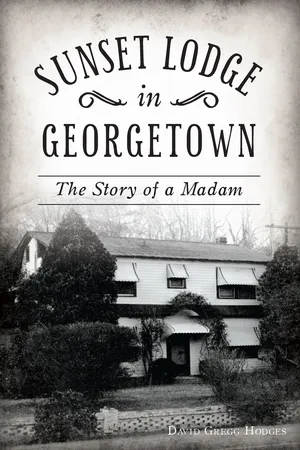
The true, "carefully researched" story of a Depression-era brothel in a Bible Belt town that thrived for over three decades and the woman who owned it (Lee Gordon Brockington, author of
Pawleys Island: A Century of History and Photographs).
Hazel Weisse moved to Georgetown, South Carolina, in 1936, and opened a brothel three miles south of Front Street. Aside from objections by a few ministers, most people in town looked the other way—and the business remained open for thirty-three years, until Weisse's retirement in 1969.
She was well known, making appearances every week at the stores on Front Street—and in the newspaper as a donor to charitable causes. She sent her "sporting ladies" to town for their weekly doctor visits, banking deposits, and shopping trips. But, aware of the conservative community around her business, she did not allow her employees free access to Georgetown. She approved their choices of clothes to wear in public, warned them not to look at men on the sidewalk, and forbade soliciting. Based on research, interviews, and local lore, David Gregg Hodges attempts the unravel the history behind a place spoken of in whispers—and reveals the people and stories behind the Sunset Lodge.
- 163 pages
- English
- ePUB (mobile friendly)
- Available on iOS & Android
eBook - ePub
About this book
Information


INTERNATIONAL PAPER EMPLOYEE
International Paper arrived in Georgetown not a minute too soon. In the middle of the Depression, the company hired 800 workers to build the plant and 1,200 permanent employees to run it. Another 1,000 workers would be in the woods cutting trees. The weekly payroll was $35,000.
One woman graduated from high school in 1941 and then applied for a job at International Paper and was fortunate to be one of the few women hired. She made $110 per month as a clerk, and she said she had no idea what to do with that much money. The first thing she did was to go to Loyal Motors in Georgetown and buy a red 1941 Ford convertible with a white skin top.
“Some of the older men at International Paper resented me. After all, there I was, a young woman—a girl, really—who got a good job and who had nothing better to spend my money on than a sports car. My coworkers were men who had been struggling through the Depression to keep their families fed.”
The Depression hit Georgetown County hard; commerce stopped and people struggled. There were men in Georgetown in the 1930s who built roads for the Works Progress Administration (WPA) making sixty-five cents per day. The men who built the Pawleys Island Road had to camp in a tent on a bed of straw from Monday through Friday nights. They built fires for warmth.
Life got a lot better fast when International Paper arrived. Imagine going from making $0.65 per day and living in a tent to making $0.44 per hour for plant workers. If you were a supervisor, you would make $1.44 per hour.68
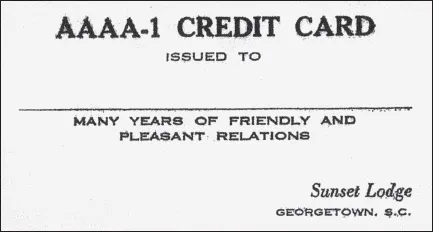
Sunset Lodge credit card. Private collection.
Suddenly, Georgetown got crowded. The population increased from five thousand to eight thousand people, and every spare bedroom in every house and apartment was rented. The newspaper even published an editorial criticizing the residents for their greedy behavior in hiking up rents. Some residents heard the Sunset Lodge went to Georgetown in 1936 because International Paper was about to build the plant, and it is true the steelworkers from Pittsburgh arrived in Georgetown to build the paper mill just a few months after the Sunset Lodge opened for business. Many people in town thought there was a connection between the Sunset Lodge opening for business and steelworkers coming to town.
Everyone at International Paper—at all of its plants around the country—knew about the Sunset Lodge. There was no place like it. Sure, there were brothels in every town, but the madam, Hazel Weisse, ran the Sunset Lodge like the big business it was. She gave away a lot of money to local charities—even more than International Paper. Her clientele was more professional than most brothels. She was a good businesswoman.
International Paper’s chauffeur always was available to take a visiting executive to the Sunset Lodge when he arrived from another plant or from New York. The executives tended to stay in Georgetown longer than at other plants. The reason they gave for the longer stays was that the sunsets were so pretty.
The Georgetown paper mill manager even had cards printed that he claimed were Sunset Lodge credit cards. He enjoyed handing out those cards whenever he traveled to other International Paper locations. “Come see us,” he would say. “Here, have a credit card to the Sunset Lodge!”
BANK MANAGER
The responsibility of the branch manager in Georgetown was to manage the staff, make loans, open accounts and be involved in town affairs. One banker had a good career with the bank, and as he said, his move to Georgetown to manage the branch was a nice way to slide into retirement.
He knew the Sunset Lodge was in Georgetown, but he never thought about the madam having a bank account, let alone the prostitutes. Going to the bank seems such a natural thing to do, but a brothel seems so unnatural that he was not prepared for his experience in Georgetown.
For one thing, those folks made a lot of money. The madam was Hazel Weisse, and she had a savings account and there always was plenty of money in her account, but the bankers knew her real money was in the trust department in their Charleston office. Her deposits sometimes rivaled or exceeded International Paper’s deposits! The money was unreal.
The banker’s predecessor set up an arrangement with Hazel to allow her working girls—or, as Hazel insisted they be called, sporting ladies—to open savings accounts. Hazel did not let them set up checking accounts, but they could set up savings accounts and they could buy bonds. Also, Hazel had an address—Route 2, Box 300—that was her official address for the Sunset Lodge, and when a new sporting lady walked in to open a savings account, the teller was supposed to ask no further questions if a woman gave that PO box as her address.
Working at the bank was a real adjustment for the banker. He had been in Georgetown only a short time when a teller walked over to let him know the young woman at her desk worked at the Sunset Lodge. He could not believe it. He stared as long as he felt he could before forcing his head down to look at some papers on his desk. The most remarkable thing about her and the other women who later followed her was how unremarkable they were. They were not flashy or tacky or dramatic. They wore nice clothes but not inappropriate. They could be anyone’s daughter. It made him think of the girl’s parents and what in the world they would say if they saw her in Georgetown at the Sunset Lodge. As he said, “Candidly, it made me sad.”
The tellers always commented on how the ladies smelled. They smelled good—perfume good. He never got close enough to take a sniff, but the tellers could tell him the name of the perfume and how much it cost.
Monday was doctor day and bank day for the sporting ladies of the Sunset Lodge. Everyone knew it. They had to go to town to see the doctor every Monday morning, and they generally spent the morning in town at the bank, at the jewelry store or at the ladies’ dress shop. If the banker had to run an errand during the morning, he might see them in the pharmacy or even the bookstore. He always could tell when they were in a store because the store owner practically closed the store to give them his full attention. Some of them went so far as to lock the front door or to post an employee at the front door to keep other customers out. They spent that much money.
Monday also was a big day for deposits at the bank. The women of the Sunset Lodge deposited their cash from the weekend into their savings accounts. It makes sense that Hazel would encourage her women to get the cash out of the Sunset Lodge every Monday; there was a massive amount of money in that building after a weekend. The ladies sometimes bought savings bonds or money orders, and sometimes they just let their savings accounts accumulate.
The women never stayed long in Georgetown, maybe six months to a year. A woman leaving town would stop by the bank, often driving a new car, to close her savings account and get her money, sometimes $8,000 to $10,000. This was in the early 1960s when the average annual income in South Carolina was $3,800.
Hazel often walked into the bank, and she always created a stir when she did. She wore her clothes beautifully, and she always looked good. She was not an attractive woman—she had an unfortunately stern face—but she dressed well, really well, and the tellers who worked there checked out her clothes and shoes and talked about her for hours afterward. Hazels always was generous with her money. She often took presents to the bank for the staff during the year. At Christmas, she gave each employee a gift that cost as much as the gifts they exchanged with their families.
The banker retired and moved away to the house he grew up in. Whenever he told someone where he had worked before retiring, the response always was to ask about the Sunset Lodge in Georgetown. Even now, every story about Georgetown triggers stories about the Sunset Lodge. Still!
FLOWER SHOP OWNERS
A couple in Georgetown owned a flower and gift shop on Front Street. Their daughter grew up in that store, first cleaning the store and then working in the back. Later, when she was in high school, she worked the front.
The daughter loved that the Sunset Lodge was in Georgetown. It did not bother her that other women chose to make their living that way. As far as she was concerned, they could do what they wanted. There was a bit of tension in town among local women who felt a certain marital pressure—that if they did not feel like it then their husbands would head to the Sunset Lodge. As she got older and married, she certainly felt it.
The Sunset Lodge was a famous business, and Hazel brought a lot of money to Georgetown and the business owners loved her. The flower shop owner liked to tell people that Hazel was in a non-polluting, green industry. She was a tourist destination! When Hazel closed the Sunset Lodge, all the business owners and many others were sorry to see her go; oh sure, she would say, the foot-washing Baptists were glad it closed, but not the rest of them.
She knew Hazel well. Hazel was tall and buxom with red hair. She wore glasses. Pretty? No, she had a harsh face, but she was very nice. She was a clothes horse. She had beautiful clothes, and she wore them well. She also spoke beautifully. Hazel went into an insurance office one day, and the receptionist listened to her speak and looked at her clothes and thought she was the wife of one of the northern plantation owners.
Their business was primarily flowers, but they also sold china, crystal and linen. Hazel’s girls often shopped there. They bought a lot, and they paid in cash. The owners were like every other business owner on Front Street; they bought inventory for the store with the girls in mind. Having them there was good for business.
The shop delivered flowers to the Sunset Lodge every week. Who from? Satisfied customers! Men sent flowers all the time. It never made any sense to the owner why a guy would send flowers to someone whose friendship he negotiated, but they sold a lot of flowers and they made a lot of money on the Sunset Lodge.
When one of Hazel’s girls was in the hospital, they would deliver flowers to the front desk for delivery to her room. They had learned from experience to seal the little envelope that held the card; otherwise, the nurses would peek to see who sent the flowers.
One Easter week, an old man rode up to the shop in a chauffeured car. He walked into the store and bought lilies to be delivered to the Sunset Lodge. The owner was so curious about this man and his interest in the Sunset Lodge that she decided to deliver the flowers to the brothel herself. Now, this lady would jump on a bourbon and water, so when Hazel invited her in for a drink, she was happy to accept. Imagine her disappointment when Hazel gave her a Coke to drink. She had her heart set on that bourbon and water.
She was sitting at the dining room table visiting with Hazel and some of the girls when a buzzer sounded. There was a customer at the back door. The girls headed to the living room to be ready, and Hazel went to let him in. Well, I best be going, the lady decided.
Hazel was a generous person who stayed in touch with everyone in town. When the owners’ daughter got married, Hazel saw the notice in the paper, and she stopped by the store for a visit. She told the owner how pleased she was about her daughter’s marriage and pulled out twenty-five dollars from her purse and handed it to her and asked her to give it to her daughter as a wedding gift. This was when a twenty-five-dollar wedding gift was a seriously big deal.69
Hazel had a birthday party for herself every October. The party was for men only and by invitation only, and men came from all over South Carolina to attend. The party lasted all day, and she gave away everything that day, from drinks to girls. The owner’s husband was invited each year; though he never went, they delivered a lot of flowers.
The Sunset Lodge closed in December 1969. Hazel and the sheriff had discussed shutting down the brothel, but he caught her by surprise that Friday afternoon, and she did not have enough cash to settle up with the girls. She called the owner’s husband at the flower shop and told him the sheriff was putting padlocks on the doors and she needed to borrow some cash through the weekend. Hazel’s chauffeur drove into their backyard, and the man walked onto the back porch. He shook the chauffeur’s hand and handed him the cash. Hazel was waiting in her car on Monday morning in front of the flower shop with the money to pay him back.
DRY CLEANERS OWNER
The dry cleaners owner was about Hazel’s age, and they got along well; besides, Hazel did a lot of business with the dry cleaners. The owner was a new widow, and that is why she made time for Hazel and they became friends.
Early on when Hazel first arrived in Georgetown, she seemed determined to set a high bar for an admittedly low-brow industry. She hired the biggest, toughest man in town to keep order at the Sunset Lodge. Hazel turned away the men who showed up dirty after a full day’s work at a local construction site or who worked on the ships. Eventually, word got around that this was a brothel with standards. She kept her bouncer until he retired, and she never had to replace him.
The 1940s were more formal than today. Men in business wore suits with vests and hats every day, even the men working at the grocery store. Women wore gloves and hats on Front Street. Hazel required her ladies to wear long dresses and heels every night. They sat in the living room and visited with the men who just wanted to talk. They danced with the men who just wanted to put money in the jukebox and dance. Hazel created an atmosphere at the Sunset Lodge that was very much about the fantasy of meeting and flirting with the pretty girl.
Every morning, Hazel’s driver would take armloads of dresses to the cleaners for her to clean and repair. She did not get the sheets and towels; those were cleaned by an industrial company out of Charleston. They would repair any missing buttons, pulled zippers or missing sequins before cleaning the dresses for later pickup. Every one of the Sunset Lodge’s girls had several outfits for work.
When one of Hazel’s girls was not at the Sunset Lodge, dressed to entertain, she was indistinguishable from any other young woman in Georgetown. If Hazel let her come to town, she would be dressed conservatively with flat shoes, all neat and clean. The stereotypical image of the dramatically dressed prostitute with tacky big hair did not apply in Georgetown. Hazel had to approve the appearance of anyone going to town, and more than once she sent a girl back upstairs to change. Hazel knew the townspeople tolerated her because she did not embarrass them, and she knew better than to rub their faces in her business activities. She never allowed her girls to solicit; if a man wanted to see one of them, he had to go to the Sunset Lodge.
The owner of the dry cleaners usually saw Hazel every week. She would drive to Front Street and park in the same parking space right beside the dry-cleaning store. Sometimes she walked to the bank or the bookstore or the pharmacy, but she always ended up at the laundry to speak to the owner. If she was happy and all was well, she would wave and exchange pleasantries and off she would go. If she was feeling down or lonely, she would stop by the owner’s office for a visit. But when she walked in and shut the door, Hazel was low. The owner knew it was time to listen. It was nothing more complicated than that.
Hazel had a challenge living in Georgetown. She was alone in a hostile place; she always had to be on guard. She chose her career and had no one to blame but herself for her problems, but still, she did not have many people she could trust. Hazel always lived on the edge between acceptance and rejection, safety and danger, freedom and jail, relaxation and tension. She made alliances with men who could help her if bad things happened and with men who could hurt her if they wanted.
Hazel was thirty-six years old when she opened the Sunset Lodge and sixty-nine years old when it closed. That is a long time.
Hazel gave away money to ingratiate herself to the community. Giving money was her business model, but it also was her style. She gave to help the hospital, she gave to pay for food baskets at Thanksgiving, she gave to the families of men killed or injured in work accidents and she was an easy ask for anyone raising money for local charities. She liked to give away money and she felt good helping people, but the truth was she gave away money for survival.
OPTOMETRIST
There was an office of optometry on Front Street in Georgetown. Most of the optometrist’s customers worked at the paper mill. When they went to see him, they just needed a pair of glasses. Nothing fancy; they just needed to see better. He was happy to set up payment plans for his customers, particularly when they were children who could not see the blackboard. He admitted it was hard to make any money. They called him doctor, but he knew he was just a struggling business owner. He had to buy expens...
Table of contents
- Front Cover
- Title Page
- Copyright
- Contents
- Author’s Narrative
- Acknowledgements
- The History
- The Stories and the Narratives
- Epilogue
- Afterword
- Notes
- About the Author
Trusted by 375,005 students
Access to over 1.5 million titles for a fair monthly price.
Study more efficiently using our study tools.
Frequently asked questions
Yes, you can cancel anytime from the Subscription tab in your account settings on the Perlego website. Your subscription will stay active until the end of your current billing period. Learn how to cancel your subscription
No, books cannot be downloaded as external files, such as PDFs, for use outside of Perlego. However, you can download books within the Perlego app for offline reading on mobile or tablet. Learn how to download books offline
Perlego offers two plans: Essential and Complete
- Essential is ideal for learners and professionals who enjoy exploring a wide range of subjects. Access the Essential Library with 800,000+ trusted titles and best-sellers across business, personal growth, and the humanities. Includes unlimited reading time and Standard Read Aloud voice.
- Complete: Perfect for advanced learners and researchers needing full, unrestricted access. Unlock 1.5M+ books across hundreds of subjects, including academic and specialized titles. The Complete Plan also includes advanced features like Premium Read Aloud and Research Assistant.
We are an online textbook subscription service, where you can get access to an entire online library for less than the price of a single book per month. With over 1.5 million books across 990+ topics, we’ve got you covered! Learn about our mission
Look out for the read-aloud symbol on your next book to see if you can listen to it. The read-aloud tool reads text aloud for you, highlighting the text as it is being read. You can pause it, speed it up and slow it down. Learn more about Read Aloud
Yes! You can use the Perlego app on both iOS and Android devices to read anytime, anywhere — even offline. Perfect for commutes or when you’re on the go.
Please note we cannot support devices running on iOS 13 and Android 7 or earlier. Learn more about using the app
Please note we cannot support devices running on iOS 13 and Android 7 or earlier. Learn more about using the app
Yes, you can access Sunset Lodge in Georgetown by David Gregg Hodges in PDF and/or ePUB format, as well as other popular books in History & North American History. We have over 1.5 million books available in our catalogue for you to explore.