"The St. Paul of the gangster era springs vividly to life again . . . A captivating glimpse into a shadowy era in the city's history." — Community Reporter
From their home base in Minnesota, the Karpis-Barker Gang cut a swath of crime and terror across the Midwest in the early 1930s. They kidnapped two important businessmen and held them for exorbitant ransoms. They stole payrolls and robbed banks as the bullets flew. Corrupt police and wily crime bosses helped Alvin Karpis and the Barker brothers Freddie and Doc every step of the way. Who were these men and women? What made them into killers and kidnappers? How did their reckless lifestyles lead to their downfall? From Ma Barker to Volney Davis to Edna Murray the Kissing Bandit, authors Deborah Frethem and Cynthia Schreiner Smith delve into the crimes, personalities and motivations of one of the most successful and infamous gangs in American history.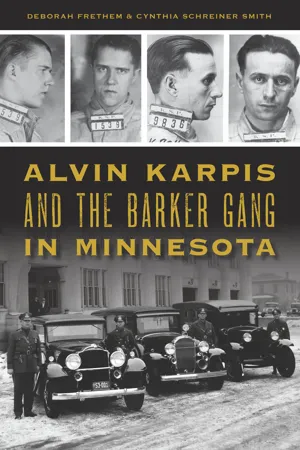
- 163 pages
- English
- ePUB (mobile friendly)
- Available on iOS & Android
eBook - ePub
Alvin Karpis and the Barker Gang in Minnesota
About this book
Trusted by 375,005 students
Access to over 1.5 million titles for a fair monthly price.
Study more efficiently using our study tools.
Information
Print ISBN
9781467146227
Subtopic
North American HistoryPART I
WHY MINNESOTA?
JOHN J. O’CONNOR
With its reputation for “Minnesota nice,” the state is not often the first one that comes to mind regarding criminal activity. But there is a good reason why many of the “motorized bandits” of the 1930s called Minnesota home. That began long before the era itself. The foundation was laid in the early twentieth century with the appointment of a new police chief, John J. O’Connor. The Saint Paul Globe newspaper published an article on June 3, 1900, waxing ecstatic about the new appointment: “In a few days the city will again have a police force with an experienced officer at its head.”
The new chief was born in Kentucky on October 29, 1855. His parents, John and Catherine O’Connor, moved to St. Paul the following year. His two younger brothers were born in Minnesota: Richard Thomas (born on June 21, 1857), who went on to become important in city government, and Daniel (born in 1860), who served on the St. Paul police force as a detective until his death in a freak accident in 1895. When he was a young man, John J. O’Connor worked as an accountant but joined the police force as a detective when he was twenty-six years old. He soon became a well-respected and highly effective officer, solving many difficult cases and apprehending suspects for several high-profile crimes. He was known for his intelligent, logical and reasoned approach to a challenging case. He was a large man physically, standing over six feet, three inches, which earned him the nickname of “Big Fellow” or, sometimes, “Big Boy.”
He was appointed chief of police on June 1, 1900. He worked hard to improve the department and make it more efficient. He was a popular man throughout the city because he reduced crime and made St. Paul a safer place for the citizens. There was very little money in the city budget for law enforcement, and O’Connor, who was a good cop, had to make the department run on limited resources.
Chief O’Connor had an idea to keep St. Paul safe. He called it “opposing organized crime with organized intelligence.” It would come to be known as the O’Connor Layover System, even though O’Connor himself never used that phrase. He allowed criminals to stay in St. Paul if they committed no crimes within the city, and he personally made sure that they adhered to his rule. “If they behaved themselves, I let them alone,” he said. But if they stepped out of line, they might find themselves locked in a room with the chief himself, from which they might emerge in far worse shape than when they entered. He and his officers were aware of every criminal who entered their city. Many criminals appreciated and enjoyed the haven of St. Paul, so they often helped with enforcement themselves. No one wanted another crook to disrupt the system.

John J. O’Connor, chief of the St. Paul police department, circa 1912. Courtesy of the St. Paul Police Historical Society.
The idea worked well throughout O’Connor’s tenure, which lasted from 1900 to 1912 and again from 1914 to 1920. Violent crime was practically nonexistent. The citizens of St. Paul were happy with their police and the state of their city. Surrounding municipalities were less pleased, as some criminals used St. Paul as their home base while committing crimes in nearby towns.
Chief O’Connor retired in 1920. He died in July 1924 in Glendale, California, where he had moved for health reasons. His body was brought back to St. Paul and entombed in an elegant mausoleum at Calvary Cemetery. He had amassed an estate of more than $250,000, a huge amount of money for that time.
Good ideas can often go wrong, and the best of intentions can have unintended consequences. O’Connor’s departure radically changed the situation. An article in the New York Daily News from April 8, 1934, noted, “Gangsters who came to St. Paul in Big John’s day to behave have remained to rob, kill, and kidnap.” That isn’t exactly true. The gangsters who committed hideous crimes in the 1930s were an entirely new group of vicious men and women. This same article acknowledges that the system worked well under O’Connor but says that the city was now paying the price in “blood and money.”
After O’Connor retired, St. Paul police chiefs changed with alarming frequency. Between 1920 and 1930, seven men served, some of them for a short time, leaving office and then returning to serve again. The last of these men was Thomas Brown, chief from 1930 through 1932. Under his leadership, the system became a full-blown partnership between the police and the criminals. Chief Brown was a true enabler of the Karpis-Barker Gang, as was made abundantly clear by subsequent events.
THE THREE RULES
Under the O’Connor Layover System, a visiting criminal had to follow three basic rules.
First, no crime was to be committed within the city limits of St. Paul. During most of the early part of the twentieth century, the rule was followed well. Robbery was almost unheard of. Violent crimes of passion, like murder and assault, were extremely rare and committed by local citizens, not by career criminals. This prohibition against crime did not apply to vice. Gambling, prostitution and illegal alcohol flourished.
Prostitution was regulated in an unorthodox manner. St. Paul officials realized that eradicating the world’s oldest profession would be impossible. They decided they would control it through a system of “fines.” A madam would not be arrested, but rather would appear in court monthly, where she would plead “not guilty” to “running a disorderly house.” The judge would find her guilty and assess a small fine, usually twenty to twenty-five dollars. She would pay the fine and go back to work, making her appearance at the court to repeat the process the following month. In fact, in 1890, John J. O’Connor married a St. Paul madam, Anna B. Murphy.
Gambling was out in the open. Pool halls had flourished after a judge ruled in 1887 that the “risking of money” between two parties where one must win and the other lose was not gambling, but merely a “game.” The Twin Cities Jockey Club, incorporated in 1887, was extremely popular. Chief O’Connor was one of the founders of the club and a frequent visitor. According to the St. Paul Police Department Historical Society, O’Connor would bet as much as $10,000 on a single horserace, at a time when his salary was $4,000 per year. His obituary stated that he was an avid fan of horse racing and that he had “won and lost” more than $1 million in the course of his lifetime.
There were classy nightclubs where organized gambling took place. The Mystic Caverns was in a cave carved out of the sandstone bluffs along the Mississippi River. One of the owners was Jack Foster, a St. Paul police officer who was the conductor of the police band. Another officer, Carl Kahlman, was a bouncer.
Prohibition, the Eighteenth Amendment to the Constitution, was the “noble experiment” that made it illegal to manufacture, transport or sell alcoholic beverages in the United States, turning ordinary citizens into lawbreakers. Alcohol was only illegal from 1920 to 1933. But during those years, St. Paul was home to several illicit bars, known as “speakeasies.” There is a certain amount of irony to this, as Minnesota could, in some ways, be called the place where Prohibition began. The Volstead Act, which was the United States Congressional act that provided for the enforcement of Prohibition, was written by Andrew J. Volstead, a congressman from Granite Falls, Minnesota.
Minnesota was a paradise for illegal alcohol for several reasons. The state’s northern border is shared with Canada, where liquor was still legal. That border was largely unpatrolled. One enterprising farmer in the Twin Cities, Art Peterson, started going up to Canada weekly to buy hay. Why would a Minnesota farmer need to purchase hay so far from home? Surely he could grow his own, or at least buy it from nearby farms? The truth is that he would hide bottles of fine Canadian whiskey within the hay bales. He was making more money selling booze than he was farming until one of the big-time operators got wind of his enterprise. Art’s bullet-riddled body was found in a ditch midway between his home and the Canadian border in 1925. Bootlegging could be a dangerous business.
Minnesota was also home to many fine breweries. During Prohibition, these breweries were not supposed to be making real beer. Many of them went out of business, but some survived by bottling soda pop and making a non-alcoholic concoction called “near beer.” But some breweries continued to make the real thing, selling it to the local speakeasies through underworld contacts.
The second rule for visiting criminals was a payment to the St. Paul Police Department. It could be called a bribe, but O’Connor didn’t see it that way. In his mind, it was just a guarantee of good behavior. The amounts were not huge and did go directly into city coffers, not into the pockets of O’Connor or subsequent police chiefs.
The third rule was that a criminal had to check-in, letting the police department know that he or she was in town and where they were staying. There were two good reasons for this rule. First, it helped the police keep track of the visiting bad guys. That way, they could make sure that the first two rules were followed. Second, it enabled the police to protect the criminals from other police departments or federal officials. During the O’Connor years, it was said that the chief kept as sharp an eye out for visiting policemen as he did for visiting criminals, and any arrest warrant from another municipality that crossed his desk was destined for the wastebasket. As far as neighboring towns and states were concerned, O’Connor didn’t feel that was his problem. “Let those other towns worry. I am not police chief of the United States. I’m the chief in St. Paul. I will keep order here.” However, his obituary in the Minneapolis Star on July 4, 1924, noted that “he always maintained that no criminal was ever allowed to stay free in St. Paul when wanted in some other city.”
Of course, there were subtleties involved in the system. A lawbreaker did not simply march up the steps of the police department and announce his presence. They usually checked in with one of the local crime bosses.
In the 1920s (before the arrival of the Karpis-Barker Gang), that boss would have been “Dapper Danny Hogan.” Several contemporary newspaper articles described him as the “smiling peacemaker,” a man who kept criminals in line, mediated gangland disputes and served as a liaison between the underworld and the police. It was as if he took over O’Connor’s role. He was considered the “Irish Godfather of St. Paul,” even though he was of Italian heritage—an orphan, he had been adopted by an Irish family. He ran an establishment known as “Dapper Dan’s” at 545 Wabasha Street. It would later become known as the Green Lantern.
According to Tim Mahoney in his book Secret Partners: Big Tom Brown and the Barker Gang, Dapper Dan’s was a hot dog stand out front, but inside it was a true haven for criminals, “a place to launder money and fence jewelry.”
Dapper Danny came to an untimely end, and his death is a mystery. At 11:30 a.m. on December 6, 1928, he went out to the garage of his home at 1607 West Seventh Street. He slipped into the driver’s seat of his automobile, not realizing that there was a large explosive charge under the hood. When he started his car, the resulting explosion injured him severely, mangling his right hand and nearly cutting off his right leg. It did not kill him right away. He died about nine hours later in the hospital, still claiming to have no idea who might have wanted his death. He didn’t think that “he had an enemy in the world.” His death was one of the first successful car bombings in the United States.
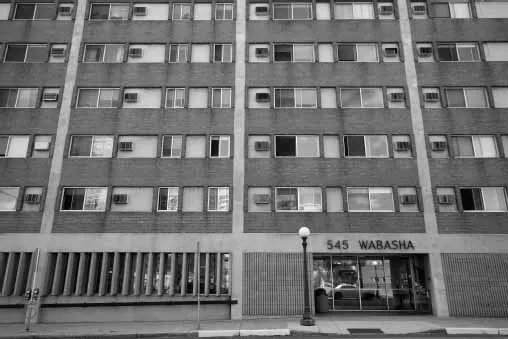
No. 545 Wabasha Street in 2019. This apartment building stands on the site of the old Green Lantern Saloon. Photo by Craig Frethem.
His funeral, held at St. Mary’s Catholic Church in downtown St. Paul, was attended by important people from both sides of the law, overflowing the sanctuary and spilling out onto the lawn. There was more than $5,000 in floral arrangements. One attendee would later say that the priest seemed very nervous, as one side of the church was filled with police officers and the other side with well-known criminals. He may have expected gunfire to break out at any second. Hogan is buried at Calvary Cemetery under a simple headstone.
No one was arrested for the murder of Dan Hogan, and it remains officially unsolved to this day, most likely because there was only scanty evidence. Police had just a few fragments of the bomb, some of them taken from Hogan’s shattered leg. According to the Indianapolis Star on the day following the explosion, the bomb contained nitroglycerin and was of a type manufactured in New York City. The official explanation was that it was likely done by “outsiders.”
One suspect was Harry Sawyer, an associate of Dapper Dan’s who took over operations at the club after Dan’s death and renamed it the Green Lantern. No proof was ever found, but taking over power as St. Paul’s crime boss makes for a convincing motive.
By the time the Karpis-Barker Gang arrived in the early 1930s, the O’Connor Layover System was in the hands of Police Chief Tom Brown and the three crime bosses who conspired to put him in power: Harry Sawyer, Leon Gleckman and Jack Peifer.
HARRY “DUTCH” SAWYER
Harry was born with the last name Sandlovich in 1890. Records differ as to where and exactly when he was born. Most records say his birthplace was Lithuania in March 1890. The 1910 census noted that he was born in Nebraska and was a natural-born citizen of the United States. This same document, which showed him living in Lincoln with his parents and six siblings, noted his parents did not come to the United States until 1891, which would have made it impossible for him to have been born in the United States. His World War I draft card also states that he was born in Lincoln, Nebraska, on December 15, 1890, and that he was a natural-born citizen. The 1940 federal census shows his birthplace as Russia. It seems likely that he was born somewhere in eastern Europe—boundaries between countries were often fluid in the waning days of the nineteenth century. Likely, his claim to natural-born American citizenship was just that, a claim. It was easier to get away with a deception like that before electronic records.
His draft card, completed on June 5, 1917, described Harry as being of medium height and stout build, with gray eyes and dark-brown hair. He was still living in Lincoln and unmarried. There he became involved with a group of automobile thieves. In 1915, he pleaded guilty to the use of explosives during a robbery but was given merely a three-year suspended sentence and served no prison time. During subsequent years, he lived in Omaha, where he acquired the nickname “Omaha Harry” and had several brushes with the law. He was arrested for being part of the robbery of the Benson Bank. Despite being identified as one of the robbers by two eyewitnesses, he came up with an alibi and was released. In 1921, he moved to Minnesota. There he became so involved with criminal activity that his parents disowned him; however, he maintained contact with his brothers.

Interior of the infamous Green Lantern Saloon speakeasy, photographed on May 13, 1931, as part of a murder investigation. This view is looking west toward the rear door. Courtesy of the St. Paul Police Historical Society.
He married Gladys Bundy, and the couple did not have any children. They lived quietly in a modest bungalow on Jefferson Avenue in St. Paul’s Highland Park district. Their house still stands. The 1930 federal census shows that they owned their home, valued at $8,500. Living with them was Gladys’s si...
Table of contents
- Front Cover
- Half Tile
- Title Page
- Copyright
- Dedication
- Contents
- Acknowledgements
- A Note Regarding the FBI
- Part I. Why Minnesota?
- Part II. The Barker Family
- Part III. The Gang
- Part IV. The End of an Era
- Bibliography
- About the Authors
Frequently asked questions
Yes, you can cancel anytime from the Subscription tab in your account settings on the Perlego website. Your subscription will stay active until the end of your current billing period. Learn how to cancel your subscription
No, books cannot be downloaded as external files, such as PDFs, for use outside of Perlego. However, you can download books within the Perlego app for offline reading on mobile or tablet. Learn how to download books offline
Perlego offers two plans: Essential and Complete
- Essential is ideal for learners and professionals who enjoy exploring a wide range of subjects. Access the Essential Library with 800,000+ trusted titles and best-sellers across business, personal growth, and the humanities. Includes unlimited reading time and Standard Read Aloud voice.
- Complete: Perfect for advanced learners and researchers needing full, unrestricted access. Unlock 1.5M+ books across hundreds of subjects, including academic and specialized titles. The Complete Plan also includes advanced features like Premium Read Aloud and Research Assistant.
We are an online textbook subscription service, where you can get access to an entire online library for less than the price of a single book per month. With over 1.5 million books across 990+ topics, we’ve got you covered! Learn about our mission
Look out for the read-aloud symbol on your next book to see if you can listen to it. The read-aloud tool reads text aloud for you, highlighting the text as it is being read. You can pause it, speed it up and slow it down. Learn more about Read Aloud
Yes! You can use the Perlego app on both iOS and Android devices to read anytime, anywhere — even offline. Perfect for commutes or when you’re on the go.
Please note we cannot support devices running on iOS 13 and Android 7 or earlier. Learn more about using the app
Please note we cannot support devices running on iOS 13 and Android 7 or earlier. Learn more about using the app
Yes, you can access Alvin Karpis and the Barker Gang in Minnesota by Deborah Frethem,Cynthia Schreiner Smith in PDF and/or ePUB format. We have over 1.5 million books available in our catalogue for you to explore.