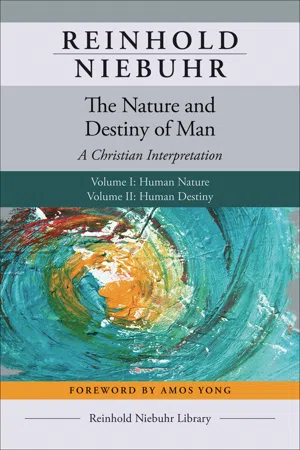
The Nature and Destiny of Man issues a vigorous challenge to Western civilization to understand its roots in the faith of the Bible, particularly in the Hebraic tradition. Niebuhr here lays out his influential understanding of the two poles of human existence: finitude and freedom. Individual human thriving requires that we fully understand and honor both of these aspects of our nature, yet human history demonstrates our penchant for placing one over the other. This book is arguably Reinhold Niebuhr's most important work. It offers a sustained articulation of Niebuhr's theological ethics and is considered a landmark in twentieth-century thought.
- 684 pages
- English
- ePUB (mobile friendly)
- Available on iOS & Android
eBook - ePub
The Nature and Destiny of Man
About this book
Information
Topic
Theology & ReligionSubtopic
Christian Theology
Volume 1 © 1941, Charles Scribner’s Sons. Volume 2 © 1943, Charles Scribner’s Sons, renewed 1970 Reinhold Niebuhr. The Nature and Destiny of Man, 2 volume set (Gifford Lectures) © 1949 Charles Scribner’s Sons, renewed 1976 Ursula Niebuhr. Preface © 1964 Reinhold Niebuhr. Foreword © 2021 by Westminster John Knox Press.
Published in the Reinhold Niebuhr Library in 2021
by Westminster John Knox Press
Louisville, Kentucky
21 22 23 24 25 26 27 28 29 30—10 9 8 7 6 5 4 3 2
All rights reserved. No part of this book may be reproduced or transmitted in any form or by any means, electronic or mechanical, including photocopying, recording, or by any information storage or retrieval system, without permission in writing from the publisher. For information, address Westminster John Knox Press, 100 Witherspoon Street, Louisville, Kentucky 40202-1396. Or contact us online at www.wjkbooks.com.
Cover design by Allison Taylor
Library of Congress Cataloging-in-Publication Data is on file at the Library of Congress, Washington, D.C.
ISBN: 9780664266318 (pbk.)
ISBN: 9781646982240 (ebook)
Most Westminster John Knox Press books are available at special quantity discounts when purchased in bulk by corporations, organizations, and special-interest groups. For more information, please email [email protected].
To my wife
URSULA
who helped, and
To my children
CHRISTOPHER and ELIZABETH
who frequently interrupted me
in the writing of these pages
Contents
Foreword by Amos Yong
I. Man as a Problem to Himself
The Classical View of Man
The Christian View of Man
The Modern View of Man
II. The Problem of Vitality and Form in Human Nature
The Rationalistic View of Human Nature
The Romantic Protest Against Rationalism
The Errors of Romanticism
Romantic Elements in Marxism
The Social Basis of Conflicting Theories
III. Individuality in Modern Culture
The Christian Sense of Individuality
The Idea of Individuality in the Renaissance
Bourgeois Civilization and Individuality
The Destruction of Individuality in Naturalism
The Loss of the Self in Idealism
The Loss of the Self in Romanticism
IV. The Easy Conscience of Modern Man
The Effort to Derive Evil from Specific Historical Sources
Nature as a Source of Virtue
The Optimism of Idealism
V. The Relevance of the Christian View of Man
Individual and General Rev...
Table of contents
- Cover
- VOL.1 Half Title
- Title Page
- Copyright
- Dedication
- Contents
- Foreword
- VOL.1 Half Title
- I. MAN AS A PROBLEM TO HIMSELF
- The Classical View of Man
- The Christian View of Man
- The Modern View of Man
- II. THE PROBLEM OF VITALITY AND FORM IN HUMAN NATURE
- The Rationalistic View of Human Nature
- The Romantic Protest Against Rationalism
- The Errors of Romanticism
- III. INDIVIDUALITY IN MODERN CULTURE
- The Christian Sense of Individuality
- The Idea of Individuality in the Renaissance
- Bourgeois Civilization and Individuality
- The Destruction of Individuality in Naturalism
- The Loss of the Self in Idealism
- The Loss of the Self in Romanticism
- IV. THE EASY CONSCIENCE OF MODERN MAN
- The Effort to Derive Evil from Specific Historical Sources
- Nature as a Source of Virtue
- The Optimism of Idealism
- V. THE RELEVANCE OF THE CHRISTIAN VIEW OF MAN
- Individual and General Revelation
- Creation as Revelation
- Historical and Special Revelation
- VI. MAN AS IMAGE OF GOD AND AS CREATURE
- Biblical Basis of the Doctrines
- The Doctrine of Man as Creature
- VII. MAN AS SINNER
- Temptation and Sin
- The Sin of Pride
- The Relation of Dishonesty to Pride
- VIII. MAN AS SINNER (CONTINUED)
- The Equality of Sin and the Inequality of Guilt
- Sin as Sensuality
- IX. ORIGINAL SIN AND MAN’S RESPONSIBILITY
- Pelagian Doctrines
- Augustinian Doctrines
- Temptation and Inevitability of Sin
- Responsibility Despite Inevitability
- Literalistic Errors
- X. JUSTITIA ORIGINAL
- Essential Nature and Original Righteousness
- The Locus of Original Righteousness
- The Content Justitia Originalis as Law
- The Transcendent Character of Justitia Originalis
- Index of Scriptural Passages
- Index of Proper Names
- Index of Subjects
- VOL.2 Half Title
- Title Page
- Contents
- VOL.2 Half Title
- I. HUMAN DESTINY AND HISTORY
- WHERE A CHRIST IS NOT EXPECTED
- 1. History Reduced to Nature
- 2. History Swallow Up in Eternity
- WHERE A CHRIST IS EXPECTED
- 1. Types of Messianism
- 2. Prophetic Messianism
- a. THE RELATION OF PROPHETISM TO MESSIANISM
- b. THE FAILURE OF MESSIANISM TO ANSWER THE PROPHETIC PROBLEM
- II. THE DISCLOSURE AND THE FULFILLMENT OF THE MEANING OF LIFE AND HISTORY
- JESUS’ OWN REINTERPRETATION OF PROPHETIC MESSIANISM
- 1. Jesus’ Rejection of Hebraic Legalism
- 2. Jesus’ Rejection of Nationalistic Particularism
- 3. Jesus’ Rejection of the Answer of Hebraic Messianism for the Problem Presented by Prophetism
- 4. Jesus’ Reinterpretation of the Eschata
- THE ACCEPTANCE BY CHRISTIAN FAITH OF THE EXPECTED AND THE REJECTED MESSIAH
- 1. Christ Crucified as the “Wisdom of God and The Power of God”
- 2. The Relation of the “Wisdom of God” to the “Power of God”
- a. THE IDENTITY OF WISDOM AND POWER
- b. THE DIFFERENCE BETWEEN WISDOM AND POWER
- 3. The Foolishness of God and the Wisdom of Men
- III. THE POSSIBILITIES AND LIMITS OF HISTORY
- SACRIFICIAL LOVE AND THE SINLESSNESS OF CHRIST
- THE RELATION OF CHRIST’S PERFECTION TO HISTORY
- 1. The Perfection of Christ and Innocency
- 2. The Perfection of Christ and Possibilities of History
- THE RELATION OF CHRIST’S PERFECTION TO ETERNITY
- SUMMARY
- IV. WISDOM, GRACE AND POWER (THE FULFILLMENT OF HISTORY)
- THE BIBLICAL DOCTRINE OF GRACE
- GRACE AS POWER IN, AND AS MERCY TOWARDS, MAN
- 1. “I am Crucified with Christ”
- 2. “Nevertheless I Live”
- 3. “Yet not I: but Christ Liveth in Me”
- a. GRACE AS THE POWER NOT OUR OWN
- b. GRACE AS THE FORGIVENESS OF OUR SINS
- V. THE CONFLICT BETWEEN GRACE AND PRIDE
- PRE-AUGUSTINIAN CONCEPTIONS OF GRACE
- THE CATHOLIC CONCEPTION OF GRACE
- THE DESTRUCTION OF THE CATHOLIC SYNTHESIS
- VI. THE DEBATE ON HUMAN DESTINY IN MODERN CULTURE: THE RENAISSANCE
- THE MEANING OF THE RENAISSANCE
- SECTARIAN PROTESTANTISM AND THE RENAISSANCE
- THE TRIUMPH OF THE RENAISSANCE
- VII. THE DEBATE ON HUMAN DESTINY IN MODERN CULTURE: THE REFORMATION
- THE LUTHERAN REFORMATION
- THE CALVINISTIC REFORMATION
- A SYNTHESIS OF REFORMATION AND RENAISSANCE
- VIII. HAVING, AND NOT HAVING, THE TRUTH
- THE PROBLEM OF THE TRUTH
- THE TEST OF TOLERANCE
- 1. Catholicism and Toleration
- 2. The Reformation and Toleration
- 3. The Renaissance and Toleration
- IX. THE KINGDOM OF GOD AND THE STRUGGLE FOR JUSTICE
- THE RELATION OF JUSTICE TO LOVE
- LAWS AND PRINCIPLES OF JUSTICE
- STRUCTURES OF JUSTICE
- 1. The Unity of Vitality and Reason
- 2. Types of Power in Social Life
- 3. The Organization and Balance of Power
- THE CHRISTIAN ATTITUDE TO GOVERNMENT
- JUSTICE AND WORLD COMMUNITY
- X. THE END OF HISTORY
- THE NEW TESTAMENT IDEAS OF THE END
- 1. The Parousia
- 2. The Last Judgment
- 3. The Resurrection
- THE END AND THE MEANING OF HISTORY
- THE DIVERSITY AND UNITY OF HISTORY
- 1. The Rise and Fall of Cultures and Civilizations
- 2. The Individual and History
- 3. The Unity of History
- Index of Scriptural Passages
- Index of Proper Names
- Index of Subjects
Trusted by 375,005 students
Access to over 1.5 million titles for a fair monthly price.
Study more efficiently using our study tools.
Frequently asked questions
Yes, you can cancel anytime from the Subscription tab in your account settings on the Perlego website. Your subscription will stay active until the end of your current billing period. Learn how to cancel your subscription
No, books cannot be downloaded as external files, such as PDFs, for use outside of Perlego. However, you can download books within the Perlego app for offline reading on mobile or tablet. Learn how to download books offline
Perlego offers two plans: Essential and Complete
- Essential is ideal for learners and professionals who enjoy exploring a wide range of subjects. Access the Essential Library with 800,000+ trusted titles and best-sellers across business, personal growth, and the humanities. Includes unlimited reading time and Standard Read Aloud voice.
- Complete: Perfect for advanced learners and researchers needing full, unrestricted access. Unlock 1.5M+ books across hundreds of subjects, including academic and specialized titles. The Complete Plan also includes advanced features like Premium Read Aloud and Research Assistant.
We are an online textbook subscription service, where you can get access to an entire online library for less than the price of a single book per month. With over 1.5 million books across 990+ topics, we’ve got you covered! Learn about our mission
Look out for the read-aloud symbol on your next book to see if you can listen to it. The read-aloud tool reads text aloud for you, highlighting the text as it is being read. You can pause it, speed it up and slow it down. Learn more about Read Aloud
Yes! You can use the Perlego app on both iOS and Android devices to read anytime, anywhere — even offline. Perfect for commutes or when you’re on the go.
Please note we cannot support devices running on iOS 13 and Android 7 or earlier. Learn more about using the app
Please note we cannot support devices running on iOS 13 and Android 7 or earlier. Learn more about using the app
Yes, you can access The Nature and Destiny of Man by Reinhold Niebuhr in PDF and/or ePUB format, as well as other popular books in Theology & Religion & Christian Theology. We have over 1.5 million books available in our catalogue for you to explore.